Dopamine Receptor Panel Screening Service
At Creative Biolabs, we offer a comprehensive dopamine receptor panel screening service designed to facilitate the discovery and optimization of therapeutic antibodies and proteins that modulate dopamine receptor activity. Leveraging cellular functional selectivity panels, our service provides a thorough evaluation of potential agonists and antagonists.
Introduction to Dopamine Receptors
Dopamine receptors, a class of G protein-coupled receptors, are widely distributed throughout the central nervous system. They are responsive to the neurotransmitter dopamine and are involved in many functions, including motor control, motivation, reward, and the regulation of mood and emotion. Impaired dopamine receptor signaling is implicated in multiple neurological disorders, such as Parkinson's disease, schizophrenia, and substance use disorders, making these receptors valuable targets for therapeutic intervention. There are five known subtypes of dopamine receptors, denoted as D1, D2, D3, D4, and D5, which are divided into two families based on their structure and function:
- D1-like Receptors: This family includes the D1 and D5 receptor subtypes. They are primarily involved in mediating excitatory neurotransmission and are linked to the stimulation of adenylyl cyclase, which increases cyclic AMP (cAMP) levels in the cell.
- D2-like Receptors: This family encompasses the D2, D3, and D4 receptor subtypes. They are typically associated with inhibitory neurotransmission and are linked to the inhibition of adenylyl cyclase, leading to decreased cAMP levels.
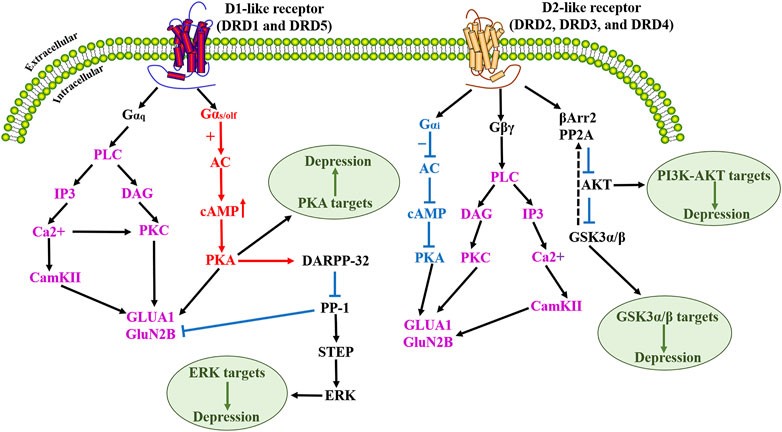 Fig.1 Dopamine receptor activation signaling cascade.1
Dopamine Receptor Panel Screening Service
At Creative Biolabs, our panel specifically targets major subtypes of dopamine receptors, including D1, D2L, D2S, D3, D4, and D5, allowing for comprehensive screening across different physiological pathways. Each subtype plays a unique role in neurotransmission and is implicated in different neurological and psychiatric conditions. By focusing on these critical targets, our screening service supports the development of drugs that are more selective and have fewer off-target effects.
We have developed stable cell lines that overexpress various dopamine receptor subtypes, enabling a reliable and reproducible assessment of activity. This robust platform ensures high fidelity in detecting subtle differences in compound efficacy and potency across different receptor subtypes.
Features of the Dopamine Receptor Panel
- Target Specificity: Our panels encompass a wide range of dopamine receptor targets, including D1, D2L, D2S, D3, D4, and D5, allowing for comprehensive screening across different physiological pathways.
- Agonist and Antagonist Activity Measurement: Our screening service delivers a comprehensive analysis of potential therapeutic agents' functional activity. Our panel technology allows for the differentiation between agonist and antagonist activities, ensuring a comprehensive understanding of drug-receptor interactions.
- High Throughput and Precision: Our advanced screening technology ensures a high throughput capability with precise data on therapeutic agents' activity and receptor interaction.
Why Choose Us
- Stable, receptor-specific cell lines ensure high reproducibility and assay consistency.
- Distinguishes agonist vs. antagonist activity with precise functional readouts.
- High-throughput screening supports efficient evaluation of compound efficacy and selectivity.
- Expert-designed assays deliver robust, data-driven insights for neurological drug discovery.
Applications
- Screen and optimize dopamine receptor agonists and antagonists.
- Evaluate subtype-specific activity across D1–D5 receptor families.
- Support drug discovery for neurological and psychiatric disorders (e.g., Parkinson's disease, schizophrenia, addiction).
- Investigate receptor signaling pathways and functional selectivity.
- Assess compound efficacy, potency, and off-target risks.
- Validate mechanisms of action using stable receptor-expressing cell lines.
- Facilitate lead candidate prioritization through high-throughput functional screening.
For more information, inquiries, or to discuss potential collaborations, reach out to our team of experts who are ready to assist you in navigating the complexities of drug discovery and development within the dopaminergic system.
Reference
- Zhao, Fangyi, et al. "Dopamine receptors: is it possible to become a therapeutic target for depression?." Frontiers in Pharmacology 13 (2022): 947785. under Open Access license CC BY 4.0, without modification.
 Download our brochure