Tumor Protein p53 (p53) Panel Screening Service
Background Service Highlights FAQs Contact Us
The Indispensable Role of p53 Panels in Cancer Screening and Therapeutic Development
The TP53 gene, encoding the p53 tumor suppressor protein, stands as a cornerstone in maintaining genomic integrity and preventing oncogenesis. Often referred to as the "guardian of the genome," p53 orchestrates critical cellular processes including cell cycle arrest, DNA repair, and apoptosis in response to cellular stress. Consequently, mutations in TP53 are among the most frequently observed genetic alterations across a vast spectrum of human cancers, rendering its functional status a pivotal determinant in cancer initiation, progression, and therapeutic response. At Creative Biolabs, with over two decades of specialized expertise in biological research and development, we recognize the profound significance of p53 in oncology. Our advanced p53 Panels Screening Service is meticulously designed to provide comprehensive insights into TP53 gene integrity and p53 protein functionality, empowering researchers and clinicians in their pursuit of precision medicine.
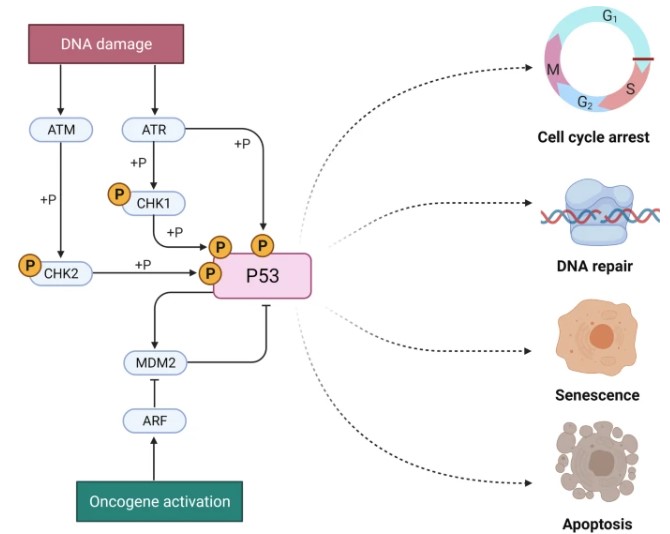 Fig.1 The role of p53.1
Our p53 Panels Screening Service
Creative Biolabs' p53 Panels Screening Service represents the culmination of extensive scientific understanding and cutting-edge technological integration. Leveraging our deep industry experience, we offer a robust platform for the precise detection and characterization of TP53 mutations, alongside the functional assessment of the p53 protein. This service is critical for a multitude of applications, from identifying inherited cancer predispositions to guiding personalized therapeutic strategies and advancing novel drug discovery initiatives. Our commitment at Creative Biolabs is to deliver unparalleled accuracy and actionable data, supporting the development of more effective cancer interventions.
Comprehensive Service Content
Our p53 Panels Screening Service encompasses a multi-faceted approach, combining gold-standard genetic analyses with sophisticated functional and protein-based assays. This ensures a holistic understanding of p53 status, from gene sequence integrity to protein activity and cellular impact.
Precision Genetic Testing: Identifying TP53 Mutations
Genetic testing forms the bedrock of our p53 screening, employing high-resolution DNA sequencing to meticulously analyze the TP53 gene.
-
Germline Testing: This is indispensable for diagnosing inherited cancer predisposition syndromes. By analyzing DNA derived from non-tumor samples, such as blood or saliva, we can identify constitutional TP53 mutations that confer a significantly elevated lifetime risk of developing various cancers. This information is crucial for genetic counseling and proactive surveillance strategies.
-
Somatic Testing: For established malignancies, somatic testing involves the analysis of DNA extracted directly from tumor tissue. This identifies acquired TP53 mutations that drive tumor development and progression. The presence and specific nature of these somatic mutations can serve as vital prognostic markers, influencing disease aggressiveness and predicting response to specific chemotherapeutic agents or targeted therapies.
Functional Assays: Assessing p53 Activity
Beyond mere mutation detection, understanding the functional consequence of TP53 alterations is paramount. Creative Biolabs employs a suite of functional assays to evaluate the transcriptional activity and overall integrity of the p53 pathway.
-
Functional Assay of p53: This yeast-based assay provides a powerful and rapid assessment of p53's ability to transactivate its target genes. When human p53 is expressed in yeast, functional p53 can activate reporter genee.g., Ade2), leading to the synthesis of adenine and the formation of white colonies. Conversely, non-functional p53 mutants fail to activate Ade2, resulting in red colonies due to adenine auxotrophy. This qualitative assay offers a clear readout of p53's transcriptional competence.
-
ELISA-based Assays: Utilizing enzyme-linked immunosorbent assay (ELISA) technology, these assays quantify the binding of active p53 to specific DNA response elements in nuclear extracts. This directly measures the DNA-binding capacity of p53, a prerequisite for its transcriptional regulatory functions.
-
Luciferase Reporter Assays: These highly sensitive assays employ reporter gene constructs, typically luciferase, linked to p53 response elements. Upon p53 binding and activation, the reporter gene is transcribed and translated, producing a quantifiable luminescence signal. The intensity of this signal directly correlates with the level of p53 transcriptional activity, providing a quantitative measure of its functional integrity.
Protein Expression Analysis: Immunohistochemistry (IHC)
Immunohistochemistry (IHC) serves as a valuable complementary tool for assessing p53 protein expression in tissue samples. While wild-type p53 typically exhibits a short half-life and low cellular abundance, many mutant p53 proteins are conformationally altered, leading to increased stability and subsequent accumulation within the cell. This overexpression of mutant p53, detectable by IHC, often correlates with the presence of TP53 mutations and can provide a rapid, visual indication of p53 status in tumor biopsies.
High-Throughput and Multiplexed Assays
For comprehensive and scalable analyses, Creative Biolabs integrates advanced high-throughput and multiplexed assay platforms:
-
Bead-based multiplex Assay: This powerful platform enables the simultaneous detection and quantification of multiple proteins within the intricate p53 signaling network. By analyzing p53 alongside key interacting partners and downstream effectors, the assay provides a more comprehensive, pathway-level understanding of p53 activity and its regulatory context.
Advanced Cell Panel Screening: Phenotypic Drug Response
Creative Biolabs' extensive cell panel screening capabilities are central to our p53 service, offering a robust system for evaluating drug responses in the context of defined p53 statuses.
-
Extensive Cell Line Library: We maintain a meticulously curated library of over 600 cancer cell lines, including engineered lines, representing a diverse array of cancer types and genetic backgrounds, including those with known TP53 mutations or wild-type p53. This vast resource allows for highly relevant in vitro drug testing.
-
2D and 3D Viability Assays: Our screening incorporates both conventional 2D monolayer cultures and more physiologically relevant 3D spheroid models, enabling a more accurate assessment of drug efficacy in a tumor microenvironment-mimicking context.
-
Specialized Panels: For in-depth mechanistic studies, we offer specialized cell panels targeting critical pathways frequently dysregulated in cancer, such as DNA Damage Response (DDR), RAS, EGFR, and HER2. These panels facilitate a deeper understanding of drug mechanisms of action and drug sensitivity in specific genetic contexts.
Our Advantages
At Creative Biolabs, our enduring presence in the industry for over 20 years signifies a legacy of scientific excellence and unwavering dedication to advancing biological research. Our p53 Panels Screening Service embodies several distinct advantages that set us apart:
-
Integrated Comprehensive Platform
-
Unparalleled Expertise
-
Extensive Resources and Technology
-
Tailored Solutions and Customization
FAQs
Q1: What is the primary purpose of p53 panel screening?
A1: The primary purpose is to comprehensively assess the status of the TP53 gene and the functionality of the p53 protein. This includes identifying inherited (germline) or acquired (somatic) mutations, evaluating p53's transcriptional activity, and determining its protein expression levels, all crucial for understanding cancer biology and guiding therapeutic strategies.
Q2: What types of samples can be used for p53 testing at Creative Biolabs?
A2: For genetic testing, we can utilize DNA extracted from various biological samples, including blood, saliva (for germline mutations), and fresh or formalin-fixed paraffin-embedded (FFPE) tumor tissue (for somatic mutations). For functional and protein assays, cell lines, nuclear extracts, and tissue lysates are commonly used.
Q3: How do functional assays differ from genetic sequencing in p53 analysis?
A3: Genetic sequencing identifies the specific DNA sequence alterations within the TP53 gene. Functional assays, on the other hand, assess the biological activity of the p53 protein, typically its ability to activate downstream target genes or bind to DNA. A mutation identified by sequencing may or may not lead to a complete loss of function, and functional assays provide direct evidence of the protein's activity.
Q4: Can Creative Biolabs' p53 Panels Screening Service assist in drug discovery and development?
A4: Absolutely. Our service is a powerful tool for drug discovery. We enable the screening of compounds for their ability to restore p53 function, inhibit oncogenic p53 mutants, or modulate p53 pathway activity. Our extensive cell line panels help identify drug-sensitive populations and elucidate mechanisms of action, accelerating the preclinical development of novel cancer therapeutics.
Contact Us
For detailed inquiries regarding our p53 Panels Screening Service, custom project proposals, or collaborative opportunities, please do not hesitate to contact our expert team at Creative Biolabs. We are dedicated to providing comprehensive solutions that accelerate your research and contribute to significant advancements in oncology.
Reference
-
Marei, Hany E et al. "p53 signaling in cancer progression and therapy." Cancer cell international vol. 21,1 703. 24 Dec. 2021, doi:10.1186/s12935-021-02396-8. Distributed under Open Access License CC BY 4.0, without modification.
 Download our brochure