Creative Biolabs employs Next-Generation Sequencing (NGS) as a cornerstone of our RET panel screening. NGS offers a high-throughput and comprehensive method for identifying diverse genomic alterations, including novel and known RET fusion partners. For RET fusions, RNA-based NGS is particularly valuable, as it directly detects fusion transcripts, overcoming limitations associated with DNA-based methods that may miss complex chromosomal rearrangements. Our rigorous bioinformatics pipeline ensures accurate identification and characterization of RET fusion events, providing clinicians with precise molecular information.
Rearranged during Transfection (RET) Panel Screening Service
Background Service Highlights FAQs Contact Us
Introduction: The Critical Role of RET in Cancer Pathogenesis
The Rearranged during Transfection (RET) proto-oncogene, encoding a receptor tyrosine kinase (RTK), plays a fundamental role in normal cellular development, growth, and differentiation. However, akin to other RTKs, aberrant RET signaling acts as a potent oncogenic driver in a subset of human cancers. These oncogenic alterations primarily manifest as gain-of-function point mutations, commonly observed in medullary thyroid carcinoma (MTC), or more significantly for targeted therapeutic strategies, as chromosomal rearrangements leading to gene fusions. RET gene fusions result in chimeric proteins where the kinase domain of RET is constitutively activated due to the fusion with various partner genes. This ligand-independent activation drives uncontrolled cell proliferation, survival, and differentiation, thereby promoting tumor initiation and progression.
The clinical significance of RET alterations has surged with the advent of highly selective RET inhibitors. These targeted agents have demonstrated remarkable efficacy in specific cancer types, particularly non-small cell lung cancer (NSCLC) and papillary thyroid carcinoma (PTC), where RET fusions are well-established oncogenic drivers. Furthermore, RET fusions are increasingly recognized in other rare tumor types, underscoring the importance of comprehensive molecular profiling. Accurate and timely identification of these RET rearrangements is paramount for patient stratification, ensuring that individuals who stand to benefit most from these precision therapies receive appropriate treatment. At Creative Biolabs, with over two decades of experience in advanced molecular diagnostics, we are committed to providing cutting-edge solutions for cancer patients.
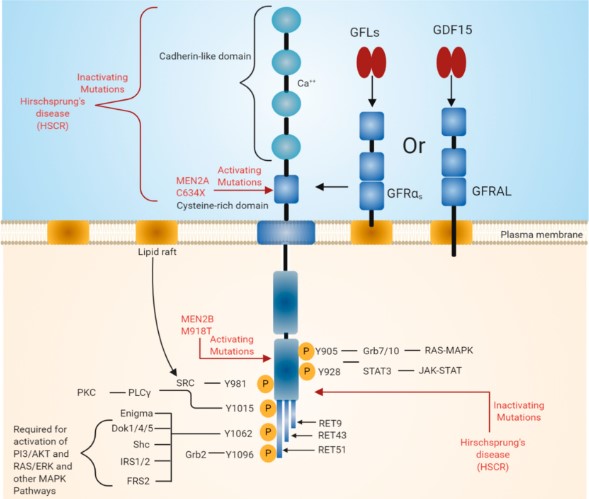 Fig.1 RET signaling pathway.1
Our Rearranged during Transfection (RET) Panel Screening Service
Creative Biolabs offers a state-of-the-art Rearranged during Transfection (RET) Panel Screening Service, meticulously designed to detect critical RET gene rearrangements with high sensitivity and specificity. Our service leverages advanced molecular diagnostic techniques to provide clinicians with precise and actionable insights, enabling informed treatment decisions for patients with RET-driven cancers. As a leading biological specialist in the industry, Creative Biolabs understands the evolving landscape of precision oncology and is dedicated to delivering diagnostic excellence.
Service Content
Our RET Panel Screening Service encompasses a multi-modal approach to ensure robust detection of various RET alterations, focusing specifically on gene fusions:
Next-Generation Sequencing (NGS) for Broad Genomic Profiling
Fluorescence In Situ Hybridization (FISH) for Visual Confirmation
Complementing NGS, our service incorporates Fluorescence In Situ Hybridization (FISH). FISH is a highly specific cytogenetic technique that uses fluorescently labeled probes to visualize chromosomal rearrangements directly. For RET fusions, break-apart FISH probes can detect the physical separation of the RET gene, indicating a rearrangement. While NGS identifies the exact fusion partners, FISH offers a visual confirmation of the chromosomal aberration, providing an additional layer of evidence for confident diagnosis. This dual-platform approach enhances the diagnostic yield and strengthens the reliability of our findings.
Reverse Transcription Polymerase Chain Reaction (RT-PCR) for Specific Fusion Detection
Where specific RET fusion partners are suspected or for rapid turnaround times, Creative Biolabs utilizes Reverse Transcription Polymeration Chain Reaction (RT-PCR). This method is highly sensitive for detecting specific RET fusion transcripts, particularly common variants like KIF5B-RET and CCDC6-RET fusions, which are frequently observed in NSCLC and PTC, respectively. While RT-PCR may be limited to known fusion partners, its speed and sensitivity make it a valuable tool for targeted detection, especially when prioritizing the most prevalent RET fusions.
Our Advantages
Creative Biolabs' expertise in molecular diagnostics for over 20 years positions us as a premier partner in precision oncology. Our RET Panel Screening Service offers distinct advantages:
- Unparalleled Expertise
- Comprehensive Workflow
- Commitment to Quality and Standardization
- Focus on Patient Outcomes
FAQs
Q1: What types of cancers associated with RET fusions?
A1: RET gene fusions are most frequently identified in non-small cell lung cancer (NSCLC) and papillary thyroid carcinoma (PTC). They can also be found at lower frequencies in other tumor types, including colorectal cancer, breast cancer, pancreatic cancer, and certain sarcomas.
Q2: Why is it important to test for RET rearrangements?
A2: Detecting RET rearrangements is crucial because they are actionable oncogenic drivers. Patients with RET fusion-positive tumors are highly likely to respond to selective RET inhibitors, which are targeted therapies offering superior efficacy and reduced side effects compared to traditional chemotherapy or multi-kinase inhibitors.
Q3: Are RET mutations the same as RET fusions?
A3: No, RET mutations and RET fusions are distinct types of genetic alterations. RET point mutations typically involve a single nucleotide change and are primarily associated with medullary thyroid carcinoma (MTC). RET fusions involve a rearrangement where the RET gene joins with another gene, leading to constitutive activation of the RET kinase. Our panel focuses on the detection of these clinically actionable RET fusions.
Contact Us
For further information regarding Creative Biolabs' Rearranged during Transfection (RET) Panel Screening Service, or to discuss specific diagnostic needs, please do not hesitate to contact our dedicated client services team. We are committed to supporting clinicians and researchers in advancing precision oncology. Our experts are available to provide detailed consultations and assist with sample submission.
Reference
- Mahato, Arun Kumar, and Yulia A Sidorova. "RET Receptor Tyrosine Kinase: Role in Neurodegeneration, Obesity, and Cancer." International journal of molecular sciences vol. 21,19 7108. 26 Sep. 2020, doi:10.3390/ijms21197108. Distributed under Open Access License CC BY 4.0, without modification.
 Download our brochure
Loading case studies...
Online Inquiry