Tumor Extracellular Matrix (ECM) targeted Immunocytokine Development Service
Are you encountering obstacles in achieving effective cytokine-based cancer immunotherapy due to systemic toxicity, limited tumor accumulation, or a dense and immunosuppressive stroma? Creative Biolabs' tumor extracellular matrix (ECM) targeted immunocytokine development service provides a powerful solution to overcome these challenges. By designing cytokine–antibody fusion proteins that specifically bind to tumor ECM components, our platform enables precise cytokine localization, enhanced immune activation, and reduced off-target effects—offering a next-generation approach to tumor-selective immunotherapy through advanced ECM-targeting and cytokine engineering technologies.
Overview
ECM is no longer viewed as a passive structural scaffold—it is a dynamic regulator of tumor progression, immune exclusion, and therapeutic response. Aberrant remodeling of fibronectin, tenascin-C, and collagens forms a unique biochemical landscape that supports malignant growth while impeding immune infiltration. Leveraging ECM components as molecular anchors provides a highly stable and tumor-restricted address for cytokine delivery. Recent research demonstrates that ECM-targeted immunocytokines markedly improve cytokine retention, immune cell recruitment, and antitumor efficacy while significantly lowering systemic toxicity. This innovative strategy represents a major advancement in precision cancer immunotherapy and translational oncology.
Creative Biolabs employs a multi-dimensional engineering strategy tailored to optimize ECM-targeted immunocytokines for potency, stability, and selectivity.
- ECM Target Selection & Profiling
We identify ECM proteins—such as fibronectin EDB/EDA, tenascin-C, and specific collagen isoforms—with high tumor selectivity and minimal expression in normal tissues.
- Binder and Antibody Engineering
High-affinity antibodies or small binder fragments are developed to anchor cytokines within the tumor matrix, maximizing intratumoral retention and exposure.
- Cytokine Payload Optimization
Cytokine payloads (e.g., IL-2, IL-12, IL-15) are fine-tuned through receptor bias engineering and mutagenesis to promote desired immune activation with minimal systemic effects.
- Fusion Construct Design
We engineer linker length, valency, and Fc configuration for optimal spatial orientation and stability, ensuring durable matrix attachment and bioactivity.
- Controlled Activation Design
Protease- or pH-sensitive modules allow the cytokine component to activate exclusively within the tumor microenvironment, preventing unwanted peripheral signaling.
Discover How We Can Help – Request a Consultation Today.
What We Can Offer
ECM Antigen Discovery & Binder Generation
Screening and validation of tumor ECM targets, with binder generation through phage display, recombinant library construction, or hybridoma technologies.
Fusion Construct Engineering
Rational design of cytokine–binder fusion architectures optimized for stability, retention, and expression performance.
Cytokine Variant Development
Development of receptor-biased or conditionally active cytokine variants through structure-guided mutagenesis and modeling.
Expression & Purification
Scalable production in HEK293, CHO, or insect cell systems with downstream purification ensuring purity and reproducibility.
Functional & Preclinical Testing
In vitro assays for ECM binding, cytokine signaling, and immune cell activation; in vivo models assessing biodistribution, tumor retention, and efficacy.
Comprehensive Data Reporting
Detailed documentation of construct design, bioactivity data, and mechanistic insights to support further optimization and regulatory preparation.
Workflow
ECM Target & Binder Validation
Screen ECM markers for tumor specificity, generate or select binders, and verify through antigen expression profiling.
Cytokine Payload Design
Engineer cytokine variants with defined receptor bias, extended half-life, and conditional activation properties.
Fusion Construct Development & Expression
Assemble optimized fusion designs and express them in scalable cell systems to ensure functionality and yield.
Preclinical Characterization
Conduct in vitro assays for ECM binding, cytokine signaling, and immune activation, verifying bioactivity and matrix retention.
In Vivo Evaluation & Reporting
Perform biodistribution, tumor retention, and efficacy studies, followed by comprehensive data interpretation and recommendations.
Required Starting Materials
- ECM target or antigen sequence data (e.g., fibronectin EDB or tenascin-C domain)
- Antibody or binder clone information (if available)
- Cytokine payload and intended tumor model specifications
Highlights
High Precision Anchorage
We design immunocytokines that bind selectively to ECM components such as fibronectin EDB and tenascin-C, ensuring localized cytokine delivery and prolonged retention in the tumor microenvironment. This targeted approach amplifies immune activation at the tumor site while minimizing systemic effects.
Optimized Cytokine Control
Each cytokine payload is precisely engineered for receptor bias, half-life, and conditional activation. These refinements promote targeted stimulation of effector cells while avoiding off-target immune responses, achieving potent and balanced antitumor activity.

Streamlined Development Pathway
Our integrated workflow covers ECM target validation, construct engineering, analytical testing, and efficacy evaluation in a coordinated process. Centralized project management ensures consistent data quality, reduced complexity, and faster progression from design to proof of concept.
Versatile Platform Design
Our modular design system enables quick adaptation to different ECM targets, cytokine payloads, and combination strategies, supporting broad application across multiple tumor types and therapeutic programs.
Discover the Creative Biolabs Advantage – Contact Us for a Customized Quote.
Publication
The tumor microenvironment comprises malignant cells, stromal fibroblasts, immune populations, and a complex ECM network of collagens, fibronectin, laminins, and proteoglycans. This matrix is more than a structural framework—it actively shapes immune cell behavior, modulating infiltration, activation, and cytotoxic function. Abnormal ECM remodeling in tumors can create physical and biochemical barriers that exclude T cells and sustain immune suppression, thereby promoting tumor growth and therapeutic resistance. ECM-targeted immunocytokine development harnesses this matrix as a biological anchor, enabling localized cytokine delivery to remodel the microenvironment, restore immune accessibility, and enhance antitumor efficacy with reduced systemic exposure.
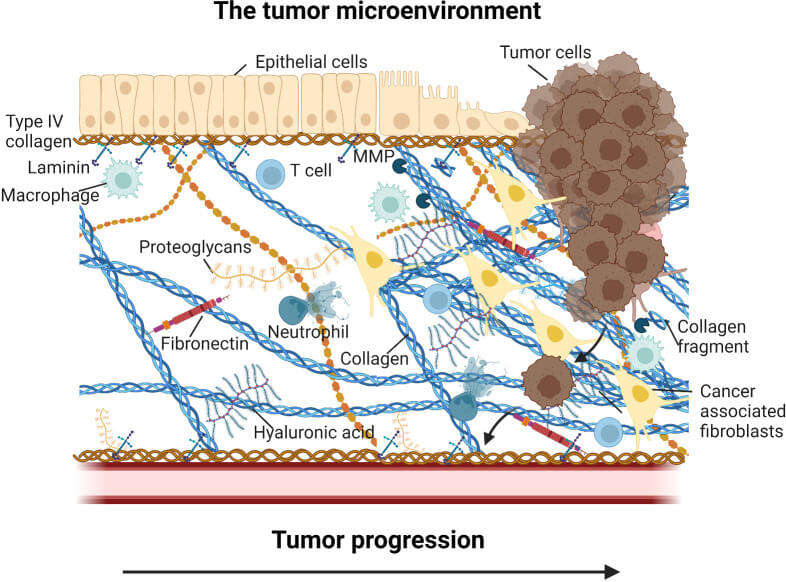 Fig.1 Comprehensive depiction of the cellular and structural composition within the tumor microenvironment. 1
Customer Reviews
- "Enhanced tumor retention – Using Creative Biolabs' ECM-targeted immunocytokine service significantly increased cytokine concentration within tumors and improved immune infiltration." — Dr. F*, Tumor Immunology Center
- "Potent and selective – Their engineered IL-15 fusion anchored to fibronectin EDB produced strong NK-cell activation while avoiding systemic cytokine effects." — Prof. G*, Cancer Immunotherapy Lab
- "Reliable collaboration – Creative Biolabs guided our ECM-targeted cytokine program from antigen selection through preclinical validation with clear data and expert insight." — Dr. H*, Oncology Biotech Division
FAQs
Q: Which ECM molecules are suitable for targeting?
A: Common ECM targets include fibronectin splice variants (EDB/EDA), tenascin-C, and collagen isoforms with tumor-specific enrichment.
Q: Can I provide my own antibody or binder?
A: Yes, client-supplied clones or binders can be incorporated and validated within our fusion design workflow.
Q: How do you control cytokine-related toxicity?
A: By anchoring cytokines to ECM structures and engineering payloads with receptor bias or conditional activation, systemic toxicity is minimized.
Related Services
Therapeutic Index Enhancement Engineering Service
Creative Biolabs optimizes cytokine and antibody fusion constructs to widen the therapeutic index by balancing efficacy and safety. Through precision engineering of receptor affinity, activation dynamics, and tissue selectivity, this service enables higher antitumor potency with minimized systemic toxicity.
Learn More →Cytokine Fc-Fusion Design & Half-Life Extension Service
This service focuses on extending cytokine stability and circulation time through Fc-fusion design. Creative Biolabs engineers Fc-modified cytokines with improved pharmacokinetics, controlled immune activation, and enhanced therapeutic durability for next-generation biologic development.
Learn More →Creative Biolabs' tumor ECM targeted immunocytokine development service integrates matrix-specific targeting and precision cytokine engineering to deliver highly selective, potent, and durable immunotherapeutic candidates. Our comprehensive development platform—from design through in vivo validation—accelerates discovery and enhances translational potential.
Contact our team to discuss your ECM-targeted immunocytokine project and discover customized solutions for your therapeutic goals.
Reference
- Flies, Dallas B et al. "Regulation of tumor immunity and immunotherapy by the tumor collagen extracellular matrix." Frontiers in immunology vol. 14 1199513. 17 Aug. 2023. Distributed under Open Access license CC BY 4.0, without modification. https://doi.org/10.3389/fimmu.2023.1199513
 Download our brochure