Albumin-Binding Domain-Cytokine Fusion Protein Development Service
Are you currently facing challenges such as rapid cytokine clearance, frequent dosing requirements, and unstable biological activity in your therapeutic program? Our albumin-binding domain-cytokine fusion protein development service helps you prolong cytokine circulation time, improve stability, and maintain potency through rational fusion design, albumin-hitchhiking technology, and translational pharmacokinetic strategies.
Overview
Cytokines offer potent immune-modulating capabilities but often are limited by short half-lives and systemic exposure. Fusion to albumin-binding domains or direct albumin-binding enables prolonged exposure via FcRn recycling, reduced renal clearance, and enhanced therapeutic window. Recent data confirm that albumin-binding domain-fused cytokines retain biological activity while improving pharmacokinetics—making this approach a compelling platform for next-generation immune therapies.
We use comprehensive Strategies for albumin-binding domain-cytokine fusion protein development service, specifically involving:
- Binding Domain Integration
We design fusion proteins that use small albumin-binding domains to recruit endogenous serum albumin, thereby leveraging natural recycling pathways and extending half-life without the size penalty of full albumin fusion.
- Linker and Orientation Engineering
We evaluate N- vs C-terminal placement, linker flexibility, and protease-cleavage sites to optimize folding, receptor access, and in-vivo stability.
- Receptor Retention & Potency Preservation
Functional assays (e.g., STAT activation) are integrated early to ensure that albumin-binding does not impair cytokine receptor engagement or downstream signaling.
- Pharmacokinetic and Exposure Modeling
Using PK/PD framework, we predict exposure curves, biodistribution, and active duration to select optimal fusion format and dosing range.
- Manufacturability & Analytical Design
We optimize expression (CHO/HEK systems), purification, aggregation resistance, and ensure high-quality product with consistent albumin-binding, minimal off-target interactions, and robust stability.
Discover How We Can Help – Request a Consultation Today.
What We Can Offer
Custom Fusion Construct Design
Tailored design of albumin-binding domain-cytokine fusions optimized for your target, indication, and desired half-life extension.
Analytical & Functional Characterization
Comprehensive profile including albumin-binding, receptor binding/activation, potency assays, and stability testing.
PK/PD and Exposure Profiling
In-vitro and in-vivo measurement of half-life, biodistribution, target engagement, and functional duration.
Manufacturing Feasibility Assessment
Evaluation of expression yield, purification efficiency, aggregation risk, and process scalability for your fusion protein.
Translational Development Support
Documentation and technical summary of fusion performance, suitability for next-phase development, with industry-relevant parameters.
Deliverables & Capabilities
- A feasibility report detailing optimal albumin-binding domain fusion strategy, predicted exposure enhancement, and receptor retention data.
- A set of candidate fusion proteins was expressed and purified, each characterized for albumin-binding, receptor activity, and biophysical stability.
- PK/PD data showing extended half-life and sufficient exposure for target engagement in model systems.
- Technical summary including lead candidate selection, design rationale, stability profile, and manufacturability metrics.
Workflow
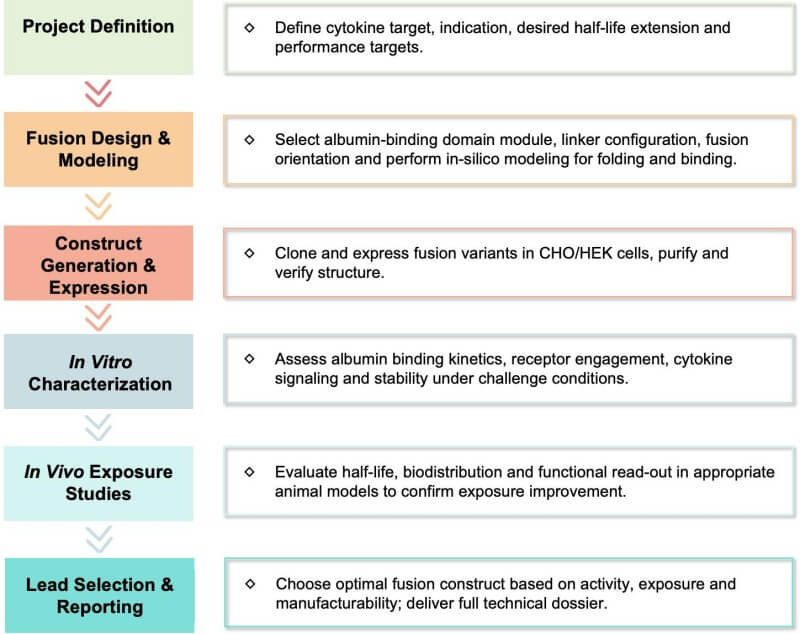
Required Starting Materials
- The amino acid sequence or existing cytokine construct/sample
- Desired target half-life or dose frequency goal and indication context.
- Any existing potency or receptor binding data to benchmark improvements.
Highlights
Prolonged Functional Exposure
Albumin-binding domain fusion extends cytokine half-life and stabilizes activity through FcRn recycling and albumin association, maintaining receptor engagement and reducing dosing needs.
High Product Quality & Reproducibility
Optimized fusion and linker design yield consistent structure, stability, and scalability, ensuring reproducible results across production batches.

Reduced Dosing Frequency & Enhanced Dosing Flexibility
Improved retention enables less frequent dosing with maintained efficacy, offering customizable pharmacokinetic profiles for diverse applications.
Collaborative Partnership
We work closely with clients through clear communication and flexible planning to ensure scientific precision and project success.
Discover the Creative Biolabs Advantage – Contact Us for a Customized Quote.
Publication
Research comparing recombinant IL-2 with its albumin-binding domain fusion demonstrates the clear advantage of binding domain–cytokine constructs in modulating immune activation and pharmacokinetics. The ABD-IL-2 fusion maintained potent stimulation of peripheral blood mononuclear cells while providing more controlled and sustained proliferation compared to unmodified IL-2. This balance between activity and stability reflects enhanced receptor engagement efficiency and reduced rapid clearance. By extending circulation time without compromising function, albumin-binding domain fusion proteins achieve prolonged therapeutic exposure, lower dosing requirements, and improved immune response modulation—offering a superior strategy for cytokine optimization in both immunotherapy and inflammation research.
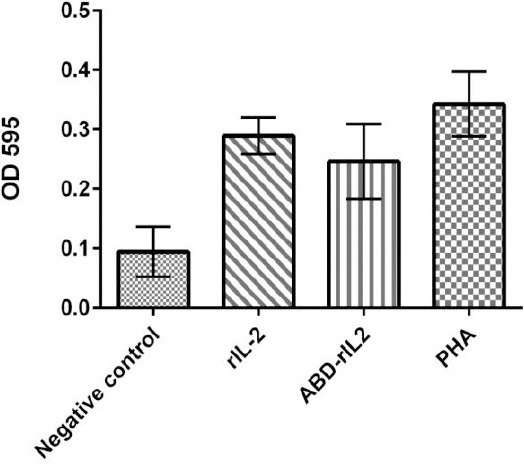 Fig.1 Comparative analysis of rIL-2 versus albumin-binding domain-IL-2 on PBMC proliferation and in vitro activity. 1
Customer Reviews
- "Extended half-life achieved: Using Creative Biolabs's albumin-binding domain-cytokine fusion protein development service has significantly improved circulation time of our IL-15 variant with maintained bioactivity." – Dr. Gn M
- "Improved manufacturability: The fusion designed by Creative Biolabs expressed at high yield and displayed excellent albumin-binding and stability." – Prof. La T
- "Streamlined design cycle: Our project moved faster thanks to their modeling and analytics pipeline for the albumin-binding domain-cytokine format." – Dr. Ze P
FAQs
Q: How does an albumin-binding domain differ from full albumin fusion?
A: An albumin-binding domain is a small binding module that recruits endogenous albumin rather than requiring fusion to the full albumin protein, preserving size and flexibility while achieving half-life extension.
Q: Will the fusion affect cytokine receptor binding and potency?
A: When designed correctly—via optimized linker length, orientation and site selection—receptor binding and downstream signaling remain preserved; our profiling confirms this.
Q: How does albumin-binding domain-fusion compare to PEGylation or Fc-fusion for half-life extension?
A: albumin-binding domain-fusion often allows smaller size, preserved bioactivity, faster tissue penetration and lower immunogenicity risk; each approach has trade-offs, and we evaluate which suits your molecule best.
Related Services
Biased Cytokine Signaling Engineering Service
We provide biased cytokine signaling engineering services to design cytokines that selectively trigger beneficial pathways while reducing unwanted effects. Using structure-based mutagenesis and receptor profiling, we tailor cytokine–receptor interactions to favor specific signaling outcomes. This approach enhances efficacy, minimizes toxicity, and enables precise immune modulation across oncology and autoimmune research.
Learn More →Cytokine Mimetic Development Services
Creative Biolabs offers cytokine mimetic development services to create synthetic molecules that mimic or regulate cytokine function with improved stability and control. Through computational design and receptor modeling, we develop mimetics with refined selectivity, extended activity, and reduced immunogenicity—ideal for targeted immune or therapeutic applications.
Learn More →Creative Biolabs' albumin-binding domain-cytokine fusion protein development service offers a comprehensive, precision-engineering platform for extending cytokine exposure, maintaining potency, and enhancing developability. From molecular design through analytic profiling and exposure modelling, we guide your biologic toward a competitive, high-value format.
Ready to accelerate your cytokine therapeutic? Reach out today to explore how we can tailor an albumin-binding domain-cytokine fusion to your program's needs.
Reference
- Adabi, Elham et al. "Evaluation of an Albumin-Binding Domain Protein Fused to Recombinant Human IL-2 and Its Effects on the Bioactivity and Serum Half-Life of the Cytokine." Iranian biomedical journal vol. 21,2 (2017): 77-83. Distributed under Open Access license CC BY 3.0, without modification. https://doi.org/10.18869/acadpub.ibj.21.2.77
 Download our brochure