We re-engineer naturally unstable aging switches into resilient negative-feedback oscillators. This dynamic control prevents irreversible aging states, a strategy proven to significantly increase cellular lifespan in model systems.
Longevity Gene Circuit Development Services
Creative Biolabs offers a rational, engineering-driven approach to developing therapeutics that treat aging at its core: the failure of cellular regulatory networks. We move research beyond single-gene targets to robust, systems-level solutions with predictable dynamics. Our approach uses synthetic biology to design circuits for durability and long-term function, ensuring a rigorous preclinical investigation of solutions aimed at re-engineering biological stability and extending healthspan.
Background Featured Services What We Can Offer Workflow Publication Why Choose Us FAQs Customer Review Related Services Contact Us
Background: The Collapse of Gene Regulatory Networks
Longevity gene circuit development is a specialized branch of synthetic biology focused on applying engineering principles to gene regulatory networks (GRNs) to restore cellular homeostasis. Landmark research has shown that the natural aging process is often driven by the collapse of a key network into a stable, detrimental state (a toggle switch), leading to outcomes like nucleolar or mitochondrial decay. Our service creates autonomous genetic clocks—robust negative-feedback loops—that force the cell to perpetually oscillate, delaying commitment to these detrimental fates and leading to dramatic lifespan extension, offering profound tools for scientific investigation.
Our Featured Services
Gene Circuit Dynamic System Design
We offer gene circuit dynamic system design services to engineer cellular longevity. We create and analyze synthetic circuits that autonomously sense, compute, and precisely regulate cellular aging pathways.
Learn More →Longevity GRN Analysis
Creative Biolabs offers longevity GRN analysis services to map, model, and modulate the complex genetic pathways driving aging and lifespan, accelerating your therapeutic discovery.
Learn More →Longevity GRN Predictive Modeling & Optimization
We apply GRN predictive modeling to optimize synthetic longevity gene circuits. Our service guarantees maximum stability and efficacy by minimizing evolutionary instability and metabolic load.
Learn More →Longevity Validation
Our longevity validation services confirm the efficacy of your aging therapeutics by comprehensively quantifying changes in cellular lifespan and epigenetic age using advanced model systems.
Learn More →Targeted Solutions and Specific Deliverables for Research
Our service directly addresses the complexity of aging through three high-impact, synthetic circuit solutions designed to validate core scientific hypotheses:
Custom Autonomous Genetic Clocks
Cell-Non-Autonomous Systemic Control
We design circuits that target accessible cells, such as hematopoietic stem cells (HSCs), to act as living bioreactors. These cells are engineered to secrete therapeutic factors that regulate conserved systemic pathways in distant organs to study non-autonomous aging mechanisms.
Precision Epigenetic Reversal
We implement transient, safety-gated reprogramming circuits. This enables the safe and precise resetting of the epigenetic clock without the sustained factor expression that carries oncogenic risks.
Contact us to schedule a confidential consultation with our lead synthetic biology expert and begin architecting a future of enhanced human resilience.
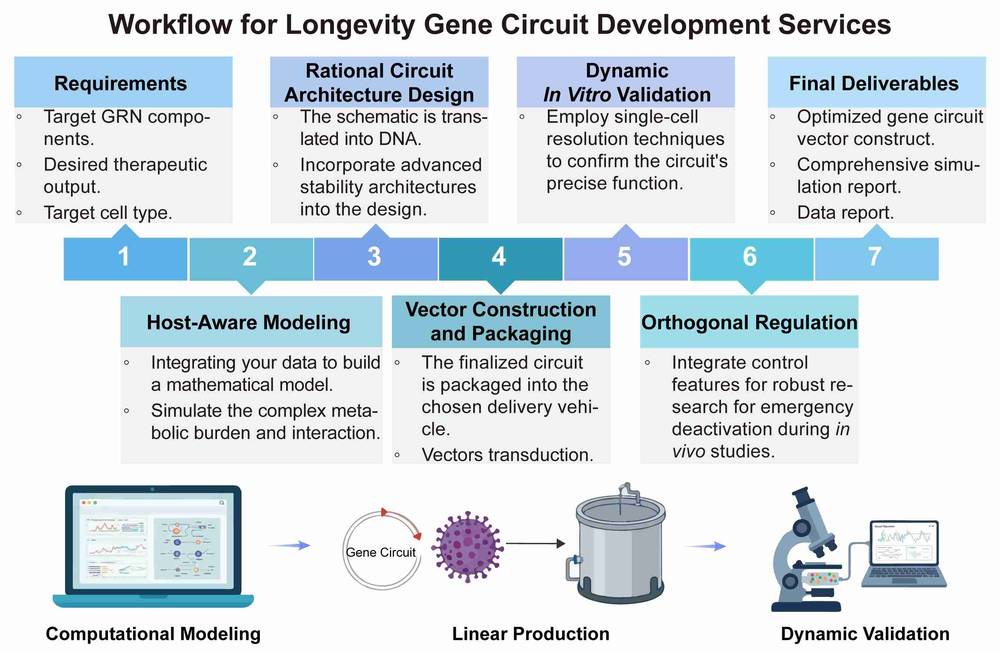
Workflow: Designing and Validating Therapeutically Robust Circuits for Preclinical Use
Our process follows a rigorous workflow, validated by over two decades of experience in complex synthetic biology constructs and suitable for high-fidelity preclinical research.
Publication
This study addresses the challenge of evolutionary instability in synthetic gene circuits by evaluating genetic feedback controllers designed to extend circuit longevity. Using a multi-scale model, they found post-transcriptional control (sRNAs) offered superior regulation with less host burden than transcriptional control. Intra-circuit feedback maintains short-term function, but growth-based feedback is superior for long-term circuit persistence. Combining these input strategies into multi-input controllers enhances robustness, providing a design framework for creating more evolutionarily resilient systems critical for reliable application in medicine and biotechnology.
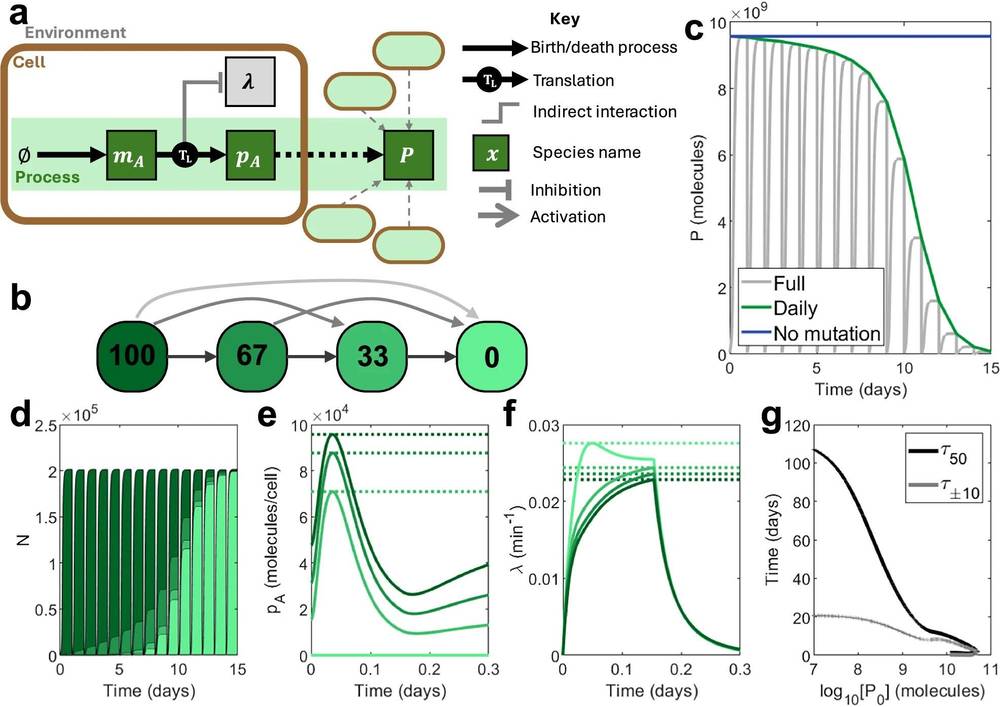 Fig.1 Simulation of a repeated open-loop batch process. 1
Why Choose Us?
Creative Biolabs distinguishes itself by applying rigorous engineering standards to the volatility of biological systems. Our focus is not just on function, but on evolutionary stability and absolute preclinical control, which are non-negotiable for high-quality scientific research.
Circuit Stability
Integrating post-transcriptional controllers (PTCs) and growth-based feedback loops prevents functional decay, ensuring long-term therapeutic efficacy in preclinical models by combating evolutionary instability.
Research Control
Guaranteed orthogonal regulation and Caspase-based kill switches ensure precise, tunable, external control and a critical safety mechanism for robust in vivo study design and regulatory compliance.

Systemic Efficacy
Our cell-non-autonomous circuit design utilizes secreted factors from accessible cells via a single injection. These living bioreactors treat distant, hard-to-target organs, offering a powerful advantage for systemic research into aging.
Epigenetic Reversal
We use CRISPRa in transient, inducible circuits for safe, non-oncogenic reversal of epigenetic age markers, avoiding teratoma risk. This provides an ideal system for safety validation and controlled biological age reversal research.
Experience the Creative Biolabs Advantage - Get a Quote Today
FAQs
Q1: Our project requires high-fidelity in vivo research. What specific control mechanisms do you integrate to ensure data reliability?
A1: We prioritize control: Every circuit includes a layered system combining an orthogonal regulatory system (for precise, dose-dependent tuning) and a fast-acting, redundant fail-safe kill switch for controlled termination.
Q2: Can these circuits be used to affect tissues beyond the initial delivery site, or are they limited to the cell they are engineered into?
A2: We design cell-non-autonomous circuits by engineering accessible cells (like HSCs) to secrete therapeutic molecules, allowing systemic modulation of aging pathways in distant organs.
Q3: How does designing an "autonomous genetic clock" or "pulsing circuit" compare to using a traditional constitutive promoter for steady factor expression?
A3: Dynamic homeostasis is superior for longevity research. Our oscillatory or pulsing designs mimic natural rhythms, preventing irreversible aging commitment and achieving up to an 82% lifespan extension, surpassing simple constitutive factor flooding.
Customer Review
-
Evolutionary Stability
Using Creative Biolabs' service in our ex vivo cell therapy research has significantly improved the durability and functional half-life of our CAR construct. The integration of (PTCs) extended stable expression threefold, solving our main problem of evolutionary decay. - Dr. J* -
Epigenetic Efficacy
The transient CRISPRa reprogramming circuit designed by Creative Biolabs achieved the targeted activation of OCT4 and SOX2 for our iPSC generation protocol. This method successfully reversed our epigenetic age assay results to near-zero. - A***a Patel
Related Services
To fully support your longevity research pipeline, Creative Biolabs recommends complementary services essential for the success of your gene circuit project:
Tumor Profiling for Biomarker Discovery
Creative Biolabs facilitates biomarker discovery via comprehensive tumor profiling, utilizing technologies like NGS (optimized for low-input samples), ISH, PCR, and IHC. We integrate data to identify tumor progression-related genes.
Learn More →How to Contact Creative Biolabs
To discuss your project in detail and learn how our expertise in engineering resilience can accelerate your longevity program, please reach out to our dedicated team of synthetic biology specialists.
Contact Our Team for More Information and to Discuss Your Project
Reference
- Byrom, Daniel P., and Alexander PS Darlington. "Genetic controllers for enhancing the evolutionary longevity of synthetic gene circuits in bacteria." Nature Communications 16.1 (2025): 8590. Distributed under Open Access license CC BY 4.0, without modification. https://doi.org/10.1038/s41467-025-63627-4
 Download our brochure
Loading case studies...
Online Inquiry