Protease-Activatable Cytokine Design Service
High systemic activity often leads to toxicity and off-target immune activation, limiting the development of effective cytokine-based therapies. Creative Biolabs' protease-activatable cytokine design service delivers a precise and practical solution by developing cytokines that remain inactive in circulation and become selectively activated by disease-related proteases. Using advanced protein engineering and molecular modeling, we design cytokines that activate only in targeted tissues, reducing systemic side effects while amplifying localized immune responses. Whether you aim to enhance antitumor activity, modulate inflammation, or improve cytokine-fusion constructs, Creative Biolabs helps you achieve precise control, optimal safety, and improved therapeutic outcomes through innovation-driven cytokine design.
Overview
Protease-activatable cytokines enable controlled immune activation through structural designs that respond specifically to proteolytic cues present in diseased tissues. By introducing protease-cleavable linkers or masking domains, cytokine activity can be "switched on" only in environments where certain proteases are overexpressed, such as tumors or sites of chronic inflammation. This conditional activation provides a safer, more targeted approach to immune modulation. Creative Biolabs integrates these cutting-edge strategies into customizable services that transform cytokine biology into practical research tools for precise therapeutic exploration.
We employ a set of comprehensive and rationally optimized strategies for protease-activatable cytokine design, which integrate structural modeling, linker engineering, and activation control mechanisms, as outlined below:
-
Protease-Cleavable Linker Integration
Creative Biolabs develops protease-sensitive peptide linkers that remain stable in circulation and are selectively cleaved in protease-rich disease microenvironments. Once the linker is cleaved, the cytokine's functional domain becomes active, restoring its full signaling capacity only within the targeted site. This approach provides high spatial control, enabling localized cytokine delivery while minimizing systemic exposure. -
Self-Masking Domain Design
Our engineers design cytokines with autoinhibitory masking domains that temporarily block receptor-binding regions until proteolytic cleavage occurs. This design minimizes background activation and ensures tightly regulated bioactivity. It is particularly suited for cytokines like IL-2, IL-15, IL-12, and IFN, where fine-tuning activation intensity is critical for efficacy and safety. -
Dual-Trigger Protease Networks
For complex biological models, Creative Biolabs offers multi-protease responsive systems that activate only when multiple proteases coexist within the disease environment. This "logic-gated" activation adds an extra safety layer, ensuring cytokine activation occurs exclusively under highly specific pathological conditions.
Discover How We Can Help – Request a Consultation.
What We Can Offer
Custom Molecular Modeling & Structure Analysis
We use computational design to identify optimal cleavage points, preserving structural stability and ensuring predictable activation behavior.
Construct Design & Gene Synthesis
Cleavable linkers or masking sequences are incorporated into cytokine constructs, followed by codon optimization and vector generation for high-efficiency expression.
Expression & Purification
Cytokine candidates are produced using HEK293, CHO, or E. coli systems and purified through affinity and size-exclusion chromatography to achieve high purity and biological integrity.
In Vitro Activation Assays
Controlled protease activation tests are performed to measure cytokine responsiveness, cleavage efficiency, and functional signal restoration.
In Vivo Functional Evaluation
Activation kinetics and immune response profiles are assessed in suitable disease models to validate selective activation and localized bioactivity.
Optimization & Scale-Up
Final constructs are refined for protease selectivity, potency, and stability, then scaled up for broader research or preclinical use.
Workflow
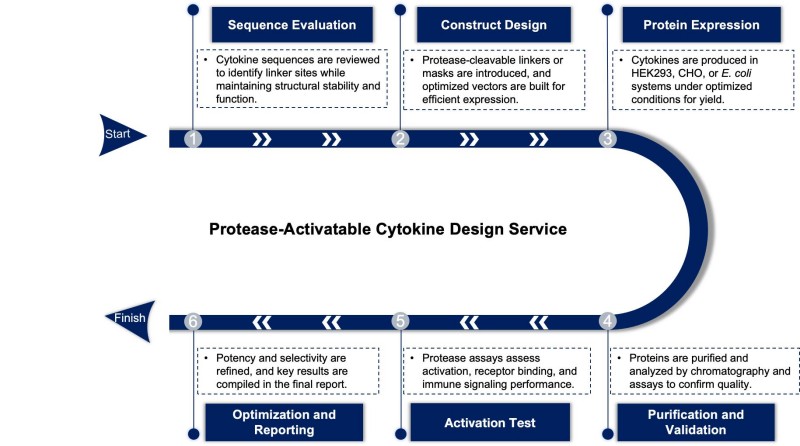
- Sequence Evaluation and Design Feasibility
Each cytokine sequence undergoes computational and structural analysis to determine regions suitable for linker or masking insertion. We evaluate molecular stability, folding tolerance, and receptor-binding domains to ensure the chosen strategy maintains proper bioactivity upon activation.
- Construct Design and Vector Preparation
Customized protease-sensitive linkers or masking elements are integrated into the cytokine scaffold. Gene synthesis follows with codon optimization tailored to the selected expression system. Expression vectors are then built to support high yield, correct folding, and controlled secretion.
- Expression Development and Protein Production
Engineered constructs are expressed in the most appropriate system—mammalian (HEK293 or CHO) for complex glycoproteins or E. coli for rapid prototyping. Expression parameters such as temperature, induction profile, and culture density are optimized for maximum recovery.
- Purification and Structural Validation
The produced cytokines are purified through affinity and gel-filtration chromatography, followed by quality checks including SDS-PAGE, HPLC, and mass spectrometry. Circular dichroism and thermal shift assays verify structural stability before activation testing.
- Activation and Functional Testing
Condition-specific assays are performed to measure activation in the presence of target proteases. The restored activity is quantified through receptor-binding, downstream phosphorylation, and immune cell activation assays, confirming specific and efficient activation behavior.
- Performance Optimization and Reporting
Based on experimental data, modifications are introduced to fine-tune cleavage kinetics, signal strength, and protease selectivity. Clients receive a comprehensive report summarizing activation results, purity, biological performance, and recommendations for next-step applications.
Required Starting Materials
- Cytokine sequence or target gene information.
- Desired protease type or cleavage sequence preference.
- Target disease or experimental context (e.g., tumor model, inflammation study).
Highlights
Target-Specific Activation
Creative Biolabs' protease-cleavable cytokines ensure precise activation limited to protease-enriched tissues, improving local immune response while maintaining systemic safety.
Enhanced Safety and Efficacy
Selective protease activation minimizes systemic exposure and immune overstimulation, expanding the effective dose range and reducing unwanted toxicity.

Versatile Cytokine Adaptability
Our design platform supports a wide array of cytokine families, including IL-2, IL-10, IL-15, IL-21, IFN, and TNF, adaptable for oncology, inflammation, and regenerative biology research.
Stable and Predictable Performance
All constructs are validated for cleavage specificity, activation reproducibility, and long-term stability, ensuring reliable results across experiments.
Discover the Creative Biolabs Advantage – Contact Us for a Customized Quote.
Publication
Three representative cytokine design strategies are compared, illustrating how engineered molecules can modulate both activation conditions and dissociation kinetics to fine-tune immune signaling. One design uses a protease-cleavable masking domain that keeps the cytokine inert until enzymatic removal, enabling spatial control of activation in protease-rich disease environments. A second variant incorporates accelerated dissociation dynamics, allowing the cytokine–receptor complex to disengage rapidly and thereby limit signal duration—beneficial for safety and dose control. The third configuration combines both features—site-specific activation and rapid off-rate—to offer highly selective, temporally-restricted cytokine function. Together, these design choices highlight why protease-activatable cytokines are crucial: they offer precise spatial targeting and kinetic control, unlocking safer and more effective therapeutic modulation of immune responses.
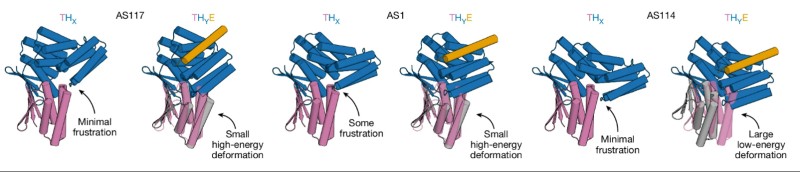 Fig.1 Comparison of three engineered cytokine design strategies. 1
Customer Reviews
- "Using Creative Biolabs' protease-activatable IL-2 design, our team achieved strong tumor-specific activation with excellent safety. This approach significantly enhanced the precision and reproducibility of our cytokine-based experiments." – Dr. R. ***, Independent Research Group
- "The protease-responsive IL-15 construct developed by Creative Biolabs performed exactly as expected—showing selective activation only in our disease model and maintaining stable bioactivity across replicates." – Dr. K. ***, Academic Research Laboratory
- "Our collaboration with Creative Biolabs on a customized protease-cleavable cytokine was seamless. The engineered construct demonstrated clear activation control and consistent experimental outcomes." – Dr. T. ***, Cellular Immunology Team
FAQs
Q: What makes protease-activatable cytokines safer than conventional cytokines?
A: They stay inactive in circulation and activate only where disease-associated proteases are abundant, reducing systemic inflammation and toxicity.
Q: Which proteases can be targeted for activation?
A: Matrix metalloproteinases (MMPs), cathepsins, and serine proteases are commonly used, but designs can be customized for other proteases.
Q: Can any cytokine be engineered for protease activation?
A: Yes, most cytokines can be modified while maintaining their folding and activity when properly designed for conditional activation.
Related Services
Cytokine PEGylation Optimization Services
Creative Biolabs enhances cytokine stability and half-life through precise PEG modification. By optimizing PEG size and attachment sites, we reduce immunogenicity and extend circulation time while preserving biological activity.
Learn More →Albumin-Binding Domain-Cytokine Fusion Protein Development Service
Creative Biolabs develops cytokine–albumin-binding domain fusions to prolong cytokine retention and improve tissue delivery. This approach enhances pharmacokinetics and maintains bioactivity for long-acting cytokine applications.
Learn More →These services can be combined to build advanced cytokine systems for precise immune modulation and therapeutic innovation. Creative Biolabs is committed to helping researchers develop the next generation of safe, effective, and conditionally active cytokine therapies.
Contact Our Cytokine Design Experts for More Information and to Discuss Your Protease-Activatable Cytokine Project Today.
Reference
- Broerman, Adam J et al. "Design of facilitated dissociation enables timing of cytokine signalling." Nature, 10.1038/s41586-025-09549-z. 24 Sep. 2025. Distributed under Open Access license CC BY 4.0, without modification. https://doi.org/10.1038/s41586-025-09549-z
 Download our brochure