We utilize IL-2/IL-2R crystal structures to design muteins with the exact binding kinetics and βγ/α selectivity ratio your therapeutic requires. This ensures precision at the molecular level.
Selective IL-2 Receptor Binding Engineering Service
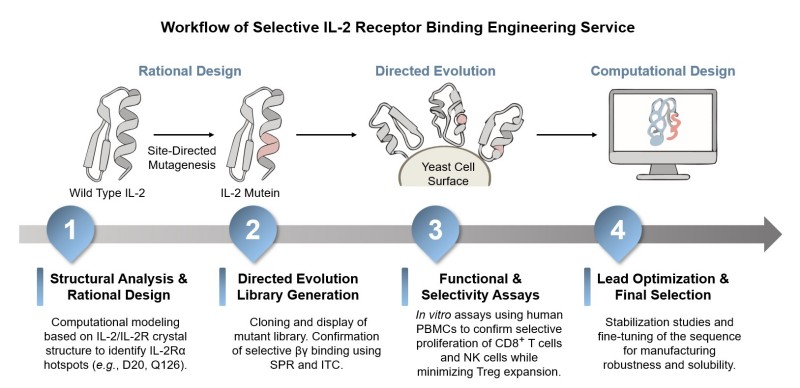
Creative Biolabs' selective IL-2 receptor binding engineering service is a comprehensive, end-to-end platform for creating next-generation cytokine therapeutics. We provide a complete workflow, from initial computational design and structure-guided mutagenesis to high-throughput library screening and full biophysical (SPR/ITC) and functional validation. Our clients gain a fully characterized, low-toxicity βγ-biased IL-2 mutein core. This de-risked asset is engineered to eliminate IL-2Rα-mediated toxicity (CLS) and is delivered optimized for seamless integration into your advanced therapeutic format - be it a tumor-targeted immunocytokine, a conditionally active prodrug, or a half-life extended conjugate.
Introduction What We Can Offer Workflow Why Creative Biolabs Customer Reviews FAQs Related Services Contact Us
Scientific Foundation: Background on IL-2 Receptor Binding Engineering
The critical non-selective binding of wild-type IL-2 to the high-affinity IL-2Rα (CD25) subunit is the root cause of systemic toxicity (VLS/CLS) and unwanted Treg expansion. Advanced cytokine engineering overcomes this by employing structure-guided rational mutagenesis and directed evolution to create variants. These IL-2v (IL-2 variants) act as crucial, low-toxicity foundations necessary for next-generation therapeutic formats-such as PD-1 fusion proteins and prodrugs-that selectively stimulate the most critical anti-tumor CD8+ T cells.
To embark on the engineering phase for your next-generation IL-2 therapeutic, interested parties are encouraged to initiate a formal consultation.
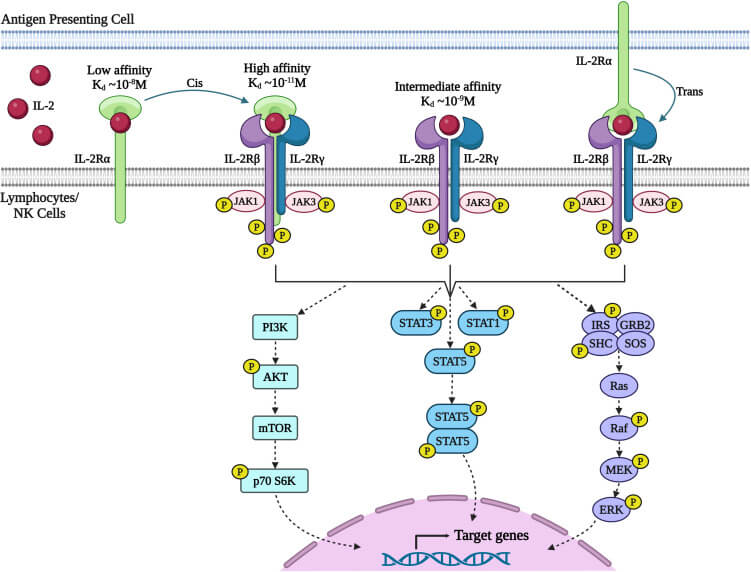 Fig.1 Biology of IL-2 and IL-2 receptors. 1
What We Can Offer
Structure-Guided Design for Specific Kd Requirements
Low-Toxicity Core Engineered for Optimal βγ Selectivity
Our candidates virtually eliminate risks like capillary leak syndrome (CLS) by strictly avoiding the IL-2Rα binding site. We engineer a low-toxicity core proven for optimal βγ selective signaling.
End-to-End Affinity and Functional Validation
We ensure preclinical performance using rigorous biophysical tools (SPR, ITC) and functional testing on human PBMCs. This comprehensive de-risking process guarantees the quality of your lead candidate.
Modular Mutein Formats for Seamless Integration
We offer customized mutein cores optimized for seamless integration into any downstream platform. Options include fusion-ready, conditional prodrug component, or half-life extension optimized formats.
Selective IL-2 Receptor Binding Engineering Service at Creative Biolabs
Highlights
Atomic Precision Engineering
Our use of structural data allows for the rational design of amino acid mutations that precisely decouple IL-2Rα binding without compromising the crucial βγ signaling interface.
Validated Low-Toxicity Foundation
We specifically engineer against the toxicity pathway, resulting in muteins that are the ideal, low-risk basis for half-life extension (PEGylation, Fc-fusion) and conditional activation (prodrugs).

Deep Market Insight
We understand that simple βγ-bias is often insufficient for targeting PD-1+ exhausted T cells. We build your core to be fusion-ready, enabling the localized, targeted delivery required for maximal anti-tumor effect in combination therapies.
Unrivaled Biophysical Characterization
Our in-house SPR, ITC, and HTS platforms provide the rigorous biophysical data necessary to de-risk your candidate before preclinical investment.
Inquire regarding the Creative Biolabs advantage and request a formal quotation today.
Customer Reviews
-
High Selectivity Achieved
Using Creative Biolabs' selective IL-2 receptor binding engineering service in our research has significantly improved the selectivity ratio of our lead candidate, which now exhibits nearly zero Treg activation at therapeutically relevant doses. This addressed a major preclinical hurdle immediately. - Dr. S***t. -
Foundation for Fusion
The mutein core provided by Creative Biolabs was stable and a perfect fit for fusion to our tumor-targeting antibody construct. Their precision engineering saved us months of optimization work compared to the generalized muteins we developed internally. - Dr. M***k.
FAQs
Q: Why can't I simply use a wild-type IL-2 molecule with a half-life extension?
A: Wild-type IL-2, even when extended, retains high affinity for IL-2Rα. This amplifies systemic toxicity and Treg expansion, drastically limiting the therapeutic dose. Our muteins provide the selective, low-toxicity core required for safe, high-dose combination therapies.
Q: How does Creative Biolabs' approach compare to simple computational mutein designs?
A: Our service integrates rational computational design with rigorous experimental validation using state-of-the-art biophysical platforms like SPR and functional PBMC assays. This integrated, structure-guided approach minimizes false positives and ensures the variant is stable and functionally selective.
Related Services
Cell Line Development Service
We offer high-yield stable cell line generation (e.g., CHO, HEK2G) for the robust, scalable production of your final IL-2 lead candidate or fusion protein.
Learn More →Immunocytokine Engineering Development
We optimize the flexible linker between the IL-2 mutein and the antibody. This ensures maximal structural stability and optimal bioactivity for your fusion protein in the tumor microenvironment.
Learn More →How to Contact Us
Creative Biolabs empowers our partners to bypass the fatal limitations of traditional IL-2 therapy and pursue superior therapeutic strategies like targeted fusion proteins and prodrugs. To learn more about how our services can protect your research and to get a personalized project quote, please contact us.
Reference
- Rokade, Sushama et al. "IL-2 based cancer immunotherapies: an evolving paradigm." Frontiers in immunology vol. 15 1433989. 24 Jul. 2024. Distributed under an Open Access license CC BY 4.0, without modification. https://doi.org/10.3389/fimmu.2024.1433989
 Download our brochure
Loading case studies...
Online Inquiry