B Lymphocyte (B Cell) & Plasma Cell Immunophenotyping Service
Background Service Highlights FAQs Contact Us
Introduction to B Lymphocytes, Plasma Cells, and Immunophenotyping
B lymphocytes, commonly known as B cells, are fundamental components of the adaptive immune system, primarily recognized for their pivotal role in differentiating into antibody-secreting cells. This lineage includes plasmablasts and terminally differentiated plasma cells, which are specialized for prolific antibody production. Humoral immunity, mediated by these antibody-sesecreting cells, constitutes a vital defense mechanism against pathogens and is a cornerstone of vaccine-induced protection. Conversely, dysregulation within these B cell and plasma cell populations can underpin a broad spectrum of pathologies, ranging from primary immunodeficiencies and chronic autoimmune diseases to malignant hematological disorders such as lymphomas, leukemias, and various plasma cell dyscrasias.
Immunophenotyping is the scientific methodology employed to identify and characterize distinct cell populations based on the expression patterns of specific surface and/or intracellular protein markers. In the context of B cells and plasma cells, this involves the meticulous application of fluorescently labeled antibodies that selectively bind to these unique cellular antigens. The subsequent analysis, predominantly performed using advanced multiparametric flow cytometry, enables the precise identification, enumeration, and phenotypic characterization of various B cell subsets (e.g., naïve, memory, transitional B cells) and plasma cells. This detailed cellular fingerprinting provides an invaluable window into the immune system's intricate state, enabling accurate diagnosis, prognostic stratification, and effective monitoring of disease progression and therapeutic response. Creative Biolabs’ commitment to this field is rooted in a deep understanding of these cellular intricacies.
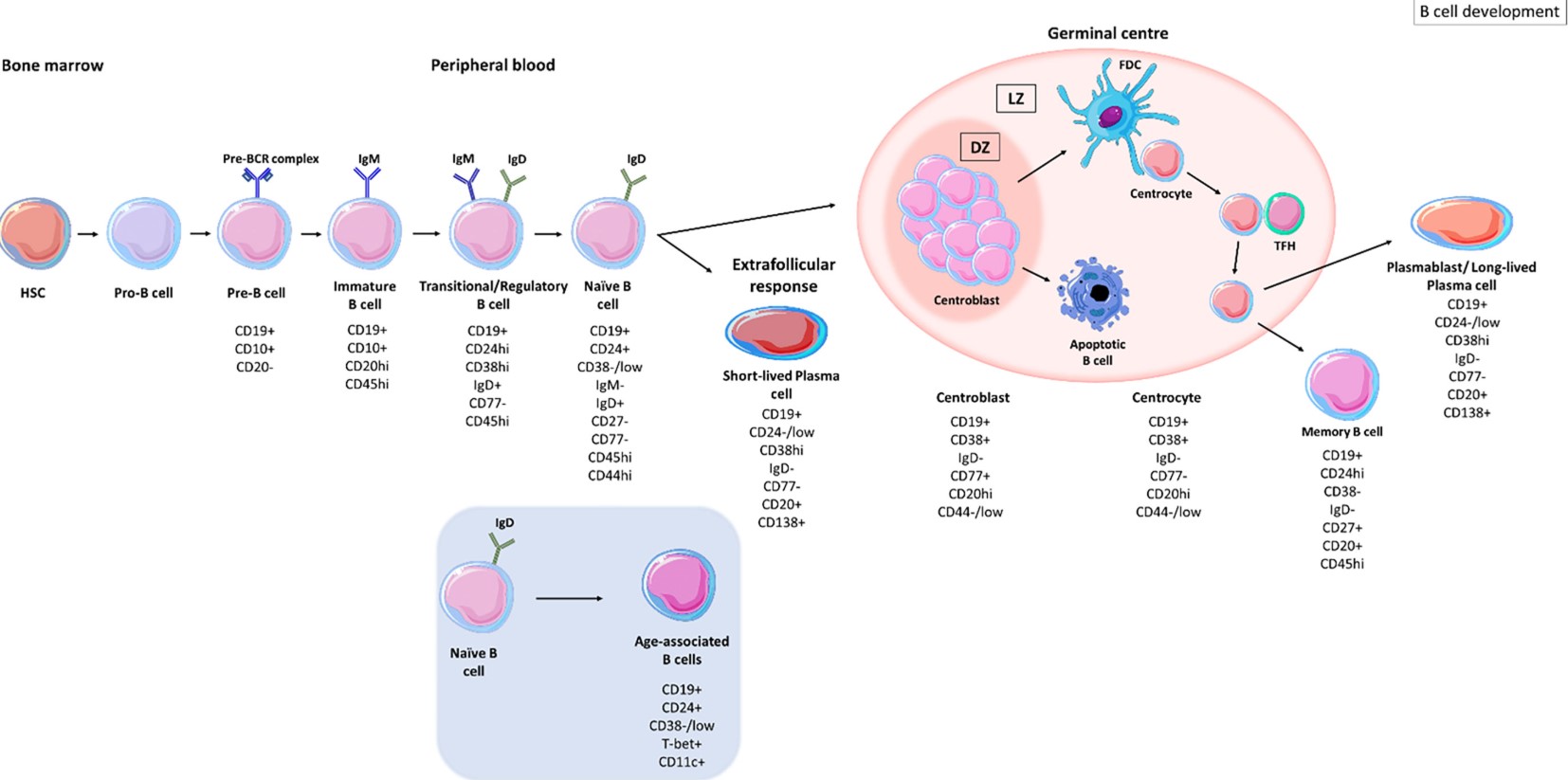 Fig.1 Overview of B cell development.1
Our B Lymphocyte (B Cell) & Plasma Cell Immunophenotyping Service
At Creative Biolabs, with over two decades of dedicated expertise in advanced biological analysis, we recognize the critical role that precise immunophenotyping plays in understanding and managing immune-related conditions. Our B Lymphocyte (B Cell) and Plasma Cell Immunophenotyping Service leverages state-of-the-art flow cytometry to provide unparalleled insights into the humoral immune compartment, crucial for both fundamental research and rigorous clinical diagnostics.
Our service uses cutting-edge flow cytometry to deeply analyze B cells and plasma cells. This powerful technology lets us look at many different markers on each cell at the same time, giving you a clear picture of complex immune cell populations.
Understanding B Cell Types with Detailed Markers
To precisely identify different types of B cells, we use a carefully chosen set of markers.
Key B Cell Identity Markers:
-
CD19: This is our most reliable general marker for B cells, found on most of them from early stages to plasma cells. However, we're careful, as some treatments or other cells (like certain CAR-T cells) can also show CD19.
-
CD20: Found on mature B cells. Its presence can be reduced or lost in certain blood cancers like CLL/SLL, and it's directly affected by common cancer drugs like Rituximab.
-
CD22: Another marker for B cells, from early to mature stages. Like CD20, its levels can drop in diseases like CLL/SLL. We also know that some CD22 tests can bind to other cells, so we choose the best methods to ensure accuracy.
Markers for Specific B Cell Functions and Disease Signs:
-
CD10, CD27, CD38: These help us identify different B cell stages (e.g., memory B cells) or activated cells.
-
Surface Light Chains (κ and λ): Unique patterns of these markers help us spot abnormal or cancerous B cells. We use special techniques to avoid misleading results.
-
CD5, CD40, CD37, CD24: These markers help identify specific types of B cell cancers (like CLL/SLL) or provide additional ways to confirm B cell identity, especially when other markers are affected by treatment.
-
Internal Markers: We can also look inside cells for markers like specific proteins or cytokines. This gives us even more detail about how B cells are functioning and what type they are.
Smart Gating Strategies for Complex Situations
Modern cancer treatments often change how B cells look to our tests. This is why Creative Biolabs uses advanced "gating strategies" – a way of carefully sorting and identifying cells – to overcome these challenges.
-
Handling Missing Markers After Treatment: When treatments remove or hide markers like CD20 or CD19 on B cells, we don't just stop there.
-
If CD20 is low or gone, we rely on CD19 and CD22, and look for specific abnormal patterns or use alternative markers like CD40 in combination with CD19.
-
If CD19 is low or gone, we check for CD20 and CD22. We also use other markers like CD40 or even look inside the cell for CD79a. We also have ways to make sure we don't confuse B cells with other cell types, such as CAR-T cells, which can sometimes appear similar.
-
Precisely Identifying Plasma Cells: Plasma cells, which make antibodies, also present unique challenges, especially after treatment.
-
Traditional markers like CD38 and CD138 can be affected by time or by new anti-myeloma drugs.
-
Creative Biolabs uses more stable alternative markers like CD229 and CD319 in our tests. These markers help us reliably find plasma cells even when CD38 or CD138 are absent or changed.
-
We also confirm plasma cell identity by looking for specific proteins inside the cells, called cytoplasmic light chains.
-
We also look for new treatment targets on plasma cells, like BCMA, to help guide therapy choices for patients with diseases like Multiple Myeloma.
Advanced Techniques for Best Results
Creative Biolabs constantly updates its methods to get the most accurate and useful data:
-
Minimizing Background Noise: When using many different colored markers, signals can sometimes overlap. We use advanced instruments and special dyes that reduce this overlap, making our results clearer and more precise.
-
Getting More Information from Each Sample: We can simultaneously measure markers on the cell surface and inside the cell. This dual approach gives us a richer, more complete picture of what a cell is and what it's doing, all from a single sample.
-
Smart Marker Selection: We carefully choose which colored marker to attach to each cell protein based on how much of that protein is present on the cell. This "antigen density" strategy ensures that even rare or dimly marked cells are clearly visible in our analysis. We use very bright dyes for these hard-to-see markers to ensure excellent resolution.
Our Advantages
Creative Biolabs' distinguishing advantage in the field of B Lymphocyte (B Cell) & Plasma Cell Immunophenotyping lies in our comprehensive understanding of the intricate interplay between cellular phenotype, disease biology, and therapeutic impact. With over two decades of dedicated experience in the industry, our capabilities extend far beyond mere data acquisition:
-
Deep Biological Insights
-
Mastery of Multiparametric Flow Cytometry
-
High-Quality Reagents and Optimized Protocols
-
Unwavering Commitment to Precision and Accuracy
FAQs
Q1: What is B cell and plasma cell immunophenotyping?
A1: B cell and plasma cell immunophenotyping is a laboratory technique, primarily utilizing multiparametric flow cytometry, to identify and characterize these immune cell populations. It relies on detecting specific protein markers on their surface or within their cytoplasm, which helps distinguish various B cell subsets and identify abnormal or malignant populations.
Q2: Why is this service important for understanding diseases?
A2: This service is crucial for diagnosing and managing a wide range of conditions. It aids in identifying deficiencies in B cell development (e.g., in primary immunodeficiencies like XLA), assessing abnormal B cell activity in autoimmune diseases (e.g., lupus, rheumatoid arthritis), and classifying hematological malignancies such as lymphomas, leukemias, and multiple myeloma. Furthermore, it is vital for monitoring disease progression and assessing the effectiveness of therapeutic interventions.
Q3: How do targeted therapies affect immunophenotyping results?
A3: Targeted therapies, especially monoclonal antibodies (e.g., anti-CD20, anti-CD19, anti-CD38 agents), can induce a reduction or complete loss of the targeted antigen on the cell surface due to mechanisms such as steric hindrance, antigen shaving, or downregulation. This directly impacts the reliability of traditional flow cytometric gating strategies. Creative Biolabs addresses these challenges by employing advanced multi-marker panels and redundant gating approaches to ensure accurate cell identification post-therapy.
Q4: What are some key markers used in B cell immunophenotyping?
A4: Key markers for general B cell identification include CD19, CD20, and CD22. For differentiating specific subsets and identifying aberrant phenotypes, markers such as CD10, CD27, CD38, CD5, surface light chains, CD40, CD37, and CD24 are utilized. For plasma cell characterization, essential markers include CD38, CD138, CD45, CD229, CD319, BCMA, and cytoplasmic light chains.
Contact Us
For more information regarding our B Lymphocyte (B Cell) & Plasma Cell Immunophenotyping Service, to discuss your specific research objectives, or to inquire about tailored clinical solutions, please do not hesitate to contact Creative Biolabs through our official website or by reaching out to our dedicated client services team via phone or email. Our expert team is ready to assist you in advancing your understanding of immune cell biology and disease.
Reference
-
Patel, Arzoo M et al. "The Role of B Cells in Adult and Paediatric Liver Injury." Frontiers in immunology vol. 12 729143. 23 Sep. 2021. DOI: 10.3389/fimmu.2021.729143. Distributed under Open Access License CC BY 4.0, without modification.
 Download our brochure