Cellular Kinase Target Engagement Assay Service
Introduction: The Evolving Landscape of Kinase Inhibitor Development
Protein kinases, orchestrating a vast array of cellular signaling pathways, remain prime therapeutic targets for a multitude of diseases, including cancer, inflammatory disorders, and metabolic conditions. The development of small molecule kinase inhibitors has revolutionized treatment paradigms in these areas. However, a persistent challenge in kinase drug discovery is the translation of promising in vitro biochemical activity into predictable cellular and in vivo efficacy. Traditional biochemical assays, while useful for initial screening, often fail to recapitulate the complex intracellular environment. Factors such as physiological ATP concentrations (typically in the millimolar range within cells, significantly higher than in many biochemical assays), the presence of scaffolding proteins, allosteric regulators, membrane barriers affecting compound permeability, and dynamic post-translational modifications can profoundly influence a compound's ability to engage its target kinase and exert a biological effect. This disconnect frequently leads to high attrition rates for drug candidates as they progress through the development pipeline.
To bridge this critical gap, robust methodologies that directly measure compound-kinase interactions within the native context of living cells are indispensable. Cellular target engagement assays provide this vital link, offering a more physiologically relevant assessment of how a drug candidate binds to its intended kinase target, thereby enabling more informed decision-making in lead optimization and candidate selection. At Creative Biolabs, we recognize the paramount importance of such precise, cellular-level understanding.
Creative Biolabs' Cellular Kinase Target Engagement Assay Service: Precision Pharmacology in Action
Creative Biolabs is at forefront of providing advanced solutions for kinase drug discovery, and our Cellular Kinase Target Engagement Assay service is designed to deliver critical insights into the intracellular behavior of your kinase inhibitors. These assays allow for the direct, quantitative measurement of compound binding to specific kinase targets within intact, living cells, providing data that is significantly more predictive of in vivo pharmacology than traditional approaches. Our service is engineered to help you de-risk your drug development programs by providing a clear understanding of cellular potency, selectivity, and the kinetics of target binding.
Service Content: Unveiling Intracellular Binding Dynamics
We employ state-of-the-art biophysical techniques, with a primary focus on Bioluminescence Resonance Energy Transfer (BRET)-based methodologies. Our Cellular Kinase Target Engagement service offers a comprehensive suite of analyses to thoroughly characterize your kinase inhibitors in a physiologically relevant setting:
Quantitative Intracellular Affinity Determination
A fundamental parameter is the affinity with which a compound binds its target in the cellular milieu. Our assays provide:
Apparent Cellular Affinity (KD or cellular IC50): We determine the concentration of your compound required to achieve 50% engagement of the target kinase in live cells. This allows for rank-ordering of compounds based on their potency within the cellular environment, where factors like cell permeability and competition with endogenous ATP are in play.
Intracellular Target Residence Time
Drug-target residence time (the duration a compound remains bound to its target) is increasingly recognized as a critical determinant of sustained pharmacological effect and in vivo efficacy, often correlating better with clinical outcomes than simple affinity measurements.
Kinetic Analysis: Creative Biolabs employs kinetic cellular kinase target engagement assay to measure the dissociation rates (koff) of compounds from their kinase targets in real-time, within living cells. This provides invaluable data on the durability of target engagement, as demonstrated in studies characterizing BTK inhibitors.
Comprehensive Selectivity Profiling
Achieving selectivity is paramount in kinase inhibitor development to maximize therapeutic efficacy while minimizing off-target effects and associated toxicities.
- Isoform Selectivity: Many kinases belong to families with closely related isoforms. Differentiating inhibitor binding to these isoforms is crucial. We can configure assays to compare compound engagement with specific kinase isoforms, such as SIK2 versus SIK3, or various PDHK isoforms, providing critical data for optimizing isoform-specific inhibitors.
- Off-Target Profiling: Beyond specific isoforms, understanding a compound's broader selectivity across the kinome is vital. While extensive kinome-wide screening is a larger endeavor, targeted panels of relevant off-target kinases can be assessed using cellular TE assays.
Engagement with Mutant and Activated Kinases
Disease states, particularly cancer, often involve mutations that alter kinase activity or inhibitor sensitivity.
Wild-Type vs. Mutant Kinases: Our service can assess and compare compound engagement with wild-type kinases versus their clinically relevant mutant counterparts, such as gain-of-function variants of SYK or drug-resistant mutants. This is essential for developing inhibitors that target specific pathogenic kinase forms or overcome resistance mechanisms.
Compound Permeability and Intracellular Availability
A compound must reach its intracellular target to be effective. Cellular TE assays inherently provide an indication of a compound's ability to cross the cell membrane and engage its target.
Cellular vs. Biochemical Potency Shifts: By comparing potency data from cellular TE assays with biochemical assay data, insights into cellular permeability and efflux can be inferred.
Mechanism of Action (MoA) Elucidation
Understanding how a compound binds its target can inform further optimization.
Differentiating Binding Modes: While not a direct structural method, the design of TE assays, particularly for kinases like PDHKs with distinct ATP-binding and allosteric (e.g., lipoamide-binding) sites, can allow for the characterization of inhibitors with different mechanisms of action. Competition with site-specific tracers can reveal whether a compound is ATP-competitive or binds to an allosteric site.
High-Throughput Screening (HTS) Capabilities
For early-stage discovery programs, the ability to screen larger numbers of compounds is essential.
Assay Miniaturization: Cellular kinase target engagement assays have been successfully miniaturized to 384-well formats, making them amenable to high-throughput screening campaigns. This has been demonstrated for targets like BTK and for isoform selectivity screening of SIK2/3 inhibitors, enabling efficient identification of promising cellularly active hits.
Scientific Backing
| Summary | Researcher utilizes a cellular kinase target engagement assay to study inhibitor interactions with these variants in live cells. Which can be optimized to study specific kinase targets, including disease-relevant mutant forms, directly in a cellular context. It emphasizes the ability to assess inhibitor potency and cellular effects for these activated kinases. |
| Result |
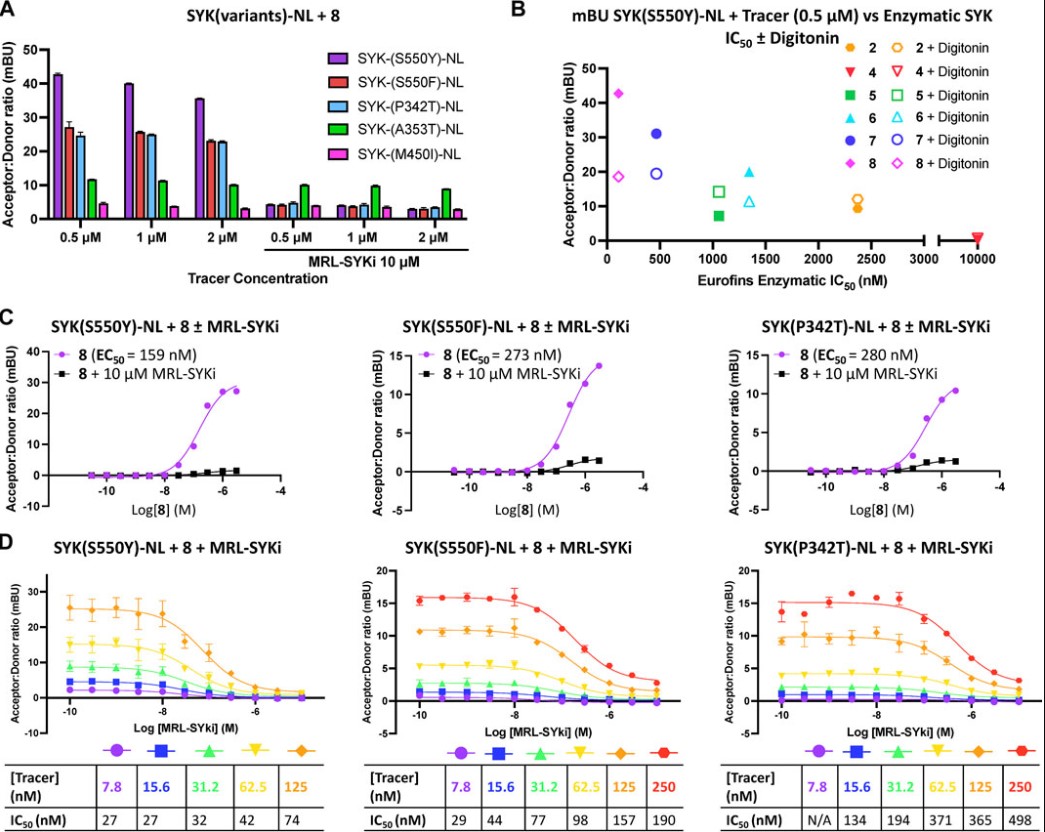 Fig.1 Effective SYK tracers combined with SYK GoF variants were detected by BRET technology.1 |
Benefits for You
Choosing Creative Biolabs for your Cellular Kinase Target Engagement studies offers distinct advantages:
- Unparalleled Physiological Relevance
- Comprehensive and Quantitative Profiling
- Cutting-Edge Technology and Expertise
- Actionable Data for Informed Decisions
FAQs
Q1: Why are cellular target engagement assays critically important compared to traditional biochemical assays for kinase inhibitors?
A1: Biochemical assays, while useful for determining intrinsic binding affinity, often lack physiological relevance. They typically use purified, sometimes truncated, enzyme domains and non-physiological ATP concentrations, and they don't account for cell permeability, efflux pumps, or interactions with other cellular components. Cellular target engagement assays, like those offered by Creative Biolabs, measure inhibitor binding directly in live, intact cells, providing a more accurate reflection of how a compound will perform in a biological system and a better correlation with downstream cellular efficacy and, ultimately, in vivo activity.
Q2: Can Creative Biolabs' service assess if my compound selectively inhibits specific isoforms of a target kinase?
A2: Absolutely. Isoform selectivity is a key aspect of our service. By developing cellular kinase target engagement assay for individual kinase isoforms (e.g., SIK2 and SIK3, or different PDHK isoforms), we can directly compare the binding affinity and/or residence time of your compound for each isoform in a cellular context. This data is crucial for optimizing compounds to minimize off-target effects associated with hitting undesired isoforms.
Q3: What types of kinases and inhibitor mechanisms can be investigated using Creative Biolabs' Cellular TE assays?
A3: Our cellular kinase target engagement assay is versatile and can be applied to a broad spectrum of kinases, including tyrosine kinases and serine/threonine kinases. We can assess engagement with wild-type kinases, clinically relevant mutants (including gain-of-function or resistance mutations), and evaluate inhibitors that bind to the ATP site as well as those that may act via allosteric mechanisms, provided appropriate tracer strategies can be implemented.
Q4: How do Cellular Target Engagement assays from Creative Biolabs contribute to de-risking my drug development program?
A4: These assays provide critical, early-stage information that can significantly de-risk drug development. By understanding how your compound behaves in a live cell—its ability to permeate the cell, engage the target with desired potency, its duration of engagement (residence time), and its selectivity profile—you can make more informed decisions. This helps in prioritizing the most promising compounds, guiding medicinal chemistry efforts to address liabilities (e.g., poor permeability, short residence time), and reducing the likelihood of costly failures in later preclinical or clinical stages due to poor cellular activity or unforeseen off-target effects.
Contact Us
Advancing your kinase inhibitor program requires a deep understanding of how your compounds interact with their targets in the most relevant biological setting. The Cellular Kinase Target Engagement Assay services at Creative Biolabs provide the precision, physiological relevance, and comprehensive data necessary to drive your project forward with confidence.
We invite you to discuss your specific kinase drug discovery challenges and objectives with our experts. Contact Creative Biolabs today to learn how our cutting-edge cellular target engagement solutions can illuminate the path to your next successful therapeutic.
Reference
- Capener, Jacob L et al. "Development of SYK NanoBRET Cellular Target Engagement Assays for Gain-of-Function Variants." bioRxiv : the preprint server for biology 2024.06.12.598544. 13 Jun. 2024. DOI: 10.1101/2024.06.12.598544. Preprint. Distributed under Open Access License CC BY 4.0, without modification.
 Download our brochure