Flow Cytometry (FC) based Caspase Activation Assay Service
What Are Caspases?
Caspases, or cysteine-aspartic proteases, are a family of protease enzymes playing essential roles in programmed cell death (apoptosis) and inflammation. They are synthesized as inactive proenzymes that undergo proteolytic processing at conserved aspartic residues to become activated. In apoptosis, caspases are categorized into two main types: initiator caspases (such as caspase-8 and caspase-9) that begin the apoptotic process, and executioner caspases (such as caspase-3, caspase-6, and caspase-7) that dismantle the cell by cleaving various substrates. This cascade of events ultimately leads to cellular disassembly, replication of the death signal, and cellular removal by phagocytosis, ensuring that the process is swift and does not disturb surrounding tissues.
Creative Biolabs has over two decades of experience in providing advanced biotherapeutics services, including the assessment of caspase activation using precise methodologies like flow cytometry.
Assessment of Caspase Activation by Flow Cytometry
- Methodologies
Flow cytometry is a robust tool that allows for the comprehensive analysis of cell populations, providing critical insights into cell characteristics and functions. The assessment of caspase activation by flow cytometry has proven invaluable in detecting apoptosis at a single-cell level. This method uses fluorogenic or fluorometric substrates, which acquire fluorescence when cleaved by active caspases, such as caspase-3 and caspase-7. The fluorescence signal offers quantitative data, enabling researchers to differentiate between early and late apoptosis stages.
- Service Contents
At Creative Biolabs, we offer both population-based assays and single-cell assays leveraging flow cytometry for assessing caspase activation:
- Population-Based Assays: We utilize fluorometric substrates to ascertain caspase-3/caspase-7 activity across a broad sample set. The samples are maintained on ice throughout the process to prevent premature substrate cleavage, ensuring accurate fluorescence readings.
- Single-Cell Assays: Flow cytometry enables the individual analysis of cells, adding the capability to measure additional parameters like cell surface markers. This approach promises a higher degree of precision in identifying apoptotic cells.
Highlights of Our Services
- High Sensitivity and Specificity
Our flow cytometry-based assays can detect low levels of caspase activity, ensuring that even minimal apoptotic events are identified.
- Versatility
The assays are adaptable for different caspases, allowing the study of various cell death modalities such as apoptosis and pyroptosis.
- Quantitative and Qualitative Assessment
We deliver both quantitative data on caspase activity levels and qualitative insights into cell fate, providing a comprehensive understanding of the cellular processes.
- Multicolor Analysis
Utilizing multicolor flow cytometry, we can simultaneously measure multiple caspases and other cellular parameters, providing a more comprehensive analysis of the apoptotic process.
- Rapid Turnaround
Creative Biolabs is committed to delivering results swiftly, enabling timely advancements in your research projects.
Scientific Backing
| Summary | In a recent study, researchers investigated the effects of areca nut on apoptosis and caspase-3 activity in OSCC cell lines (HSC-2 and HSC-3). Using flow cytometry, researchers demonstrated significant caspase-3 activation and increased apoptotic events, particularly after 48 hours of exposure. These findings illustrate the potential of areca nut as an anticancer agent and highlight the value of flow cytometry services in cancer research. |
| Result |
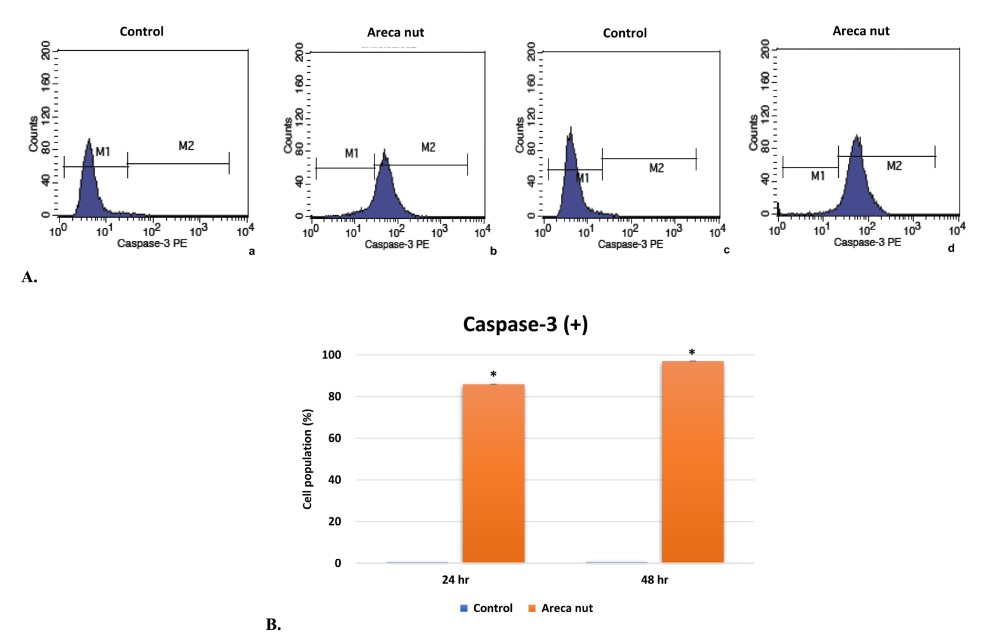 Fig.1 The effect of areca nut on caspase-3 activity in HSC-2 cells analyzed by flow cytometry.1 |
Frequently Asked Questions
Q1: How does flow cytometry compare to other methods for assessing caspase activation?
A1: Flow cytometry offers several advantages, including high sensitivity, quantitative analysis, and the ability to assess individual cells within a population. This is superior to methods like Western blotting, which are qualitative and less sensitive to low levels of caspase activity.
Q2: How do I choose between population-based and single-cell assays?
A2: The choice depends on your research requirements. Population-based assays offer a broad overview and quick results for large sample sets, whereas single-cell assays provide detailed insights into individual cell behavior and additional parameters like cell surface markers.
The assessment of caspase activation by flow cytometry offered by Creative Biolabs is a powerful tool for understanding cell death processes. Our high-sensitivity, quantitative assays support a wide range of applications in cancer research, drug development, and inflammation studies, backed by robust scientific methodologies and a commitment to advancing research frontiers.
Reference
- Sari, Liza Meutia, Gus Permana Subita, and Elza Ibrahim Auerkari. "Areca nut extract demonstrated apoptosis-inducing mechanism by increased caspase-3 activities on oral squamous cell carcinoma." F1000Research 7 (2018). Distributed under Open Access License CC BY 4.0, without modification.
 Download our brochure