Flow Cytometry (FC) based EGFR Activation/Deactivation Assay Service
Introduction
The epidermal growth factor receptor (EGFR) plays a pivotal role in the regulation of normal cellular growth and differentiation. However, the dysregulation of EGFR or its ligands is critically involved in the pathogenesis of several cancers, including those of the breast, lung, colorectal, and brain. Understanding the mechanisms of EGFR activation and deactivation is imperative for developing targeted therapies. The endocytic pathway and various internalization mechanisms, including clathrin-mediated endocytosis, play an essential role in EGFR signaling balance.
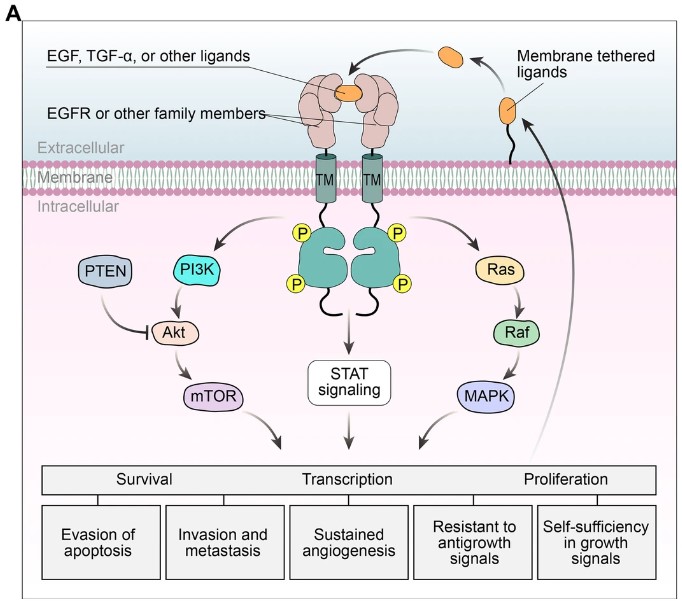 Fig.1 Schematic of EGFR structure and functions.1
Mechanisms of EGFR Activation and Deactivation
Upon ligand binding, EGFR undergoes a conformational change, leading to the activation of intracellular kinase domains that stimulate downstream effectors such as Shc, Grb2, PLCγ, and PKC. The receptor can be deactivated by dephosphorylation catalyzed by phosphatases such as PTP1B or PTPN2, or by internalization via clathrin-coated pits, leading to either recycling back to the cell surface or proteolytic degradation in lysosomes.
Our Flow Cytometry-based EGFR Activation/Deactivation Assay
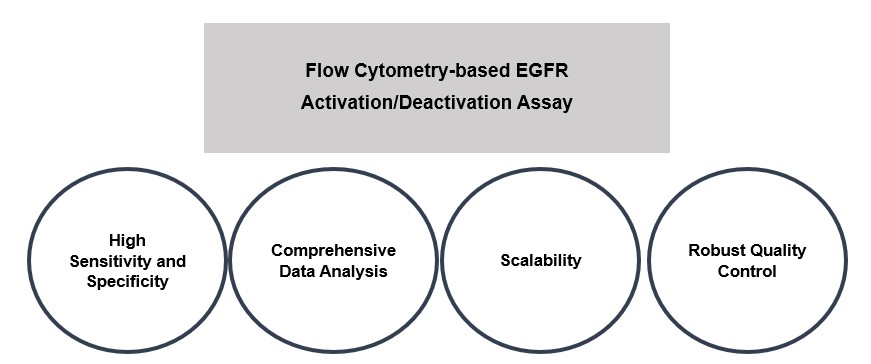
At Creative Biolabs, we have developed a robust flow cytometry-based assay to quantify and compare phosphorylated EGFR (activated) versus total EGFR. This allows for precise measurement of receptor activation states and downregulation mechanisms. Given the complexity of EGFR signaling and its implicated pathways, our assay provides essential insights into receptor behavior under various conditions.
Service Contents
Our flow cytometry-based EGFR activation/deactivation assay service includes:
- Sample Preparation: We process various cell types, ensuring optimal conditions for accurate measurement.
- Flow Cytometric Analysis: Utilizing state-of-the-art flow cytometry technology to measure both phosphorylated and total EGFR levels.
- Data Interpretation: Comprehensive analysis and interpretation of data to elucidate the specific pathways of EGFR internalization and degradation.
- Custom Protocol Development: Tailored assay protocols to meet the unique needs of your research.
Our Related Services
In addition to our primary EGFR assay, Creative Biolabs offers a range of related services aimed at supporting your research in receptor signaling and cancer biology:
- Protein Phosphorylation Assays: Detailed analysis of phosphorylation states of various signaling proteins.
- Ligand Binding Assays: Quantitative measurements of receptor-ligand interactions.
- Cell Signaling Pathway Analysis: Comprehensive mapping of signaling pathways activated upon EGFR stimulation.
Frequently Asked Questions
Q1: What is the significance of EGFR in cancer research?
A1: EGFR is integral to the regulation of cellular processes that, when dysregulated, lead to cancer. Its role in cancer cell proliferation, invasion, and metastasis makes it a critical target for therapeutic intervention.
Q2: How does flow cytometry enhance the study of EGFR activation?
A2: Flow cytometry allows for simultaneous measurement of multiple parameters within a single cell population, providing a high-throughput, precise method to compare phosphorylated and total EGFR levels across different conditions.
Q3: What are the advantages of using Creative Biolabs' assay services?
A3: Creative Biolabs offers extensive expertise, state-of-the-art technology, and customizable protocols tailored to meet your research needs, ensuring reliable and comprehensive results.
Partner with Us
Collaborate with Creative Biolabs for your EGFR activation/deactivation assay needs. From assay development to data interpretation, we provide the tools and expertise necessary for groundbreaking discoveries in cancer biology and beyond. Partner with us to leverage our deep knowledge and innovative technologies tailored to your unique research objectives.
Reference
- Shi, Kunyu, et al. "Emerging strategies to overcome resistance to third-generation EGFR inhibitors." Journal of Hematology & Oncology 15.1 (2022): 94. Distributed under Open Access License CC BY 4.0, without modification.
 Download our brochure