Small animal in vivo PK refers to conducting pharmacokinetic (PK) studies in small animal models like mice, rats, or rabbits. This provides a valuable resource for preclinical research, allowing scientists to assess drug candidate behavior and optimize dosing strategies for subsequent efficacy and safety evaluations.
Learn More →FcRn Binding Assay Service
Background Our Products Workflow Publication Why Choose Us FAQs Customer Review Related Services Contact Us
FcRn Binding Assay: Precision Insights for Enhanced Antibody Performance
By binding to neonatal Fc receptor (FcRn), IgG antibodies can evade lysosomal degradation and maintain their presence in the bloodstream longer, enhancing their therapeutic efficacy. Understanding this interaction is vital for optimizing the performance of antibody-based drugs.
The FcRn binding assay is an advanced analytical tool designed to evaluate the interaction between the Fc fragment of IgG and FcRn. This assay plays a crucial role in understanding the pharmacokinetics and efficacy of therapeutic antibodies, which are critical for developing and optimizing biopharmaceuticals. At Creative Biolabs, we are proud to introduce our cutting-edge FcRn binding assay, reflecting our commitment to excellence and expertise in biopharmaceutical research. Our FcRn binding assay is designed with precision to support the rigorous needs of antibody development and therapeutic evaluation. Leveraging our extensive experience and advanced technologies, we offer reliable and accurate analyses to ensure optimal performance and efficacy of your antibody-based therapies. Our team of experts is dedicated to providing top-tier service and insights, making us a trusted partner in your research.
At Creative Biolabs, several advanced techniques can be employed for analyzing FcRn binding interactions, each offering unique advantages:
| Technique | Description | Advantages | Limitations |
|---|---|---|---|
| SPR | A label-free technique that measures real-time changes in optical properties due to molecular binding events. | Real-time data, high sensitivity, precise kinetics, and affinity measurements. | Requires SPR equipment |
| ELISA | A method that uses enzyme-linked antibodies to detect and quantify antigen-antibody interactions. | Simple, widely used, and effective for bulk quantification. | Does not provide real-time data or detailed kinetics. |
| Isothermal Titration Calorimetry (ITC) | Measures heat changes during molecular binding to provide thermodynamic data such as binding affinity and site numbers. | Provides comprehensive thermodynamic data, and accurate binding parameters. | Requires high sample concentrations, and sophisticated equipment. |
Our FcRn Products
| Cynomolgus / Rhesus macaque: |
|---|
| Cynomolgus / Rhesus macaque FcRn / FCGRT&B2M Heterodimer Protein, His Tag (BLI verified) |
| Cynomolgus / Rhesus macaque FcRn / FCGRT&B2M Heterodimer Protein, His,Avi Tag (SPR verified) [Biotinylated] |
| Human: |
| Human FcRn / FCGRT&B2M Heterodimer Protein, His, Avi Tag (SPR verified) [Biotinylated] |
| Human FcRn / FCGRT&B2M Heterodimer Protein, His Tag (SPR & BLI verified) |
| Mouse: |
| Mouse FcRn / FCGRT&B2M Heterodimer Protein, His Tag (BLI verified) |
| Mouse FcRn / FCGRT&B2M Heterodimer Protein, His, Avi Tag (BLI verified) [Biotinylated] |
| Other Species: |
| Bovine FcRn / FCGRT&B2M Heterodimer Protein, His, Avi Tag (SPR verified) [Biotinylated] |
| Feline FcRn / FCGRT&B2M Heterodimer Protein, His, Avi Tag (SPR verified) [Biotinylated] |
| Rabbit FcRn / FCGRT&B2M Heterodimer Protein, His Tag&Tag Free (SPR verified) |
Flowchart of SPR
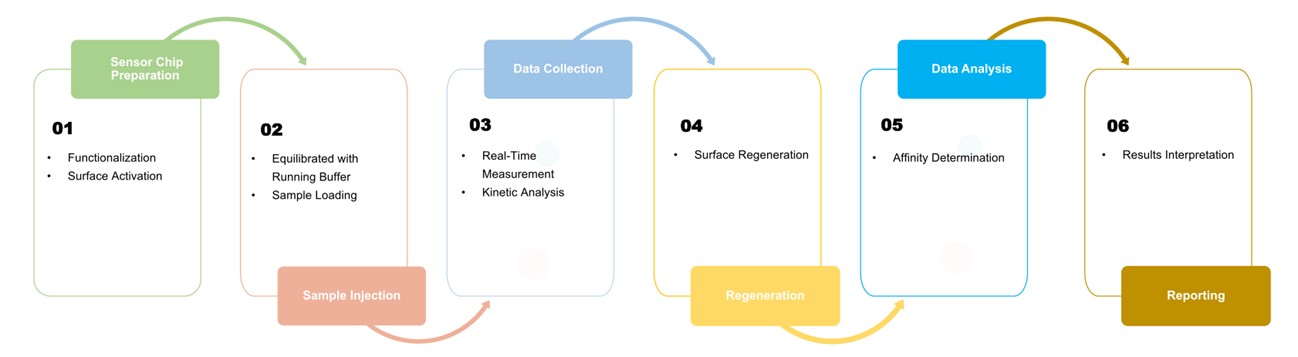
Determining FcRn binding affinity is crucial for the development and optimization of therapeutic antibodies. Accurate measurement of FcRn binding affinity helps in:
- Optimizing antibody pharmacokinetics: Stronger FcRn binding can extend the half-life of antibodies, enhancing their therapeutic efficacy and reducing dosing frequency.
- Improving drug efficacy: By understanding how well an antibody binds to FcRn, researchers can design antibodies with improved pharmacological profiles, leading to more effective treatments.
- Ensuring safety: Proper FcRn binding analysis helps in predicting potential side effects and ensuring that antibodies remain effective and safe throughout their therapeutic use.
Publication
This publication investigates the role of the Fab region of IgG in the antibody's interaction with the neonatal Fc receptor (FcRn). The study hypothesizes that the Fab region interferes with the FcRn-mediated trafficking of IgG. The research compares a full-size IgG1 with an Fc-only counterpart, both containing a variant (MST-HN) designed for enhanced FcRn binding. It finds that while the Fab region doesn't affect binding in cell-free assays, it does impair the interaction with membrane-associated FcRn in cellular assays. This leads to less efficient intracellular FcRn occupancy and accumulation for the full-size antibody compared to the Fc-only fragment. The study concludes that the cellular membrane context is a critical factor in FcRn biology and that Fc-only fragments are functionally superior to full-size IgG1 molecules in blocking the IgG salvage pathway in vivo.
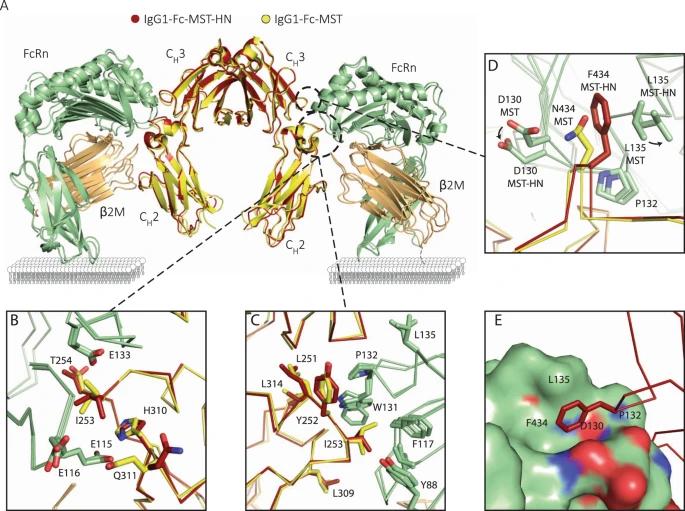 Fig.1 Comparative crystallography of FcRn:β2M interacting with Fc-MST and modified Fc-MST.1
Why Choose Us?
Creative Biolabs stands at the forefront of FcRn biology, offering unparalleled expertise and cutting-edge platforms to ensure the success of your biotherapeutic projects. Our commitment to scientific rigor and client satisfaction sets us apart.
Optimizing pharmacokinetics
Stronger FcRn binding can extend the half-life of antibodies, improving therapeutic efficacy and reducing dosing frequency.
Enhancing drug efficacy
Understanding an antibody's FcRn binding helps in designing antibodies with better pharmacological profiles for more effective treatments.

Ensuring safety
Analyzing FcRn binding is crucial for predicting potential side effects and ensuring the antibody's safety.
Guiding development
These insights guide the development of new therapeutics, enabling a more strategic approach to drug design.
Contact Creative Biolabs now to initiate your project.
FAQs
Q1: Why are both cell-free and cell-based FcRn assays necessary?
A1: While cell-free assays like SPR provide precise kinetic data on the direct FcRn-IgG interaction, cell-based assays offer a more physiological context, mimicking in vivo conditions. They are crucial for observing how factors like the cell membrane and the antibody's Fab regions can influence binding, internalization, and recycling, providing a more complete picture for accurate in vivo prediction.
Q2: How can FcRn binding data help me optimize my antibody's half-life?
A2: By characterizing your antibody's binding affinity and dissociation rates at both acidic and neutral pH, we can identify opportunities for Fc engineering. Modulating these interactions can either extend the half-life (for sustained therapeutic effect) or reduce it (for rapid clearance of pathogenic antibodies), directly impacting dosing frequency and patient convenience.
Q3: Is your FcRn binding assay service suitable for biosimilar development?
A3: Absolutely. Our comprehensive assays, including both quantitative binding and functional cellular assays, are ideal for demonstrating comparability between your biosimilar candidate and a reference product. This robust data package is essential for regulatory submissions and establishing bioequivalence.
Customer Review
-
Enhanced Predictability
The functional FcRn-mediated recycling assays from Creative Biolabs provided the most predictive in vitro data we've seen. This allowed us to confidently down-select our lead candidates, significantly reducing the risk and cost associated with in vivo studies. - Dr. L***e Wong
-
Problem-Solving Partnership
When our internal assays yielded ambiguous results regarding FcRn interaction, Creative Biolabs stepped in with their advanced platforms and deep expertise. They quickly identified the subtle pH-dependent binding characteristics we were missing, enabling us to refine our molecule's design. - Dr. M***n Singh
Related Services
To further support your biotherapeutic development, Creative Biolabs offers a range of complementary services that can seamlessly integrate with your FcRn binding assay project:
Small Animal In Vivo PK Service
Non-rodent In Vivo PK Service
Non-rodent in vivo PK studies involve assessing drug behavior in non-rodent species, such as dogs and non-human primates. These studies are crucial in preclinical drug development to understand how drugs are absorbed, distributed, metabolized, and excreted, providing valuable insights into pharmacokinetics.
Learn More →How to Contact Us
Overall, precise determination of FcRn binding affinity is essential for developing antibodies with optimal therapeutic properties and achieving better clinical outcomes. At Creative Biolabs, we offer comprehensive FcRn binding assay services that provide accurate and detailed analysis of your antibody interactions with FcRn. Our advanced assay technology ensures real-time, label-free measurement of binding kinetics and affinity.
Contact us to leverage our expertise in FcRn binding analysis and advance your antibody development projects with precision and confidence.
Reference
- Brinkhaus, Maximilian, et al. "The Fab region of IgG impairs the internalization pathway of FcRn upon Fc engagement." Nature Communications 13.1 (2022): 6073. Distributed under Open Access license CC BY 4.0, without modification. DOI: https://doi.org/10.1038/s41467-022-33764-1
 Download our brochure
Loading case studies...
Online Inquiry