HCN Channel Assay Service
As an industry leader in providing advanced biotechnology services, Creative Biolabs is committed to advancing the field of ion channel research with our HCN channel assay service. By combining cutting-edge technologies, tailored assay options, and high-throughput screening capabilities, we provide researchers with the tools needed to accelerate the discovery of novel therapies targeting HCN channels.
HCN Channels
The hyperpolarization-activated cyclic nucleotide-gated (HCN) ion channels are a family of voltage-gated ion channels that play a key role in controlling the electrical activity of excitable cells, such as neurons and cardiac pacemaker cells. These channels are activated by hyperpolarization and are modulated by cyclic nucleotides like cAMP and cGMP, making them integral to processes like heart rate regulation and synaptic transmission. Due to their pivotal role in controlling the rhythmicity and excitability of these vital tissues, HCN channels have emerged as promising targets in drug development for treating a variety of conditions, such as cardiac arrhythmias, epilepsy, and chronic pain.
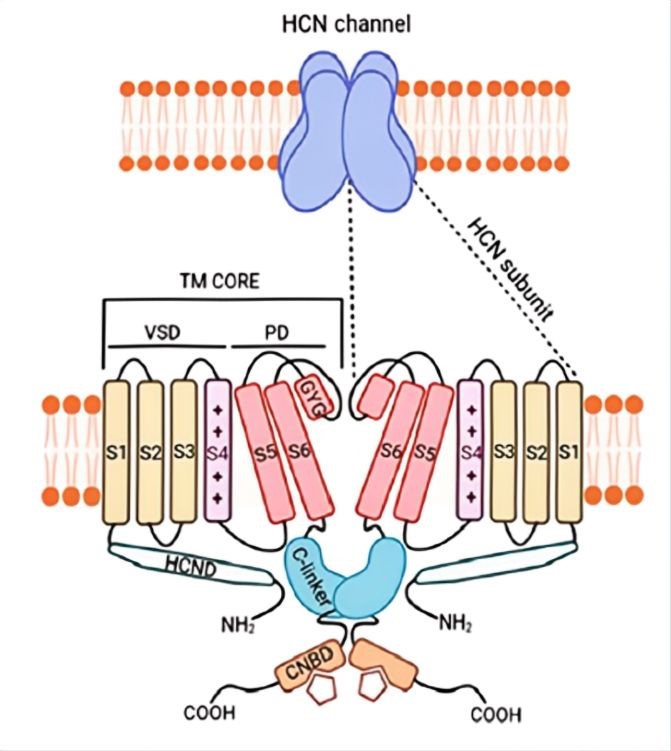 Fig.1 The structure of a HCN channel.1
HCN Channel Assay Service
Creative Biolabs leverages state-of-the-art technology platforms that underpin our unique HCN channel assay service. Our team utilizes cutting-edge electrophysiological techniques that allow detailed and reliable assessments of ion channel activities. In addition, we have established stable cell lines expressing HCN1, HCN2, HCN4, and other types, and offer corresponding drug screening services. We provide comprehensive data analysis, including hit identification, dose-response curves, and insights into the pharmacological profiles of compounds. Whether you're studying the pharmacology of a particular HCN channel subtype, testing potential drug candidates, or exploring channel kinetics, our team can design assays to meet your goals.
Advanced Technologies at Creative Biolabs
- Patch-Clamp Systems: For precise measurement of ion channel activity, we utilize patch-clamp systems. These systems enable real-time monitoring of HCN channel activity, allowing for efficient and consistent data collection across a wide range of experimental conditions.
- Fluorescence-Based Assays: Our assays use fluorescence imaging technologies to track changes in ion flux and membrane potential, providing real-time insights into channel activity. This approach is ideal for screening large numbers of compounds quickly and efficiently.
- HCN Channel Cell Lines: We have developed specialized cell lines that express HCN channels, ensuring that assays are conducted under conditions that closely mimic physiological environments.
Our HCN channel assays have been integrated into various panels, including
- Cardiac Panel
- Cardiovascular Panel
- Metabolic and Gastrointestinal Panel
- Pain-Inflammation Panel
- Seizure-Convulsion Panel
- Oncology Panel
- Sedation Off Target Panel
Applications
-
Cardiac Drug Development
HCN channels regulate heart rhythm and pacemaker activity. Our assay supports the screening of drug candidates targeting HCN1, HCN2, and HCN4 to treat arrhythmias and related cardiovascular conditions. -
Epilepsy and Neurological Research
HCN channels affect neuronal excitability and are linked to epilepsy. We offer precise assays to evaluate modulators that may reduce seizures and support CNS drug discovery. -
Chronic Pain Therapy
HCN channels are involved in pain signaling. Our service enables screening of therapeutics that modulate HCN activity, advancing treatments for chronic pain and inflammation. -
Off-Target Effect Assessment
Our assay helps detect unwanted effects of drugs on cardiac or neuronal excitability by profiling HCN channel activity, supporting early safety evaluation.
For more information about our HCN channel assay service, please contact us today to discuss how we can support your research and drug development needs.
Reference
- Kim, Daniel, et al. "Localization of hyperpolarization-activated cyclic nucleotide-gated channels in the vertebrate retinas across species and their physiological roles." Frontiers in Neuroanatomy 18 (2024): 1385932. Distributed under Open Access license CC BY 4.0, without modification.
 Download our brochure