JNK Quantification Service
The JNK Quantification Service is a specialized analytical platform that measures and quantifies c-Jun N-terminal kinase (JNK) activity in biological samples to aid in research on cellular responses to stress and disease.
JNK Signaling Pathway
The c-Jun N-terminal kinase (JNK) signaling pathway is a crucial component of cellular responses to various stressors, including cytokines, UV light, and osmotic shock. This pathway is part of the larger mitogen-activated protein kinase (MAPK) family and plays a significant role in regulating cell proliferation, differentiation, and apoptosis.
The JNK pathway typically begins with the activation of a variety of upstream kinases in response to cellular stress. These kinases, such as the MAPK kinase kinase (MKK), phosphorylate and activate JNK. Once activated, JNK translocates to the nucleus, where it can phosphorylate a range of transcription factors, including c-Jun, which is a component of the AP-1 transcriptional complex. This activation leads to changes in gene expression that promote cellular survival, inflammation, or apoptosis, depending on the context and severity of the stress signal.
In addition to its role in stress responses, the JNK signaling pathway is involved in various physiological processes, including embryonic development and tissue repair. Dysregulation of JNK signaling has been implicated in numerous diseases, including neurodegenerative disorders, cancer, and inflammatory conditions. Thus, targeting the JNK pathway holds potential therapeutic promise for a variety of pathologies, making it an important area of research in cellular and molecular biology.
JNK Quantification Service at Creative Biolabs
Our JNK quantification service provides a comprehensive analysis of JNK activity levels, which are crucial for understanding various cellular processes, including stress responses, apoptosis, and inflammation. This service employs advanced biochemical assays and technologies, such as ELISA or Western blotting, to accurately measure phosphorylated and total JNK protein levels in biological samples. You can utilize this service to profile JNK signaling pathways in different experimental conditions, aiding in the investigation of disease mechanisms and the development of targeted therapies. With a focus on precision and reproducibility, the JNK quantification service delivers reliable data that enhances the understanding of JNK's role in cellular function and pathology.
Process of Our JNK Quantification Service

Here are several methods and markers commonly used to assess JNK activation and deactivation at Creative Biolabs:
-
Western Blotting
- Phosphorylation Status: JNK activation is typically assessed by measuring the phosphorylation of specific threonine and tyrosine residues (e.g., Thr183 and Tyr185). A phosphorylated form of JNK corresponds to its active state.
- Total JNK Levels: To provide context for the phosphorylation data, total JNK protein levels can also be assessed.
-
Enzyme Activity Assays
- Kinase Assay: In vitro kinase assays can directly measure JNK activity by using specific substrates and assessing their phosphorylation using radiolabeling or other detection methods.
-
Cell-based Assays
- Fluorescent or Luminescent Reporter Systems: Cells can be transfected with reporter constructs that are responsive to JNK activity. Changes in fluorescence or luminescence can indicate JNK activation.
- FRET (Fluorescence Resonance Energy Transfer): The dynamics of JNK activity can be monitored in real-time using this technology
-
Immunofluorescence
- Cellular Localization: JNK activation can influence its localization within the cell, which can be visualized using antibodies against phosphorylated JNK combined with confocal microscopy.
-
RNA Interference
- Gene Knockdown or Knockout: Reducing JNK expression through RNA interference or gene editing technologies can help determine the functional impact of JNK on cellular pathways and responses.
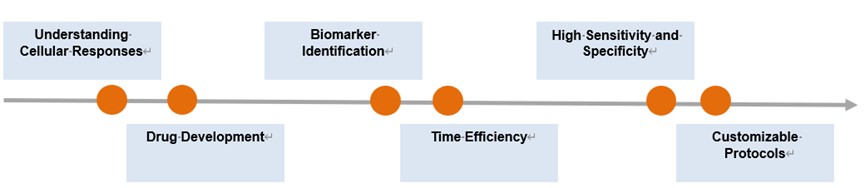
Advantages of NK Quantification Service
JNK quantification services are specialized analyses used to measure the activity or expression levels of JNK proteins in biological samples. Here are some advantages of JNK quantification services:
Frequently Asked Question
Q1: How does JNK activation/deactivation work?
A1:
| JNK Activation | JNK Deactivation |
|---|---|
| The activation of JNK typically occurs in response to a variety of extracellular stimuli, such as UV radiation, pro-inflammatory cytokines, and oxidative stress. Upon these stimuli, upstream kinases, primarily the MAPK kinase kinases (MKKs), phosphorylate JNK on specific threonine and tyrosine residues, inducing a conformational change that enhances its catalytic activity. Once activated, JNK can translocate to the nucleus, where it phosphorylates various transcription factors, most notably c-Jun, leading to the modulation of gene expression that drives cellular response pathways. | The deactivation of JNK involves several intricate processes that ensure the timely resolution of its signaling activity. One primary mechanism is the action of specific protein phosphatases, such as MKP-1 (MAPK phosphatase-1), which dephosphorylate JNK at the threonine and tyrosine residues that are crucial for its activation. Additionally, ubiquitin-mediated proteasomal degradation can target JNK for removal when the cellular conditions normalize. Feedback inhibition mechanisms may also contribute, where activated JNK can induce the expression of inhibitors that further curtail its activity. |
Contact Us
At Creative Biolabs, we pride ourselves on delivering high-quality JNK Quantification Services tailored to meet the specific needs of our clients. Our experienced bioassay team uses state-of-the-art technology to ensure that your project results are accurate and reliable. You can contact us today and we are here to support you in your R&D efforts!
 Download our brochure