p70 S6K Quantification Service
The p70 S6K Quantification Service is a specialized assay that measures the levels of phosphorylated ribosomal protein S6 kinase (p70 S6K) in biological samples, providing insights into cell signaling pathways and the regulation of protein synthesis.
p70 S6K Signaling Pathway
The p70 S6 kinase (S6K) signaling pathway is a crucial regulator of cell growth, proliferation, and metabolism, primarily activated by the mechanistic target of rapamycin (mTOR) in response to growth factors and nutrient availability. Upon activation, mTOR phosphorylates S6K, which subsequently enhances its kinase activity, leading to the phosphorylation of substrates like the ribosomal protein S6. This process ultimately promotes protein synthesis and cell cycle progression. Additionally, S6K plays a role in regulating insulin signaling and glucose metabolism, linking nutrient status with cellular responses. Dysregulation of this pathway has been implicated in various metabolic disorders and cancers, making it a significant focus for therapeutic interventions.
p70 S6K Quantification Service at Creative Biolabs
Our p70 S6K quantification service provides precise measurement and analysis of the p70 S6 kinase (S6K1) protein levels, which play a crucial role in cell growth, proliferation, and metabolic regulation. Utilizing advanced immunometric techniques like enzyme-linked immunosorbent assays (ELISA) or Western blotting, our service offers reliable quantitative data that you can use to study various biological processes, disease mechanisms, and therapeutic targets. With capabilities to detect different phosphorylation states of S6K, this service aids in understanding the activity of signaling pathways involved in cancer, diabetes, and other metabolic disorders.
- Process of our service:

-
Creative Biolabs offers a variety of methods to help you assess the activation and inactivation of p70 S6K, which can examine its phosphorylation status, activity, and downstream effects:
Detection of Phosphorylation
-
Western Blot Analysis
Utilize antibodies specific to the phosphorylated forms of S6K. Common sites for phosphorylation include Thr389, which is indicative of S6K activation. Assess the total S6K levels as a control. -
Mass Spectrometry
This method can provide detailed information about the phosphorylation sites and levels of phosphorylation on S6K proteins.
Activity Assays
-
In Vitro Kinase Assays
Purify S6K from cells and measure its kinase activity using suitable substrates (e.g., S6 or other known substrates). The rate of catalysis can serve as a measure of S6K activity. -
Reporter Assays
Use luciferase-based or GFP-based reporter systems to indirectly assess S6K activity by linking it to a downstream promoter that is regulated by S6K activity.
Functional Assays
-
Ribosomal Protein S6 Phosphorylation
Assess the phosphorylation status of ribosomal protein S6 (Ser235/236) as a downstream target of S6K, indicative of its activation. -
Cell Growth and Proliferation Studies
Measure cellular responses to growth factors or nutrients. The effects on cell cycle progression or cell viability can reflect S6K activity.
Regulatory Pathways
- Evaluate Upstream Regulators
- Investigate Feedback Mechanisms
-
Western Blot Analysis
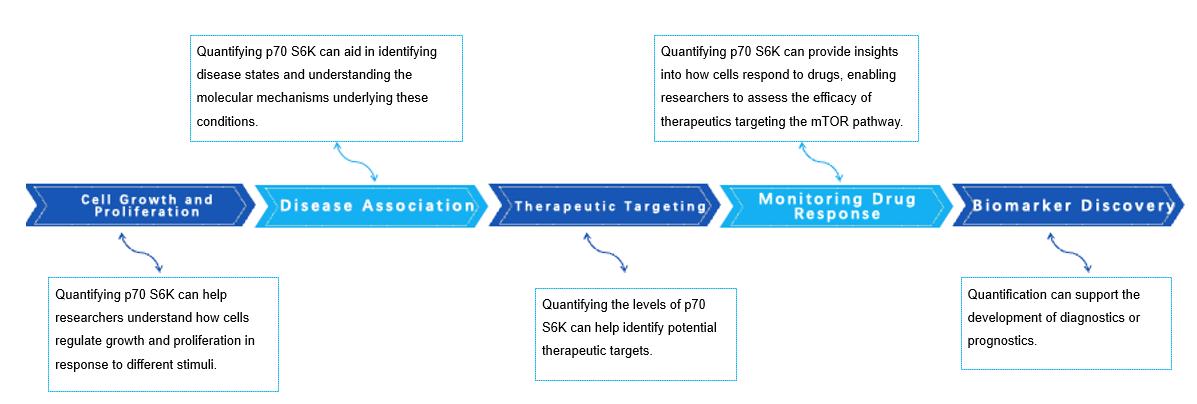
Advantages of p70 S6K Quantification
Frequently Asked Question
Q1: How does p70 S6K activation/deactivation work?
A1:
| p70 S6K Activation | p70 S6K Deactivation |
|---|---|
| p70 S6K is achieved primarily through its activation of nutrient availability, especially amino acids. The activation process begins with the binding of growth factors to their respective receptors, leading to the recruitment and activation of the phosphoinositide 3-kinase (PI3K) pathway. This, in turn, activates the mTORC1, a key regulator of cell growth. Upon mTORC1 activation, p70 S6K is phosphorylated at multiple sites, including Thr389, which enhances its enzymatic activity and promotes downstream signaling pathways involved in protein synthesis and ribosome biogenesis. This cascade ultimately supports cellular functions that contribute to growth, proliferation, and survival, emphasizing the importance of p70 S6K in adaptive responses to changing nutrient environments. | The deactivation of p70 S6K, a key protein kinase involved in cellular growth and metabolism, typically occurs through various regulatory mechanisms that respond to nutrient availability and growth factors. Under conditions of nutrient deprivation or stress, signaling pathways such as the mTOR pathway can be inhibited, leading to a reduction in the phosphorylation activity of p70 S6K. This deactivation can involve negative feedback mechanisms, where the accumulation of certain metabolic intermediates or the activation of specific kinases, such as AMP-activated protein kinase (AMPK), contribute to the downregulation of p70 S6K. Additionally, the phosphorylation of p70 S6K itself can influence its activity, with specific sites being targeted by phosphatases that promote its inactivation. |
Contact Us
Thank you for your interest in our services! At Creative Biolabs, we specialize in advanced P70 S6K quantification, providing accurate and reliable results tailored to your research needs. Our state-of-the-art facilities and expert team ensure that you receive high-quality data for your studies on cell signaling and protein synthesis. Whether you're conducting fundamental research or exploring therapeutic applications, we're here to support your work. For inquiries, service details, or to discuss your specific requirements, please don't hesitate to contact us. We look forward to collaborating with you!
 Download our brochure