Human Colon Cell SW-620-based Proliferation Assay Service
Human Colon Cell SW-620-based Proliferation Assay for Immune-Oncology Field
Colorectal cancer (CRC) remains one of the most prevalent forms of cancer, necessitating advanced research methodologies to combat its proliferation and metastasis. The SW-620 cell line, derived from human colon adenocarcinoma, is instrumental in studying the tumor biology, therapeutic responses, and underlying mechanisms of Colorectal cancer (CRC). SW-620-based proliferation assays are pivotal in immune-oncology research, facilitating the evaluation of various therapeutic agents, including immunotherapies and targeted treatments.
Human Colon Cell SW-620-based Proliferation Assay Services at Creative Biolabs
At Creative Biolabs, we extend our cutting-edge expertise to provide a comprehensive Human Colon Cell SW-620-based proliferation assay. With over 20 years of experience, our approach integrates innovative techniques and extensive scientific knowledge to bolster the immune-oncology field. Creative Biolabs offers state-of-the-art SW-620-based proliferation assay services tailored to meet various research needs. Our services include:
Custom Assay Development: tailored protocols to investigate specific research questions.
High-throughput Screening: large-scale compound screening using SW-620 cells.
Mechanistic Studies: a detailed exploration of cellular responses and pathways.
Proliferation Assay Types Available at Creative Biolabs
At Creative Biolabs, we offer a wide variety of proliferation assay types to meet the different needs of client projects, including but not limited to the following types:
|
|
|
|
|
|
-
Crystal violet viability Assay
|
|
|
Featured Luminescent ATP-based SW-620 Proliferation Assay
The Luminescent ATP-based Assay is a cornerstone of our SW-620 proliferation studies. The experiment leverages the role of ATP in luciferin-catalyzed oxidation of D-luciferin to produce bioluminescence, with the detected light intensity corresponding to intracellular ATP levels, indicating the number of viable, metabolically active cells. Thus, cell proliferation can be analyzed based on luminescence data, such as growth inhibition (GI50), total growth inhibition (TGI), 50% lethal concentration (LC50) values, and other criteria.
Potential Applications
Our SW-620-based proliferation assays are versatile and can be utilized in various fields, including:
-
Drug Development: Identifying potential anticancer compounds.
-
Mechanistic Studies: Exploring cellular pathways and therapeutic targets.
-
Combination Therapies: Evaluating the synergistic effects of drug combinations.
-
Predictive Modeling: Assessing drug resistance and response patterns.
Benefits for You
-
Customized Solutions: We tailor our assays to precisely match your research requirements.
-
High Accuracy: Utilizing luminescent ATP assays ensures highly reliable and sensitive detection of cell viability.
-
Experienced Team: With decades of expertise, our team delivers robust and reproducible data.
Scientific Backing
|
Summary
|
SW-620-based proliferation assay is rooted in comprehensive research. For example, studies have demonstrated digoxin's ability to inhibit CRC cell proliferation and induce cell cycle arrest by significantly reducing the viability of HCT8 and SW620 cells, which highlights the effectiveness of chosen models and assay types.
|
|
Result
|
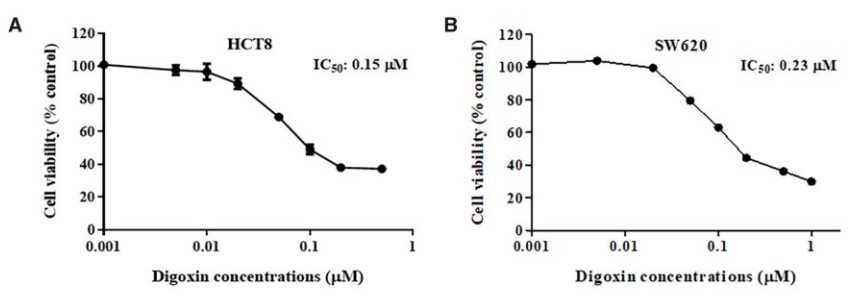
Fig.1. The proliferation inhibitory effect of digoxin on colorectal-cancer cells HCT8 and SW620 detected by MTT assay.1
|
Frequently Asked Questions
Q1: How do SW-620-based assays contribute to drug resistance studies?
A1: These assays enable detailed examination of multidrug resistance mechanisms, such as the ABCB1-mediated efflux in SW620 cells, providing insights into overcoming resistance in CRC therapies.
Q2: Can Creative Biolabs customize proliferation assays for specific research needs?
A2: Absolutely. We develop customized protocols and offer flexible assay designs to address unique research questions and objectives.
At Creative Biolabs, our human colon cell SW-620-based proliferation assays serve as a powerful tool in the fight against colorectal cancer. Our comprehensive approach, employing a variety of assay types, ensures precise, reliable, and actionable data for advancing cancer research and therapeutic development.
Reference
-
Hou, Yong-Qiang, et al. "Multifaceted anti-colorectal tumor effect of digoxin on HCT8 and SW620 cells in vitro." Gastroenterology Report 8.6 (2020): 465-475. Distributed under Open Access License CC BY 4.0, without modification.
For Research Use Only | Not For Clinical Use


 Download our brochure