BackgroundWhat We Can Offer?WorkflowWhy Us?FAQRelated Services
In targeted protein degradation (TPD), heterobifunctional degraders present significant medicinal chemistry and pharmacokinetic challenges. Because these chimeras couple two distinct binding ligands via a central chemical linker, they inherently reside in "beyond Rule of 5" (bRo5) chemical space. High molecular weight (MW > 700-1000Da), elevated polar surface area (PSA > 140-200Å2), and a high count of rotatable bonds often lead to poor cell permeability, erratic solubility, rapid hepatic clearance, and unpredictable bioavailability. At Creative Biolabs, our In Silico ADMET Prediction Service combines physics-based 3D conformational sampling, machine-learning ADME/Tox models, and specialized bRo5 pharmacokinetic algorithms to forecast, diagnose, and optimize Absorption, Distribution, Metabolism, Excretion, and Toxicity profiles specifically tailored for bivalent degrader molecules.
Background of In Silico ADMET Prediction
Classical ADMET prediction platforms trained on traditional small molecules (< 500Da) frequently fail when applied to bivalent degraders. Traditional 2D molecular descriptors underestimate the ability of flexible chimeric molecules to adopt chameleonic intramolecular hydrogen-bonded (IMHB) conformations in apolar membrane environments-a critical mechanism that allows large degraders to cross cell membranes despite high formal polar surface areas.
In vitro ADMET testing for large chimeras is fraught with experimental artifacts such as non-specific vessel binding, low solubility in assay buffers, and ambiguous PAMPA/Caco-2 permeability readouts. In silico ADMET profiling resolves these empirical limitations at the virtual design stage. By evaluating 3D conformational ensembles, dynamic polar surface area shifts (ΔPSA), metabolic cleavage sites, and systemic clearance parameters prior to synthesis, our platform helps chemistry teams select and optimize leads that balance high degradation activity with drug-like pharmacokinetic properties.
Fig.1 The bRo5 chemical space oral bioavailability determinants: molecular and in vitro ADME properties.1
How Creative Biolabs' In Silico ADMET Prediction Service Can Assist Your Project?
Achieving favorable PK/ADMET properties in bRo5 TPD space requires computational tools calibrated specifically for high-MW, flexible molecules. Creative Biolabs delivers a specialized suite of predictive ADMET capabilities:
3D Chameleonicity & Dynamic PSA (ΔPSA) Profiling: Simulating conformational ensembles in explicit aqueous vs. lipophilic environments to evaluate intramolecular hydrogen bonding (IMHB) capacity and predict passive cell membrane permeability.
Solubility & Physicochemical Property Optimization: Physics-based and ML-driven estimation of thermodynamic solubility, lipophilicity (LogP/LogD7.4), ionization (pKa), and rotatable bond distribution across diverse linker and binder combinations.
Metabolic Soft-Spot & Cleavage Site Identification: Atomistic modeling of Cytochrome P450 (CYP) isoforms and phase II metabolic enzymes to map metabolic soft-spots across linkers and terminal ligands, preventing rapid systemic clearance.
Transporter & Plasma Protein Interaction Profiling: Predicting interactions with efflux transporters (P-gp, BCRP) and plasma protein binding (PPB/fraction unbound fu) to estimate net intracellular accumulation and free active drug exposure.
Comprehensive In Silico Safety & Off-Target Liability Screening: Machine-learning classification for hERG potassium channel inhibition, hepatotoxicity risks, mutagenicity (Ames test), and reactive metabolite formation.
Workflow of In Silico ADMET Prediction Service
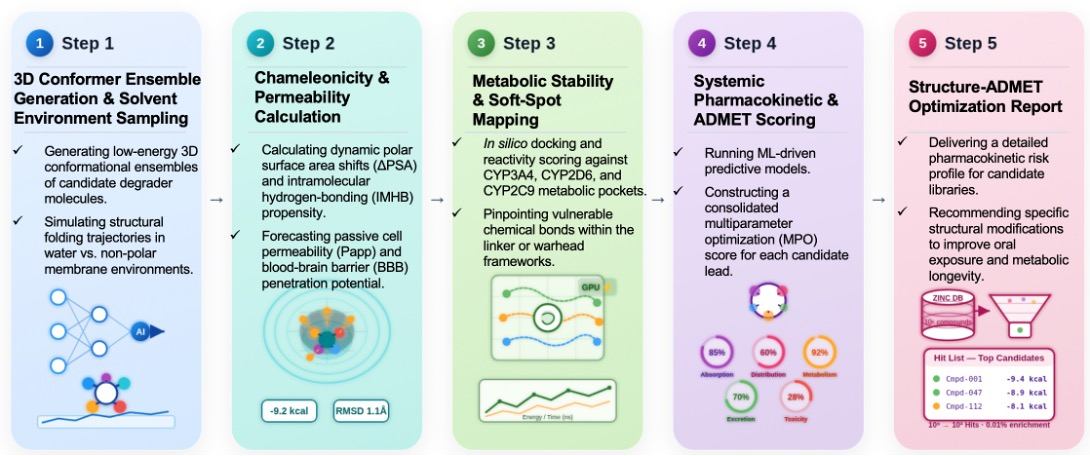
Stage 1
3D Conformer Ensemble Generation & Solvent Environment Sampling
Generating low-energy 3D conformational ensembles of candidate degrader molecules.
Simulating structural folding trajectories in water vs. non-polar membrane environments.
Stage 2
Chameleonicity & Permeability Calculation
Calculating dynamic polar surface area shifts (ΔPSA) and intramolecular hydrogen-bonding (IMHB) propensity.
In silico docking and reactivity scoring against CYP3A4, CYP2D6, and CYP2C9 metabolic pockets.
Pinpointing vulnerable chemical bonds within the linker or warhead frameworks to guide structural stabilization.
Stage 4
Systemic Pharmacokinetic & ADMET Scoring
Running ML-driven predictive models for solubility, P-gp efflux substrate likelihood, clearance (CL), and hERG toxicity.
Constructing a consolidated multiparameter optimization (MPO) score for each candidate lead.
Stage 5
Structure-ADMET Optimization Report
Delivering a detailed pharmacokinetic risk profile for candidate libraries.
Recommending specific structural modifications (e.g., linker rigidification, fluorination, ester-to-amide replacements) to improve oral exposure and metabolic longevity.
Advantages of Our Services
At Creative Biolabs, our computational ADMET suite offers a specialized platform designed to overcome the distinct pharmacokinetic obstacles of bRo5 degradation chemistry. By coupling physics-based 3D conformational sampling with machine-learning safety analytics, we enable clients to engineer cell-permeable, metabolically stable degrader candidates with high confidence.
Tailored Specifically for bRo5 Degrader Space
Moves beyond classical Rule of 5 metrics to evaluate 3D chameleonicity, dynamic PSA, and flexible molecular architectures.
Integrated 3D Conformational Physics
Incorporates solvent-dependent molecular dynamics to capture real-world membrane translocation mechanisms.
Metabolic Soft-Spot Precision
Combines reactivity calculations and P450 docking to extend systemic half-life through rational linker modification.
Rapid Turnaround & High Capacity
Screens hundreds of virtual degrader variations within 2-3 weeks, accelerating lead optimization.
Direct CRO Workflow Integration
Computational ADMET predictions connect seamlessly with Creative Biolabs' downstream custom synthesis, in vitro ADME assays (PAMPA, Caco-2, microsomes), and in vivo PK profiling.
Frequently Asked Questions
Q1: Why do standard Rule of 5 (Ro5) ADMET prediction tools fail for heterobifunctional degraders?
A1: Standard Ro5 tools rely on 2D chemical descriptors that penalize high molecular weight and high polar surface area. Degraders frequently operate outside traditional space, achieving permeability by adopting compact, 3D folded conformations with internal hydrogen bonds when entering lipid membranes. Our service models this 3D chameleonic behavior explicitly.
Q2: How does your platform predict cell permeability for large, flexible molecules?
A2: We generate low-energy 3D conformational ensembles in both polar (aqueous) and non-polar (lipid-like) virtual environments. By measuring the change in exposed polar surface area (ΔPSA) and the formation of intramolecular hydrogen bonds (IMHB), we calculate a dynamic permeability score that correlates with cellular uptake.
Q3: Can in silico ADMET modeling help improve the metabolic stability of unstable linkers?
A3: Yes. Our pipeline identifies metabolic "soft-spots"-such as ester cleavage, oxidative dealkylation, or benzylic oxidation sites-along the linker and terminal binders. We then recommend targeted chemical modifications (e.g., introducing steric hindrance, replacing flexible alkyl chains with rigid heterocycles, or bioisosteric replacement) to increase metabolic stability.
Q4: What structural data is needed to initiate an in silico ADMET prediction project?
A4: Only the 2D or 3D chemical structures (SMILES, SDF, or PDB format) of your candidate degraders are required. If target or E3 co-crystal data is available, we can also factor binding pose constraints into structural sampling.
Q5: What downstream experimental services can Creative Biolabs provide to validate predicted ADMET profiles?
A5: Creative Biolabs offers a full suite of wet-lab validation services. Predictions can be experimentally confirmed via custom compound synthesis, in vitro PAMPA/Caco-2 permeability assays, liver microsomal stability testing, plasma protein binding assays, hERG patch-clamp testing, and in vivo rodent PK profiling.
Overcoming the pharmacokinetic liabilities inherent to bivalent degradation chemistry requires looking beyond 2D chemical descriptors into the dynamic 3D conformational mechanics of your candidate molecules. Creative Biolabs' computational ADMET suite provides the structural clarity and predictive precision needed to engineer cell-permeable, metabolically durable degrader leads-ensuring your pipeline advances toward clinical success with minimal risk. Please do not hesitate to contact us for more details.
Contact Our Team for More Information and to Discuss Your Project →
Reference
Jiménez, Diego García, et al. "Molecular properties, including chameleonicity, as essential tools for designing the next generation of oral beyond rule of five drugs." ADMET and DMPK 12.5 (2024): 721-736. Distributed under Open Access license CC BY 4.0, without modification. https://doi.org/10.5599/admet.2334


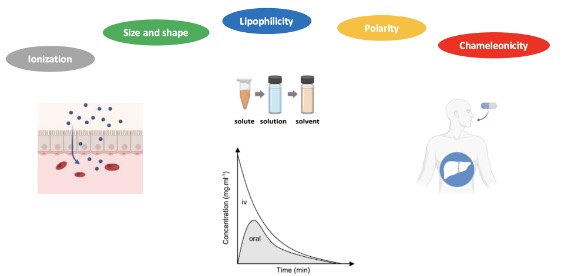 Fig.1 The bRo5 chemical space oral bioavailability determinants: molecular and in vitro ADME properties.1