BackgroundWhat We Can Offer?WorkflowWhy Us?FAQRelated Services
In targeted protein degradation (TPD), moving beyond traditional binary target occupancy introduces novel safety and toxicity challenges. Off-target proteome degradation, hook-effect-induced systemic imbalances, unwanted isoform knockdown, and E3-ligase-mediated collateral degradation can arrest promising degrader candidates late in development. At Creative Biolabs, our In Silico Toxicity Prediction Service deploys high-throughput structural bioinformatics, machine-learning toxicity profiling, and atomistic ternary complex simulations to forecast, screen, and mitigate off-target liabilities and systemic toxicity risks early in the drug discovery process.
Background of In Silico Toxicity Prediction for Heterobifunctional Degraders
Toxicity profiling for heterobifunctional degraders differs fundamentally from classical small-molecule safety screening. Because a degrader acts catalytically, even weak, transient off-target interactions can trigger catastrophic degradation of non-target proteins if the resulting pseudo-ternary complex (Off-Target Protein-Degrader-E3 Ligase) achieves stable interface packing and favorable spatial geometry.
Evaluating toxicity solely through post-synthesis wet-lab proteomics (e.g., dTAG, TMT mass spectrometry) or animal models is time-consuming and expensive. In silico toxicity prediction intercepts toxicological liabilities at the blueprint stage. By cross-screening candidate degraders against proteome-wide structural databases and modeling pseudo-ternary complex stability, our platform identifies structural alerts, off-target degradation risks, and liability vectors before chemical synthesis begins.
How Creative Biolabs' In Silico Toxicity Prediction Service Can Assist Your Project?
Navigating off-target proteolysis and metabolic liabilities requires multi-layered computational evaluation. Creative Biolabs combines structural modeling with predictive safety analytics:
Proteome-Wide Pseudo-Ternary Off-Target Screening: Cross-docking candidate degraders and E3 complexes against structural proteome databases (e.g., AlphaFold DB, PDB) to detect unintended off-target ternary assemblies that could drive unwanted protein degradation.
Selectivity & Isoform Knockdown Discrimination: Evaluating structural homology across protein kinase families, paralogs, and closely related isoforms to engineer target-exclusive degradation profiles and prevent collateral toxicity.
E3 Ligase Auto-Degradation & Collateral Ubiquitination Profiling: Simulating E3-degrader-E3 self-assembly trajectories to predict autologous E3 destruction or non-specific bystander ubiquitination.
Machine Learning ADMET & Structural Alert Filters: Screening chimeric structures against predictive models for hERG inhibition, hepatotoxicity, mutagenicity, cytochrome P450 inhibition, and reactive metabolite formation.
Hook-Effect & Accumulation Modeling: Quantitative systems pharmacology (QSP) and kinetic simulations predicting dose-dependent intracellular accumulation, high-dose hook effect liabilities, and cell-membrane disruption risk.
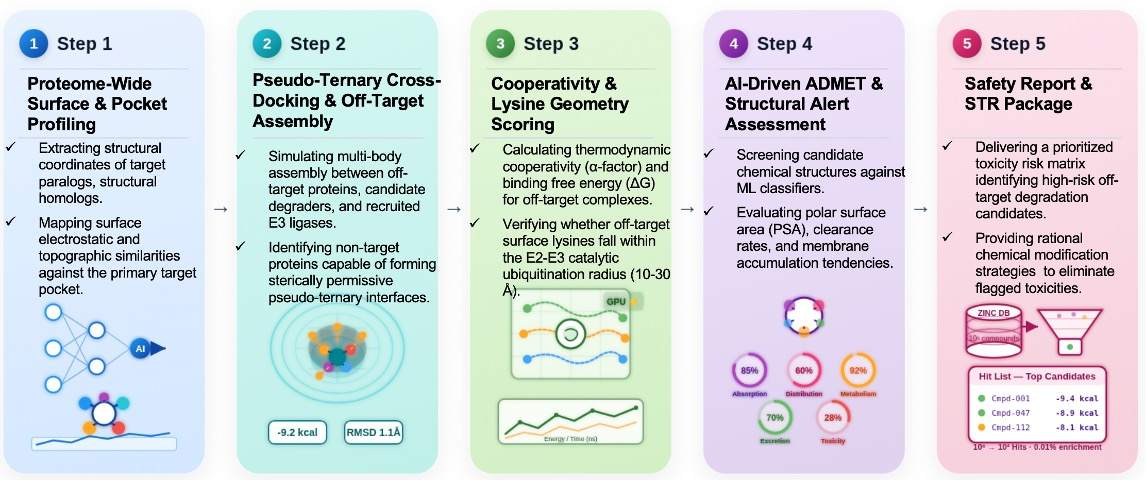
Workflow of In Silico Toxicity Prediction Service
Stage 1
Proteome-Wide Surface & Pocket Profiling
Extracting structural coordinates of target paralogs, structural homologs, and off-target candidate panels.
Mapping surface electrostatic and topographic similarities against the primary target pocket.
Providing rational chemical modification strategies (linker tuning, warhead alteration) to eliminate flagged toxicities.
Advantages of Our Services
At Creative Biolabs, our computational toxicity framework provides a specialized safety portal designed to address the unique off-target physics of event-driven degraders. By combining proteome-scale multi-body docking, machine-learning ADMET analytics, and structural mechanics, we help research teams de-risk their pipelines well before entering pre-clinical animal studies.
Leverages expansive structural databases to screen candidate molecules against thousands of human proteins simultaneously.
Early-Stage Risk De-Risking
Eliminates toxic or promiscuous leads at the virtual stage, saving millions in synthesis and wet-lab proteomics costs.
Actionable Structural Guidance
Recommends specific chemical modifications-such as exit vector shifts or linker geometry changes-to clear identified safety red flags.
Integrated CRO Pipeline Connection
Computational safety predictions easily link with Creative Biolabs' wet-lab proteomic profiling (TMT/MS), SPR binding assays, and in vitro cytotoxicity testing.
Frequently Asked Questions
Q1: Why is traditional small-molecule toxicity prediction insufficient for targeted protein degraders?
A1: Traditional toxicity models assess binary binding affinity and enzyme inhibition. Degraders operate catalytically through three-body assemblies; an off-target protein with weak binary binder affinity can still be rapidly degraded if the pseudo-ternary complex forms a favorable protein-protein interaction interface. Our service explicitly models these multi-body interactions.
Q2: How does your platform predict off-target degradation across the human proteome?
A2: We combine surface-homology mapping with automated multi-body docking. Candidate degraders are cross-docked against structural databases of human proteins in complex with E3 ligases. Complexes that exhibit positive thermodynamic cooperativity (α > 1) and position off-target lysines within the ubiquitination radius are flagged for potential toxicity.
Q3: Can in silico toxicity modeling help design isoform-selective degraders?
A3: Yes. By comparing high-resolution 3D models of closely related protein isoforms, our algorithms identify subtle steric differences or electrostatic variations at the ternary interface. We then recommend linker length or warhead modifications that destabilize pseudo-ternary complexes with unwanted isoforms while preserving target complex stability.
Q4: How does the platform evaluate E3 ligase auto-degradation?
A4: We model homodimeric or self-recruiting ternary configurations where a degrader molecule mediates E3-degrader-E3 self-assembly. By scoring the geometry and lysine exposure of these self-complexes, we predict whether a candidate molecule will cause unwanted depletion of the E3 ligase itself.
Q5: What downstream validation services can Creative Biolabs provide following toxicity predictions?
A5: Creative Biolabs offers an end-to-end CRO platform. Following computational prediction, we can perform custom synthesis of optimized candidates, followed by quantitative proteomics (TMT mass spectrometry), cell viability assays, hERG channel testing, and Western blot target degradation profiling.
Creative Biolabs' computational safety suite equips your R&D program with early, proteome-wide toxicity foresight-enabling your team to bypass off-target liabilities, preserve therapeutic windows, and confidently select leads destined for clinical success. Please do not hesitate to contact us for more details.
Contact Our Team for More Information and to Discuss Your Project →
Reference
Montisci, Fabio, et al. "Data-driven generation of conformational ensembles and ternary complexes for PROTAC and other chimera systems." Journal of Chemical Information and Modeling 65.18 (2025): 9541. Distributed under Open Access license CC BY 4.0, without modification. https://doi.org/10.1021/acs.jcim.5c00880