In Silico Binary Structure Prediction & Evaluation Service
BackgroundWhat We Can Offer?WorkflowWhy Us?FAQRelated Services
Before embarking on complex three-body assembly or chemical conjugation, a targeted protein degradation (TPD) campaign hinges on a solid structural foundation: understanding how candidate binders engage their target or E3 ligase individually. High-resolution structural insights into these binary interactions (Protein-Ligand) serve as the essential prerequisite for mapping exit vectors, assessing binding pocket dynamics, and avoiding non-productive steric configurations downstream. At Creative Biolabs, our In Silico Binary Structure Prediction & Evaluation Service integrates cutting-edge AI structural prediction, dynamic binding pocket profiling, and atomistic force-field scoring to resolve, refine, and validate binary target and E3 ligand complex geometries with exceptional fidelity.
Background of In Silico Binary Structure Prediction & Evaluation
In heterobifunctional molecule discovery, binary interaction modeling is far more than routine docking. While traditional inhibitor pipelines focus solely on active-site occupancy, binary evaluation for degraders must establish whether a ligand's binding pose accommodates chemical modifications without disrupting target engagement. It provides the initial structural baseline needed to calculate binding free energies (ΔG), characterize binding site plasticity, and identify solvent-oriented exit vectors required for linker attachment.
A major bottleneck in early TPD pipelines is the lack of empirical X-ray crystallography or Cryo-EM structures-especially when targeting non-enzymatic proteins, transcription factors, or novel E3 ligases. In silico binary prediction bridges this gap by generating high-confidence, dynamic structural ensembles prior to wet-lab biophysical testing. By combining deep-learning structural predictors with explicit-solvent molecular dynamics (MD), our workflows resolve transient binding poses, map cryptic surface pockets, and evaluate conformational stability across diverse target families.
Fig.1 DeepTernary is an SE(3)-equivalent graph neural network equipped with attention blocks to facilitate efficient information exchange.1
How Creative Biolabs' In Silico Binary Structure Prediction & Evaluation Service Can Assist Your Project?
A successful binary modeling strategy must balance static structural prediction with dynamic biophysical evaluation. Creative Biolabs provides a comprehensive suite of computational tools to characterize target-binder and E3-binder complexes:
AI-Assisted Structural Modeling & Complex Generation: Utilizing state-of-the-art deep learning architectures (e.g., AlphaFold3, ESMFold) and consensus docking algorithms to construct high-accuracy 3D models for targets, mutated variants, and uncharacterized E3 ligases.
Binding Site & Cryptic Pocket Mapping: Identifying traditional active clefts, allosteric sites, and transient surface grooves using enhanced sampling molecular dynamics to expand the druggable boundary of challenging targets.
Solvent-Exposed Exit Vector Profiling: Algorithmic calculation of solvent-accessible surface area (SASA) and trajectory orientation on bound ligands to determine optimal, sterically unhindered attachment points for linker conjugation.
Thermodynamic & Affinity Scoring: Applying MM/PBSA and MM/GBSA end-state free energy calculations to rank candidate binders by calculated binding affinity (ΔG) and structural stability.
Workflow of In Silico Binary Structure Prediction & Evaluation Service
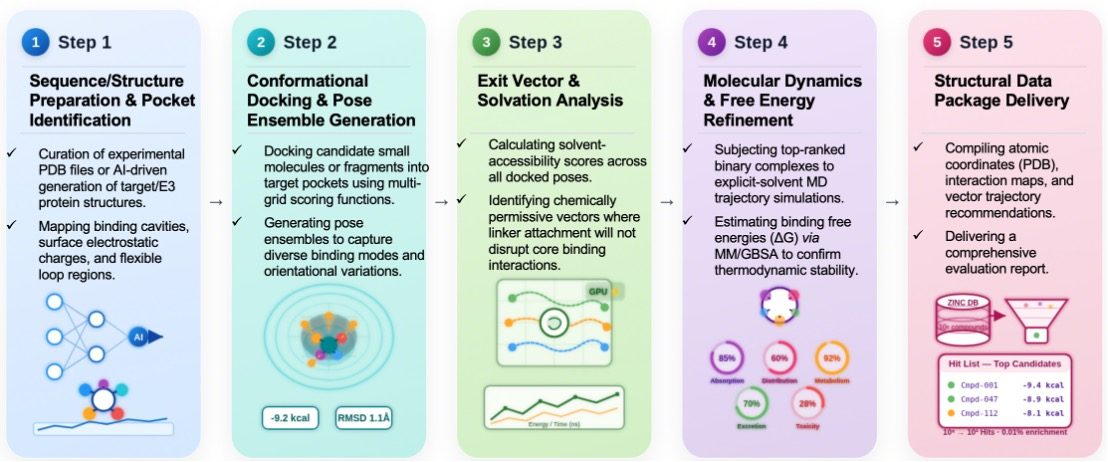
Curation of experimental PDB files or AI-driven generation of target/E3 protein structures.
Mapping binding cavities, surface electrostatic charges, and flexible loop regions.
Stage 2
Conformational Docking & Pose Ensemble Generation
Docking candidate small molecules or fragments into target pockets using multi-grid scoring functions.
Generating pose ensembles to capture diverse binding modes and orientational variations.
Stage 3
Exit Vector & Solvation Analysis
Calculating solvent-accessibility scores across all docked poses.
Identifying chemically permissive vectors where linker attachment will not disrupt core binding interactions.
Stage 4
Molecular Dynamics & Free Energy Refinement
Subjecting top-ranked binary complexes to explicit-solvent MD trajectory simulations.
Estimating binding free energies (ΔG) via MM/GBSA to confirm thermodynamic stability.
Stage 5
Structural Data Package Delivery
Compiling atomic coordinates (PDB), interaction maps, and vector trajectory recommendations.
Delivering a comprehensive evaluation report to guide downstream linker conjugation and ternary modeling.
Advantages of Our Services
At Creative Biolabs, our computational drug discovery suite provides a sophisticated, data-driven framework designed to establish reliable binary structural foundations for targeted degradation programs. By combining deep-learning structural prediction with atomistic molecular simulations, we help research teams de-risk early binder selection and establish precise vector geometries before committing to chemical synthesis.
High-Precision AI & Physics Hybrid Modeling
Fuses deep-learning structural prediction algorithms with rigorous force-field molecular dynamics for uncompromised structural accuracy.
Unlocking "Undruggable" Targets
Specialized in resolving transient pockets, surface grooves, and allosteric sites on non-enzymatic proteins and novel E3 ligases.
Focus on Vector Permissibility
Tailored specifically for degradation chemistry by evaluating binding poses through the lens of solvent accessibility and linkability.
Rapid Project Execution
Delivers fully validated, energy-minimized binary structures and vector reports within 2-3 weeks.
Integrated Downstream Compatibility
Binary outputs seamlessly feed into Creative Biolabs' ternary complex modeling, custom organic synthesis, and biophysical assay platforms (SPR, BLI, ITC).
Frequently Asked Questions
Q1: Why is binary structure evaluation necessary before moving to ternary complex modeling?
A1: Accurate ternary complex modeling relies entirely on correct starting poses for the individual binders. Evaluating binary structures first ensures that candidate ligands bind stably to their respective targets and present accessible, unhindered exit vectors for linker attachment before simulating complex three-body assemblies.
Q2: Can your platform predict binary structures for targets without published crystal or Cryo-EM data?
A2: Yes. We combine state-of-the-art AI protein structure prediction tools (e.g., AlphaFold3, ESMFold) with enhanced sampling molecular dynamics to generate dynamic 3D structural models of uncharacterized targets, mutated variants, and novel E3 ligases.
Q3: How does binary evaluation identify optimal exit vectors for linker conjugation?
A3: Our trajectory algorithms analyze the solvent-accessible surface area (SASA) of every atom in the docked ligand pose. Chemical positions that point toward open solvent without disrupting key protein-ligand hydrogen bonds or hydrophobic contacts are flagged as optimal exit vectors.
Q4: What types of ligand molecules can be evaluated in your binary prediction pipeline?
A4: Our computational platform handles a broad range of chemical entities, including traditional small molecules, fragment hits, peptidomimetics, macrocycles, and covalent binders.
Q5: What downstream services can Creative Biolabs provide once binary structures are validated?
A5: Creative Biolabs provides a complete continuum of CRO services. Validated binary structures can immediately transition into our in silico ternary complex modeling and linker design workflows, followed by custom chemical synthesis and biophysical interaction testing (SPR, ITC, BLI).
Build a flawless structural foundation for your targeted degradation campaign. Partnering with Creative Biolabs grants you direct access to cutting-edge AI structural prediction, dynamic binding pocket analysis, and a team of computational structural biologists dedicated to resolving your binary complex geometries. Contact our computational discovery experts today to request a customized project proposal tailored to your program goals.
Contact Our Team for More Information and to Discuss Your Project →
Reference
SE (3)-equivariant ternary complex prediction towards target protein degradation." Nature communications 16.1 (2025): 5514.Distributed under Open Access license CC BY 4.0, without modification. https://doi.org/10.1038/s41467-025-61272-5


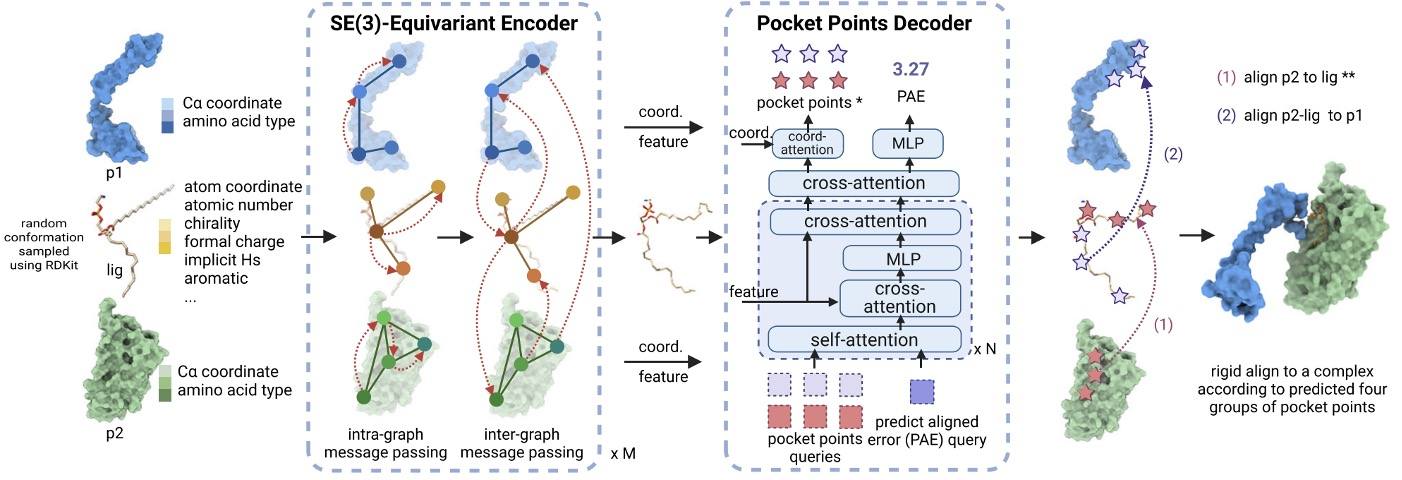 Fig.1 DeepTernary is an SE(3)-equivalent graph neural network equipped with attention blocks to facilitate efficient information exchange.1