BackgroundWhat We Can Offer?WorkflowWhy Us?FAQRelated Services
In the architecture of a heterobifunctional degrader, the chemical connector-the Linker-is far more than a passive, inert spacer. It serves as the critical structural director that dictates the spatial geometry, conformational flexibility, and biophysical alignment between the target protein and the E3 ubiquitin ligase core. At Creative Biolabs, our In Silico Linker Screening Service applies state-of-the-art computational chemistry, conformational sampling, and multi-body molecular dynamics to rapidly design, screen, and optimize bespoke linkers engineered for maximal degradation kinetics.
Background of In Silico Linker Screening
In heterobifunctional degraders, the Linker is the chemical bridge covalently joining the Target Ligand and E3 Recruiter. Rather than an inert spacer, it acts as the primary structural director-dictating spatial spacing, shaping inter-protein contact interfaces to drive positive cooperativity (α > 1), and orienting target lysines toward the catalytic E2-ubiquitin site within a 10-30Å functional radius. A suboptimal linker-whether too short (inducing steric clashes) or too long and flexible (incurring entropic penalties and exacerbating the autoinhibitory "hook effect")-can completely eliminate degradation potency (DC50).
Empirical trial-and-error synthesis across millions of potential linker length, composition, and rigidity combinations is prohibitively slow and expensive. In silico computational screening solves this bottleneck by modeling multi-body ternary dynamics prior to wet-lab synthesis. Using advanced docking, conformer sampling, and molecular dynamics (MD), computational workflows predict ternary stability, evaluate cooperativity (α-factor), and optimize spatial geometry for maximum degradation kinetics. Concurrently, virtual filters balance molecular weight, polar surface area (PSA), and cell permeability-compressing lead optimization from months to weeks while dramatically cutting R&D costs.
Fig.1 The workflow comprises two main modules: "Linker design" and "Linker evaluation".1
How Creative Biolabs' In Silico Linker Screening Service Can Assist Your Project?
Navigating the vast chemical search space of linker lengths, flexibilities, and compositions presents a major bottleneck in targeted degradation workflows. At Creative Biolabs, our dedicated computational platform overcomes this challenge by combining structure-based modeling, automated conformer generation, and machine-learning scoring functions into a streamlined in silico pipeline. By simulating ternary complex thermodynamics and dynamic conformational ensembles before committing to wet-lab chemistry, we eliminate non-viable linker candidates early, optimize degradation potency, and de-risk your lead optimization efforts. Partnering with Creative Biolabs allows research teams to harness world-class computational modeling to transform binary binders into highly potent, drug-like chimeric degraders.
Virtual Linker Library Construction & Docking: Automated generation and conformational screening of diverse linker motifs (aliphatic, polyethylene glycol [PEG], rigid aromatic/heterocyclic, and cleavable geometries).
Ternary Complex Docking & Interface Profiling: Full-assembly structural modeling (Target-Linker-E3) to evaluate interface packing, steric clash risk, and thermodynamic stability.
Conformational Entropy & Energy Landscape Mapping: Physics-based evaluation of linker flexibility to balance conformational restriction against entropic loss upon target-ligase binding.
Ubiquitination Trajectory & Distance Profiling: Dynamic spatial mapping to ensure candidate linkers maintain surface-exposed target lysines within the optimal catalytic radius of the E3 machinery.
In Silico ADMET & Property Optimization: Multi-objective filtering for polar surface area, hydrogen bond donors/acceptors, and synthetic accessibility scores (SAscore) to deliver cell-permeable leads.
Workflow of In Silico Linker Screening Service
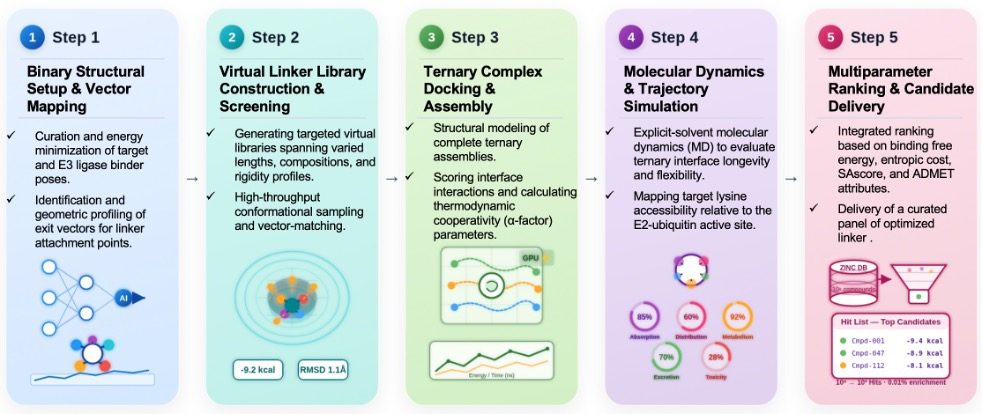
Stage 1
Binary Structural Setup & Vector Mapping
Curation and energy minimization of target and E3 ligase binder poses.
Identification and geometric profiling of exit vectors for linker attachment points.
High-throughput conformational sampling and vector-matching against binary binding geometries.
Stage 3
Ternary Complex Docking & Assembly
Structural modeling of complete ternary assemblies using physics-based force fields and ensemble docking.
Scoring interface interactions and calculating thermodynamic cooperativity (α-factor) parameters.
Stage 4
Molecular Dynamics & Trajectory Simulation
Explicit-solvent molecular dynamics (MD) to evaluate ternary interface longevity and flexibility.
Mapping target lysine accessibility relative to the E2-ubiquitin active site.
Stage 5
Multiparameter Ranking & Candidate Delivery
Integrated ranking based on binding free energy, entropic cost, SAscore, and ADMET attributes.
Delivery of a curated panel of optimized linker designs ready for custom chemical synthesis.
Advantages of Our Services
At Creative Biolabs, our computational screening framework is tailored specifically to address the complex spatial and thermodynamic demands of bivalent degraders. By replacing traditional, iterative chemistry trials with predictive structural modeling, we empower clients to identify optimal linker architectures with speed and precision.
Specialized for Chimeric Degradation Mechanics
Unlike standard docking platforms, our algorithms specifically model multi-body dynamics, thermodynamic cooperativity, and conformational entropy.
Streamlined Development Timelines
Screening thousands of linker variations computationally accelerates lead optimization cycles from months to a few weeks.
Broad Chemical Library Diversity
Virtual screening spans rigid, semi-rigid, flexible, and bio-cleavable linker compositions to discover unique structural solutions.
Balancing Potency & Permeability
Multiparameter scoring ensures recommended linkers enhance degradation kinetics without compromising cell permeability or solubility.
Integrated End-to-End CRO Services
Computational predictions seamlessly connect with Creative Biolabs' downstream custom chemical synthesis, biophysical interaction assays (SPR, ITC), and cellular degradation testing.
Frequently Asked Questions
Q1: Why is computational linker screening preferred over traditional synthetic iteration?
A1: Traditional linker optimization requires synthesizing dozens of individual degrader analogues to empirically vary length and composition. Computational screening evaluates thousands of linker variations in silico, modeling ternary stability, spatial orientation, and entropic costs beforehand-drastically cutting synthetic costs and project timelines.
Q2: How does your platform determine the optimal linker length for a specific target-E3 pair?
A2: We perform vector-matching and ensemble docking to calculate the end-to-end distance between binder attachment points. By simulating the full ternary complex, our platform identifies the minimum linker length that avoids steric clashes between the two proteins while avoiding excess length that leads to entropic penalties.
Q3: Can your in silico workflow handle rigid or non-traditional linker compositions?
A3: Yes. Our virtual library includes rigid spanners (such as piperazines, alkynes, and bicyclic rings) alongside conventional alkyl and PEG chains. Rigid linkers can lock the degrader into a productive conformation, boosting thermodynamic cooperativity and improving cellular permeability.
Q4: How does linker design influence the "hook effect" in targeted degradation?
A4: The hook effect (autoinhibition at high compound concentrations) occurs when binary complexes outcompete ternary complex formation. Linkers that induce strong positive cooperativity (α > 1) stabilize the ternary complex, widening the therapeutic window and mitigating the hook effect-a property our platform models computationally.
Q5: What downstream services are available once optimal linkers are predicted?
A5: Creative Biolabs offers fully integrated CRO support, including custom organic synthesis of the designed linkers and complete degrader molecules, biophysical characterization (SPR, BLI, ITC), cellular degradation assays (Western blot), and ternary complex structural analysis.
Transform your lead optimization pipeline with data-driven computational precision. By partnering with Creative Biolabs, you gain direct access to advanced in silico modeling, dynamic ternary simulations, and an expert team of computational chemists focused on engineering high-performance linkers tailored to your specific degradation targets. Contact us today for a confidential consultation and a tailored project proposal designed for your program.
Contact Our Team for More Information and to Discuss Your Project →
Reference
Murakami, Yuki, et al. "Data-Driven Design of PROTAC Linkers to Improve PROTAC Cell Membrane Permeability." JACS Au 6.2 (2026): 1400. Distributed under Open Access license CC BY 4.0, without modification. https://doi.org/10.1021/jacsau.6c00033


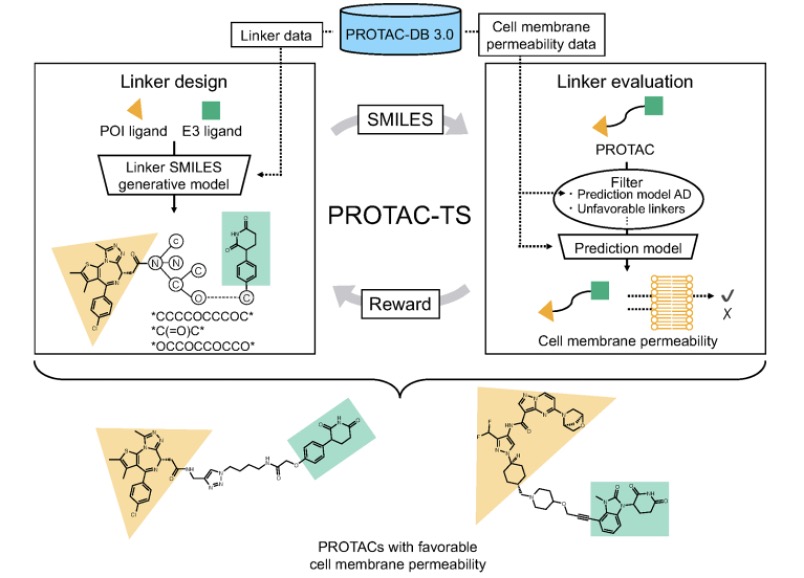 Fig.1 The workflow comprises two main modules: "Linker design" and "Linker evaluation".1