BackgroundWhat We Can Offer?WorkflowWhy Us?FAQRelated Services
In heterobifunctional degrader engineering, the bridging chemistry-the Linker-acts as the master orchestrator of therapeutic activity. Even when paired with highly potent terminal binders, a poorly matched bridge can entirely eliminate cellular clearance by inducing steric strain, disrupting protein-protein orientation, or destabilizing the degradative assembly.
At Creative Biolabs, our In Silico Linker Design & Optimization Service leverages structural bioinformatics, rigid-body docking, and molecular dynamics to computationally craft, screen, and refine linker architectures tailored for peak degradation kinetics.
Background of In Silico Linker Design & Optimization
The linker serves as the physical tether uniting the target binder and E3 ligase recruiter. Beyond simple connectivity, it governs spatial geometry, dictates inter-protein contact landscapes to drive positive cooperativity (α > 1), and positions target lysines within the 10-30A ubiquitination radius of the E2-conjugating enzyme. Suboptimal bridge length or elasticity-whether overly constrained (inducing steric collisions) or hyper-flexible (causing severe entropic loss and exacerbating hook-effect autoinhibition)-directly undermines degradation potency (DC50).
Exploring the vast combinatorial space of length, composition (e.g., aliphatic chains, PEG units, rigid heterocycles), and exit-vector geometry via physical synthesis is inherently slow and resource-intensive. In silico linker optimization eliminates wet-lab trial-and-error by simulating multi-body ternary assemblies prior to chemical synthesis. By combining conformational sampling with free-energy profiling (ΔG), our workflows evaluate structural flexibility, predict interface stability, and balance physicochemical attributes (MW, PSA, LogP) to deliver cell-permeable leads in weeks rather than months.
Fig.1 Scheme of the pipeline for linker optimization.1
How Creative Biolabs' In Silico Linker Design & Optimization Service Can Assist Your Project?
Designing high-performing chemical bridges requires balancing structural mechanics with drug-like properties. Whether starting from scratch with raw computational screens or enhancing existing lead molecules, Creative Biolabs provides flexible, end-to-end computational strategies to de-risk chimeric lead optimization:
De Novo Linker Discovery & De Novo Screening: Rapidly generation and screening of thousands of novel virtual linker motifs-spanning flexible aliphatic chains, PEG variants, semi-rigid spanners, and rigid heterocycles-matched precisely to your specific target-E3 spatial coordinates.
Optimization of Customer-Provided Linkers & Lead Chimeras: Have an existing degrader lead with sub-optimal potency, poor cell permeability, or a narrow therapeutic window? We perform deep-dive structural profiling on client-provided molecules to identify steric friction, entropic liabilities, or unfavorable exit vectors, systematically mutating and refining the bridge to boost DC50 and oral bio-availability.
Rigidity Tuning & Conformational Space Sampling: Evaluating structural ensembles to strategically introduce rigidifying elements (e.g., piperazines, alkynes, macrocycles) that freeze the degrader into its bioactive conformation, reducing entropic penalty upon binding and mitigating autoinhibitory hook effects.
Ternary Geometry & Interface Profiling: Simulating complete three-body topologies (Target-Linker-E3) to identify geometries that foster favorable inter-protein contacts, eliminate steric clashes, and drive positive thermodynamic cooperativity (α > 1).
Ubiquitination Trajectory & Lysine Radius Mapping: Modeling spatial orientation to confirm surface-exposed target lysines remain accessible to the E3-E2 ubiquitin-transfer domain within an optimal 10-30Å window.
Physicochemical & Druggability Filtering: Simultaneous multi-objective screening against molecular weight, polar surface area (PSA), hydrogen-bond donor counts, lipophilicity (LogP), and synthetic accessibility scores (SAscore) to deliver synthetically tractable, cell-permeable candidates.
Workflow of In Silico Linker Design & Optimization Service
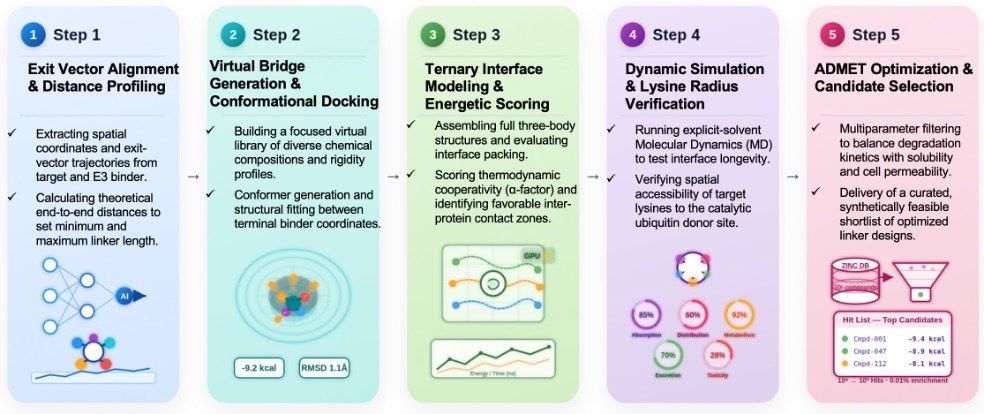
Stage 1
Exit Vector Alignment & Distance Profiling
Extracting spatial coordinates and exit-vector trajectories from target and E3 binder structures.
Calculating theoretical end-to-end distances to set minimum and maximum linker length parameters.
Building a focused virtual library of diverse chemical compositions and rigidity profiles (or ingesting client linker structures).
Conformer generation and structural fitting between terminal binder coordinates.
Stage 3
Ternary Interface Modeling & Energetic Scoring
Assembling full three-body structures and evaluating interface packing.
Scoring thermodynamic cooperativity (α-factor) and identifying favorable inter-protein contact zones.
Stage 4
Dynamic Simulation & Lysine Radius Verification
Running explicit-solvent Molecular Dynamics (MD) to test interface longevity.
Verifying spatial accessibility of target lysines to the catalytic ubiquitin donor site.
Stage 5
ADMET Optimization & Candidate Selection
Multiparameter filtering to balance degradation kinetics with solubility and cell permeability.
Delivery of a curated, synthetically feasible shortlist of optimized linker designs.
Advantages of Our Services
At Creative Biolabs, our computational drug discovery suite offers an advanced, physics-driven framework engineered specifically to solve the complex conformational and thermodynamic challenges of bivalent degrader design. By transitioning from traditional trial-and-error chemistry to predictive three-body simulation, we empower research teams to rapidly identify, refine, and deliver high-performance chemical bridges that maximize degradation kinetics while maintaining drug-like properties.
Engineered for Multi-Body Mechanics
Algorithms built specifically to model complex ternary thermodynamics, entropic penalties, and spatial geometry.
Flexible Engagement Models
Seamlessly handles de novo virtual screening from scratch as well as computational troubleshooting/optimization of client-supplied degrader leads.
Dramatically Shorter R&D Cycles
Rapidly evaluates thousands of virtual bridge configurations, cutting optimization timelines from months to weeks.
Diverse Chemical Motif Options
Screens flexible, rigid, and spirocyclic linkers to resolve specific spatial or permeability bottlenecks.
Holistic Property Balancing
Optimizes degradation potency alongside cell permeability, lipophilicity, and synthetic feasibility.
End-to-End CRO Integration
Computational outputs transition directly into Creative Biolabs' custom organic synthesis and biophysical testing services.
Frequently Asked Questions
Q1: Can Creative Biolabs optimize linkers for degrader molecules that we have already synthesized and tested in-house?
A1: Absolutely. We regularly work with client-provided lead molecules. If your current degrader exhibits sub-optimal degradation potency (DC50), low cell permeability, or steric liabilities, our team can model your exact compound within the ternary complex, pinpoint structural bottlenecks, and computationally propose modified linker variants with improved spatial geometry and drug-like properties.
Q2: How does computational linker design accelerate lead optimization compared to standard synthesis?
A2: Empirical optimization requires synthesizing and testing dozens of discrete chimeric molecules to vary length and composition. Computational design screens thousands of virtual variations in silico-predicting ternary stability, spatial alignment, and entropic costs beforehand-drastically reducing wet-lab chemistry cycles.
Q3: How do you determine whether a rigid or flexible linker is better for a specific target-E3 pair?
A3: Our platform simulates both flexible (e.g., PEG, alkyl) and rigidified (e.g., piperazine, alkyne) motifs within the ternary complex. Flexible linkers adapt easily to spatial constraints but incur an entropic penalty; rigid linkers freeze the molecule in a productive orientation, boosting cooperativity (α > 1) and cell permeability if vector alignment is precise.
Q4: Can your platform model linkers that reduce the autoinhibitory hook effect?
A4: Yes. The hook effect is minimized when ternary complex assembly is thermodynamically favored over binary binding. By scoring for positive cooperativity (α > 1) and interface stability, our workflow prioritizes linkers that broaden the active therapeutic window.
Q5: What downstream services are available once optimal linkers are identified?
A5: Creative Biolabs provides complete downstream CRO capabilities, including custom organic synthesis of the recommended linkers and final chimeric molecules, biophysical binding assays (SPR, BLI, ITC), and cellular degradation assays (Western blot).
Streamline your chimeric lead optimization with data-driven computational modeling. Partnering with Creative Biolabs gives you direct access to advanced ternary simulations, structural bioinformatics, and experienced computational chemists dedicated to engineering high-performance linkers for your target program. Contact us now to get more details.
Contact Our Team for More Information and to Discuss Your Project →
Reference
Kao, Chien-Ting, et al. "Fragment linker prediction using the deep encoder-decoder network for PROTACs drug design." Journal of chemical information and modeling 63.10 (2023): 2918. Distributed under Open Access license CC BY 4.0, without modification. https://doi.org/10.1021/acs.jcim.2c01287


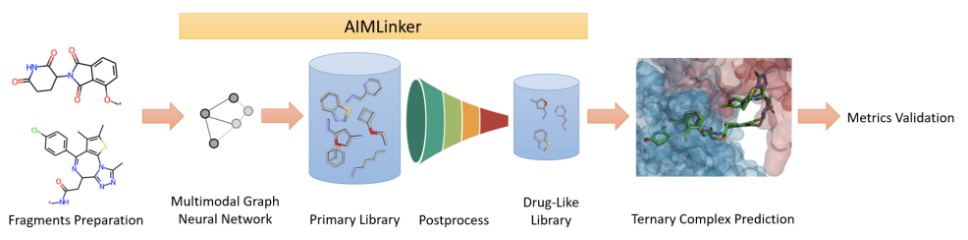 Fig.1 Scheme of the pipeline for linker optimization.1