BackgroundWhat We Can Offer?WorkflowWhy Us?FAQRelated Services
In targeted protein degradation (TPD), a primary bottleneck in early-stage lead optimization is bridging the gap between binary binder affinity and actual cellular degradation efficiency. A molecule that binds both its target protein and E3 ligase with nanomolar affinity (Kd) may still exhibit poor or undetectable maximum degradation (Dmax) or degradation potency (DC50). At Creative Biolabs, our In Silico Degradation Activity Prediction Service addresses this challenge by deploying physics-based free-energy modeling, kinetic rate simulations, and machine-learning degradation classifiers. By quantitative modeling of the entire catalytic cycle, we empower research teams to accurately forecast DC50 and Dmax values prior to wet-lab chemical synthesis and cellular testing.
Background of In Silico Degradation Activity Prediction
A Targeted protein degradation is a multi-step dynamic process governed by event-driven catalysis rather than passive occupancy. Predicting cellular degradation activity requires evaluating the complete temporal trajectory. A comprehensive prediction model must account for the thermodynamic stability of the ternary complex, the spatial orientation of target lysines relative to the E3-E2 ubiquitin donor, the rate of polyubiquitination, and the intracellular compound concentration dynamics over time.
Relying on empirical trial-and-error synthesis to optimize DC50 often leads to costly, unproductive chemical iterations. In silico degradation activity prediction converts qualitative structural data into quantitative kinetic forecasts. By modeling ternary cooperativity (α-factor), ubiquitination rates (kub), and intracellular clearance dynamics computationally, our platform helps clients prioritize candidate molecules with superior catalytic efficiency, broad therapeutic windows, and minimal hook-effect autoinhibition.
Fig.1 Schematic representation of the protein degradation mechanism of action.1
How Creative Biolabs' In Silico Degradation Activity Prediction Service Can Assist Your Project?
Predicting functional DC50 and Dmax metrics requires combining structural thermodynamics with dynamic kinetic modeling. Creative Biolabs provides a comprehensive computational framework:
Quantitative DC50 & Dmax Machine-Learning Classifiers: Utilizing proprietary AI models trained on extensive biophysical and cellular degradation datasets to predict half-maximal degradation concentration DC50 and maximum degradation efficiency Dmax.
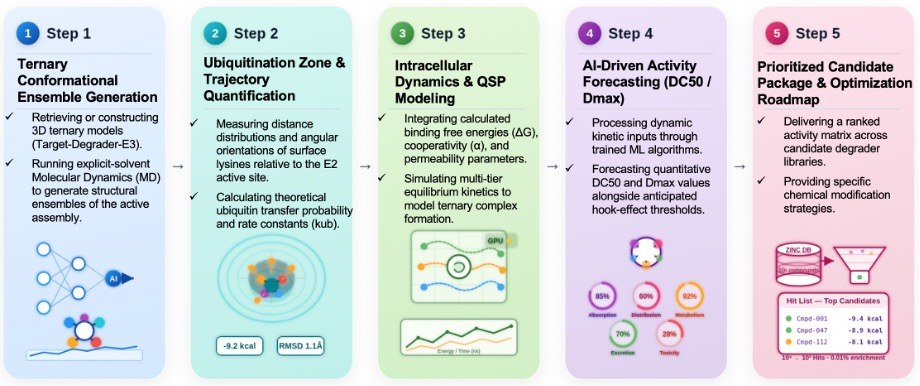
Ubiquitination Kinetic Rate kub Modeling: Calculating spatial orientation, conformational fluctuation, and distance vectors between E2-loaded ubiquitin and target surface lysines to estimate relative polyubiquitination rates.
Thermodynamic Cooperativity (α) & Free Energy (ΔG) Integration: Combining MM/GBSA free-energy calculations with multi-body ensemble docking to quantify ternary complex cooperativity and stability parameters.
Hook-Effect & Intracellular Concentration Kinetics: Simulating concentration-dependent species distribution (BinaryTarget, BinaryE3, Ternary) using quantitative systems pharmacology (QSP) modeling to predict autoinhibitory thresholds and optimal dosing windows.
Delivering a ranked activity matrix across candidate degrader libraries.
Providing specific chemical modification strategies to enhance degradation rates and widen therapeutic windows.
Advantages of Our Services
At Creative Biolabs, our computational drug discovery suite provides an advanced, physics-guided modeling platform tailored to overcome the unique predictive challenges of event-driven pharmacology. By integrating multi-body structural mechanics with kinetic dynamics and machine learning, we enable clients to forecast cellular degradation metrics with high confidence before committing to synthesis.
Full-Cycle Event-Driven Modeling
Moves beyond static binding predictions to model the entire catalytic continuum, from ternary assembly to ubiquitin transfer.
Quantitative DC50 / Dmax Output
Delivers clear, actionable numerical activity estimates rather than simple qualitative binding scores.
Integration of Biophysics and Permeability
Combines 3D structural thermodynamics with 2D/3D ADME properties to reflect realistic intracellular activity.
Rapid Discovery Turnaround
Evaluates virtual compound libraries within 2-3 weeks, accelerating lead optimization cycles.
Seamless Downstream CRO Validation
Computational activity predictions transition smoothly into Creative Biolabs' wet-lab synthesis, SPR/ITC biophysical assays, and cellular degradation testing (Western blot).
Frequently Asked Questions
Q1: Why does high binding affinity to both target and E3 ligase not guarantee high degradation activity (DC50)?
A1: High binary affinity only reflects two-body binding. Degradation potency (DC50) depends on forming a stable ternary complex with positive thermodynamic cooperativity (α > 1), displaying an unhindered exit vector, and correctly orienting surface lysines toward the E2 ubiquitin donor. Our service models these multi-body kinetic factors directly.
Q2: How does your platform calculate the ubiquitination rate (kub)?
A2: We run explicit-solvent molecular dynamics simulations on the predicted ternary complex to map the spatial trajectory, distance distribution, and conformational accessibility of surface-exposed target lysines relative to the E3-bound E2 ubiquitin donor domain.
Q3: Can this service predict the "hook effect" and the active concentration window?
A3: Yes. Using quantitative systems pharmacology (QSP) and kinetic equilibrium modeling, our platform simulates the concentration-dependent distribution of binary vs. ternary complexes, predicting the exact concentration threshold where autoinhibition occurs and defining the projected therapeutic window.
Q4: What structural inputs are required to run degradation activity predictions?
A4: Ideal inputs include 3D structures or reliable computational models of the target protein, E3 ligase, and candidate degrader chemical structures. If 3D ternary complexes are unavailable, our team can construct them using our integrated binary and ternary structure prediction workflows.
Q5: What downstream services can Creative Biolabs provide following activity predictions?
A5: Creative Biolabs provides complete downstream CRO solutions. Top-predicted candidate degraders can immediately enter our custom organic synthesis pipeline, followed by biophysical validation (SPR, BLI, ITC) and quantitative cellular degradation assays (Western blot, flow cytometry).
Transforming binary binding hits into potent cellular degraders requires predictive insight into the multi-body kinetics of event-driven catalysis. Creative Biolabs' computational degradation activity prediction suite delivers the quantitative clarity needed to select, refine, and prioritize high-performance lead candidates with confidence-saving valuable R&D capital and dramatically compressing development timelines. Please do not hesitate to contact us for more details.
Contact Our Team for More Information and to Discuss Your Project →
Reference
Montisci, Fabio, et al. "Data-driven generation of conformational ensembles and ternary complexes for PROTAC and other chimera systems." Journal of Chemical Information and Modeling 65.18 (2025): 9541. Distributed under Open Access license CC BY 4.0, without modification. https://doi.org/10.1021/acs.jcim.5c00880


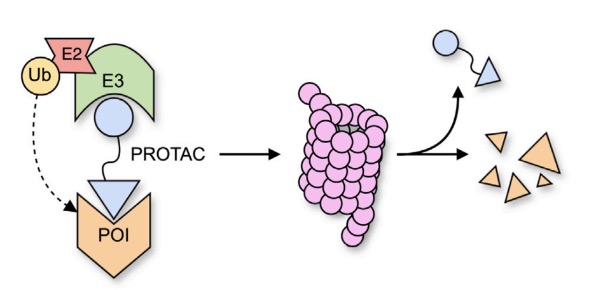 Fig.1 Schematic representation of the protein degradation mechanism of action.1