BackgroundWhat We Can Offer?WorkflowWhy Us?FAQRelated Services
In the landscape of targeted protein degradation (TPD), the choice of the ubiquitin ligase machinery dictates a degrader's tissue selectivity, safety profile, and therapeutic index. At the center of this mechanism is the E3 Ligase Ligand-the molecular handle that recruits ubiquitin ligase complexes to mediate the destruction of disease-causing proteins.
While classical recruiters such as cereblon (CRBN) and von Hippel-Lindau (VHL) have established proof-of-concept, the field urgently requires fresh E3 handles to circumvent drug resistance, reduce off-target toxicity, and achieve tissue-restricted degradation. Creative Biolabs provides a specialized In Silico E3 Ligase Ligand Screening Service that harnesses molecular docking, machine learning scoring, and structural mechanics to accelerate the identification and optimization of novel E3-binding handles.
Background of In Silico E3 Ligase Ligand Screening
E3 ubiquitin ligases serve as the specificity drivers of the ubiquitin-proteasome system (UPS), selectively targeting proteins for 26S proteasomal degradation. In heterobifunctional degrader design, recruiting an E3 ligase via a specialized ligand acts as the catalytic trigger to force transient proximity between the target protein and E3 machinery (Target-Degrader-E3). Moving beyond established recruiters like CRBN and VHL to novel E3 ligases is essential for achieving tissue-selective degradation, reducing systemic toxicity, and overcoming clinical resistance caused by ligase mutations. However, effective E3 ligands must satisfy stringent biophysical criteria-offering solvent-exposed exit vectors for linker attachment and promoting positive thermodynamic cooperativity across often shallow or non-catalytic protein interfaces.
Navigating the complex multi-body mechanics and shallow surface landscapes of novel E3 ligases makes in silico modeling an essential strategy prior to chemical synthesis. By leveraging advanced macromolecular docking, molecular dynamics (MD) simulations, and AI structural prediction (e.g., AlphaFold3), computational screening evaluates ternary complex stability and predicts thermodynamic cooperativity before entering the wet lab. Automated trajectory algorithms pinpoint optimal solvent-accessible exit vectors for linker conjugation, while enhanced sampling algorithms uncover transient, cryptic binding pockets on previously "undruggable" E3 surfaces. This data-driven computational approach compresses early recruiter discovery from months to weeks, eliminating non-viable candidates early and drastically accelerating targeted degradation programs.
Fig.1 Workflow for validating E3 ligase using promiscuous kinase inhibitors as POI ligands.1
How Creative Biolabs' In Silico E3 Ligase Ligand Screening Service Can Assist Your Project?
Traditional high-throughput physical screens struggle to capture the multi-body dynamics of E3 handle recruitment, often spending valuable resources on binary binders that fail in cellular degradation contexts. At Creative Biolabs, we deploy a dedicated computational suite integrating physics-based force fields, automated conformational sampling, and proprietary scoring models. By simulating E3 engagement in silico, we help research teams filter out non-functional hits, optimize linker attachment points, and expand into novel ligase classes with minimized financial and temporal risk.
Ultra-High-throughput Virtual Screening (vHTS): Screening extensive virtual compound collections against experimental crystal/Cryo-EM structures or high-accuracy AI-generated E3 models.
Solvent Exposure & Attachment Vector Mapping: Algorithmic identification of solvent-oriented chemical positions to guide downstream linker installation without compromising E3 engagement.
Three-Body Interface Simulation: Structural modeling and energetic profiling of full ternary assemblies to evaluate interface stability and cooperativity before entering the wet lab.
De Novo Handle Generation & Fragment Growing: AI-assisted fragment expansion and structure-guided design tailored to shallow or cryptic binding regions on novel E3s.
Physicochemical & Profiling Filters: In silico screening against PAINS, aggregation-prone structures, and unfavorable ADMET profiles to ensure synthetic feasibility and cell-permeability.
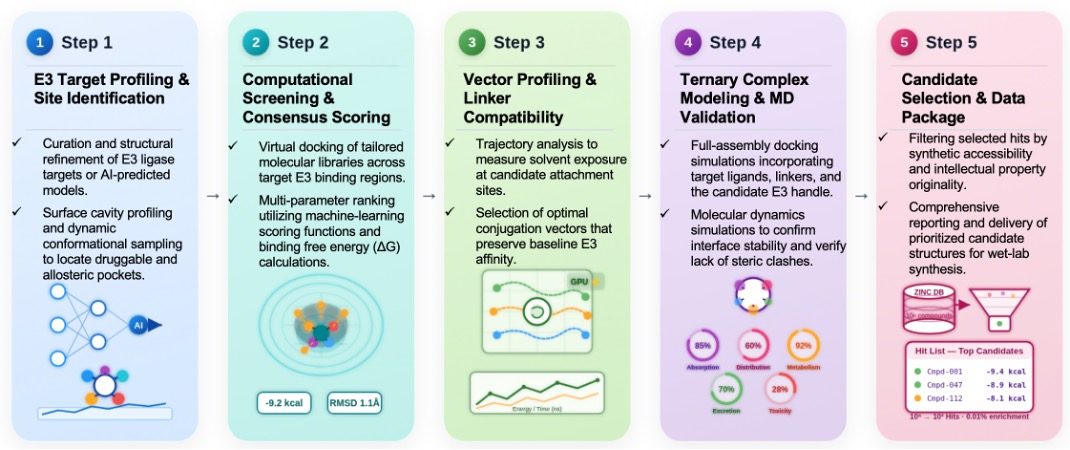
Workflow of In Silico E3 Ligase Ligand Screening Service
Stage 1
E3 Target Profiling & Site Identification
Curation and structural refinement of E3 ligase targets or AI-predicted models (AlphaFold/ESMFold).
Surface cavity profiling and dynamic conformational sampling to locate druggable and allosteric pockets.
Stage 2
Computational Screening & Consensus Scoring
Virtual docking of tailored molecular libraries across target E3 binding regions.
Multi-parameter ranking utilizing machine-learning scoring functions and binding free energy (ΔG) calculations.
Stage 3
Vector Profiling & Linker Compatibility
Trajectory analysis to measure solvent exposure at candidate attachment sites.
Selection of optimal conjugation vectors that preserve baseline E3 affinity.
Stage 4
Ternary Complex Modeling & MD Validation
Full-assembly docking simulations incorporating target ligands, linkers, and the candidate E3 handle.
Molecular dynamics simulations to confirm interface stability and verify lack of steric clashes.
Stage 5
Candidate Selection & Data Package
Filtering selected hits by synthetic accessibility (SAscore) and intellectual property originality.
Comprehensive reporting and delivery of prioritized candidate structures for wet-lab synthesis.
Advantages of Our Services
Unlocking non-traditional E3 ligase ligands requires specialized computational tools designed around the physics of degradation rather than simple target inhibition. Creative Biolabs combines deep expertise in structural biology with automated computational pipelines to deliver high-confidence E3 handles.
Purpose-Built TPD Algorithms
Our platforms are explicitly engineered to assess three-body dynamics, solvent vectors, and cooperativity factors rather than simple active-site occupancy.
Compressed Discovery Timelines
Screening millions of virtual structures computationally cuts early handle identification cycles from several months to weeks.
Capability Beyond Standard Ligases
Advanced dynamic sampling allows us to tackle non-CRBN/VHL ligases, enabling tissue-selective and tumor-specific recruiter discovery.
Access to Extensive Chemical Libraries
In silico evaluation spans diverse virtual compound sets, including lead-like, fragment, and macrocyclic databases.
Integrated CRO Solutions
Computational findings smoothly transition into Creative Biolabs's wet-lab capabilities, including custom organic synthesis, SPR/ITC binding assays, and cellular degradation validation.
Frequently Asked Questions
Q1: How does screening for an E3 handle differ from traditional small-molecule virtual screening?
A1: Standard virtual screening seeks molecules that block functional or enzymatic pockets to inhibit target activity. E3 recruiter screening, however, seeks binders that leave the ligase functionally intact while presenting accessible vectors for linker conjugation and fostering stable, cooperative interactions with a second target protein.
Q2: Can this platform evaluate E3 ligases that lack experimental 3D structures?
A2: Yes. We combine state-of-the-art AI protein structure prediction tools with molecular dynamics simulations to generate dynamic, high-resolution models of unexplored E3 ligases, allowing virtual screening to proceed even in the absence of published crystal data.
Q3: How do you handle E3 targets with shallow or flat binding surfaces?
A3: For E3 ligases lacking deep binding clefts, we deploy fragment-based computational screening combined with cryptic pocket detection algorithms. This approach reveals transient surface grooves that can accommodate small-molecule handles or peptidomimetic constructs.
Q4: How are attachment vectors evaluated on candidate E3 binders?
A4: Our pipeline automatically calculates the solvent-accessible surface area and vector trajectories of docked compounds. Positions that face outward without altering core binding interactions or causing steric interference with the E3 surface are flagged as viable attachment sites.
Q5: What downstream support is available after candidate handles are identified?
A5: Creative Biolabs provides seamless transition to wet-lab validation, including custom chemical synthesis of candidate E3 handles, bifunctional molecule assembly, biophysical interaction profiling (SPR, BLI, ITC), ubiquitination testing, and quantitative cellular degradation assays.
Take the next step in diversifying your targeted degradation pipeline with structure-guided computational intelligence. Partnering with Creative Biolabs grants access to tailored virtual screening workflows and three-body modeling. Contact our computational drug discovery specialists today for a confidential discussion and a customized project proposal tailored to your target E3 ligase ligand.
Contact Our Team for More Information and to Discuss Your Project →
Reference
Miletic, Nebojsa, et al. "Workflow for E3 ligase ligand validation for PROTAC development." ACS chemical biology 20.2 (2025): 507-521. Distributed under Open Access license CC BY 4.0, without modification. https://doi.org/10.1021/acschembio.4c00812


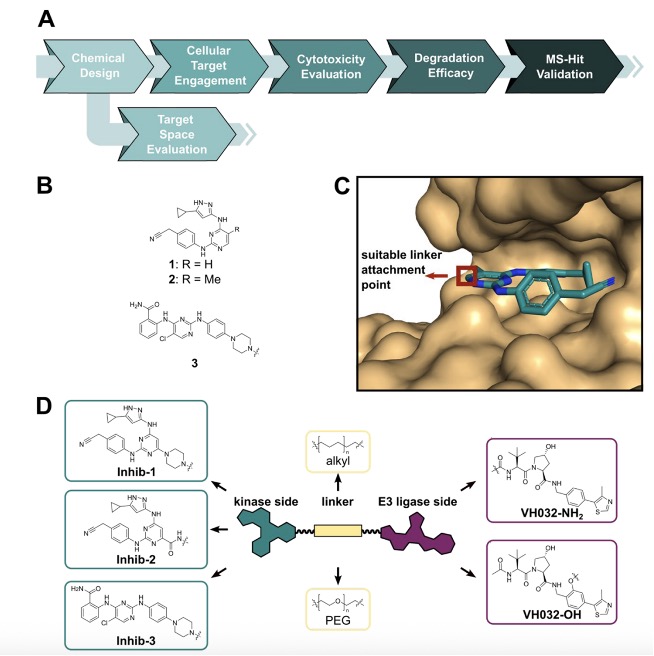 Fig.1 Workflow for validating E3 ligase using promiscuous kinase inhibitors as POI ligands.1