In Silico Protein Degrader Molecule Design & Evaluation Services
BackgroundWhat We Can Offer?WorkflowWhy Us?FAQRelated Services
In the rapidly expanding landscape of targeted protein degradation (TPD), moving from concept to a clinical-grade bivalent degrader requires navigating complex multi-body biophysics, stringently aligned exit vectors, and "beyond Rule of 5" pharmacokinetic hurdles. Creative Biolabs provides an end-to-end In Silico Protein Degrader Molecule Design & Evaluation services that replaces slow, high-cost trial-and-error chemistry with predictive structural intelligence.
Background of In Silico Protein Degrader Molecule Design & Evaluation
Targeted protein degradation (TPD) represents one of the most promising therapeutic paradigms in modern drug discovery. Unlike classical small-molecule inhibitors that rely on occupancy-driven pharmacology to block functional active sites, heterobifunctional degraders operate through an event-driven catalytic mechanism. By acting as molecular matchmakers, these chimeric molecules simultaneously engage a Target Protein of Interest (POI) and an E3 ubiquitin ligase core, forcing non-native proximity between the two proteins. This proximity drives the enzymatic transfer of ubiquitin onto target surface lysines, tagging the target for irreversible clearance via the 26S ubiquitin-proteasome system (UPS). Because a single degrader molecule dissociates intact after ubiquitination to repeat the cycle, TPD achieves profound cellular knockdown at sub-stoichiometric concentrations, unlocking previously "undruggable" non-enzymatic drivers of disease.
However, developing bivalent degraders presents extraordinary biophysical, structural, and pharmacokinetic challenges. Operating largely in "beyond Rule of 5" (bRo5) chemical space, these complex molecules must simultaneously optimize binary target engagement, solvent exit vectors, three-body thermodynamic cooperativity (α-factor), ubiquitination geometry, cell permeability, and metabolic stability. At Creative Biolabs, our In Silico Protein Degrader Molecule Design & Evaluation Services provide a comprehensive, physics-guided, and AI-augmented computational ecosystem. By integrating structural bioinformatics, macromolecular docking, explicit-solvent molecular dynamics (MD), and machine-learning predictive analytics, we empower research teams to rationally design, evaluate, and optimize every component of their degrader pipeline prior to wet-lab synthesis-drastically cutting R&D timelines and de-risking development.
Fig.1 Computational workflow for Protein Degrader Molecule design.1
How Creative Biolabs' In Silico Protein Degrader Molecule Design & Evaluation Services Can Assist Your Project?
To systematically de-risk every stage of targeted degradation development, Creative Biolabs has built an integrated ecosystem of ten specialized computational modules. This end-to-end framework bridges early target feasibility assessment with multi-body structural mechanics, kinetic activity forecasting, and advanced 3D pharmacokinetic optimization. By treating the degrader molecule as an integrated biophysical system rather than a collection of isolated parts, our platform provides biopharma researchers with unprecedented predictive accuracy-eliminating non-viable chemical designs early and delivering fully optimized, synthetically feasible lead candidates for wet-lab validation.
Not all proteins degrade with equal efficiency. Before launching a chemistry campaign, assessing the intrinsic structural feasibility and "degradability" of the target is paramount. This service utilizes AI structure prediction (AlphaFold3, ESMFold) and enhanced sampling molecular dynamics to evaluate target surface topologies, locate accessible surface lysines within flexible loops, and map transient or cryptic binding pockets on non-enzymatic targets. By quantifying target turnover rates, surface lysine availability, and structural plasticity, we provide early computational Go/No-Go decision gates for novel targets.
A successful warhead for a heterobifunctional degrader does not merely require tight binary affinity; it must present accessible attachment vectors toward open solvent without disrupting target engagement. Our platform executes structure-based virtual high-throughput screening (vHTS) across multi-million compound libraries, utilizing physics-based force fields and AI scoring functions to identify novel active-site, allosteric, or cryptic-pocket binders engineered specifically for downstream linker attachment.
Expanding the accessible E3 ligase repertoire beyond standard recruiters (such as CRBN and VHL) is essential to achieve tissue-restricted degradation, mitigate systemic toxicity, and overcome acquired resistance. We perform computational virtual screening and de novo fragment growing against novel, tissue-specific, or tumor-selective E3 ligases. By mapping shallow surface grooves and identifying functional E3-binding handles, we help diversify your degrader platform with novel recruiter chemistry.
The chemical connector joining terminal binders is far more than an inert spacer; it serves as the structural director governing ternary assembly. Our screening pipeline evaluates extensive virtual linker libraries-spanning aliphatic, polyethylene glycol (PEG), rigid aromatic, and heterocyclic motifs-matching exit vector trajectories to identify candidate lengths and compositions that prevent steric collisions while minimizing entropic penalties.
Whether starting de novo or optimizing client-supplied degrader leads with poor potency or low permeability, this service provides deep-dive structural refinement. We introduce rigidifying elements (spirocycles, alkynes, macrocycles) to lock the molecule into bioactive conformations, tune conformational entropy, optimize distance vectors to position target lysines within the 10–30Å ubiquitination radius, and resolve autoinhibitory "hook-effect" liabilities.
High-confidence three-body modeling relies on accurate starting binary architectures (Target-Binder and E3-Binder). This service constructs, minifies, and evaluates 3D binary complex geometries using consensus docking and explicit-solvent molecular dynamics. We map hydrogen-bond networks, calculate end-state binding free energies (MM/GBSA), and algorithmically profile solvent-accessible surface area (SASA) to validate exit vectors before assembly simulation.
The hallmark of TPD efficacy lies in assembling a productive three-body complex (Target-Degrader-E3). We deploy specialized macro-protein docking and molecular dynamics to reconstruct complete ternary ensembles. Our platform quantifies thermodynamic cooperativity (α-factor), assesses inter-protein contact packing, evaluates interface longevity, and verifies target lysine exposure relative to the E3-E2 ubiquitin-transfer domain.
Degraders can trigger unique toxicity profiles through off-target pseudo-ternary assembly, E3 auto-degradation, or non-specific bystander ubiquitination. We cross-dock candidate degraders and E3 complexes against proteome-wide structural databases to detect off-target degradation liabilities early. Combined with machine-learning filters for hERG liability, CYP inhibition, and hepatotoxicity, we provide actionable structural edits to eliminate safety red flags.
High binding affinity does not automatically correlate with cellular degradation potency (DC50) or maximum clearance (Dmax). This service combines multi-body structural thermodynamics, ubiquitination kinetic rate (kub) modeling, and quantitative systems pharmacology (QSP) to simulate the complete catalytic cycle over time, delivering accurate numerical forecasts of cellular degradation metrics and active dosing windows.
Operating in bRo5 space, degraders frequently suffer from poor cell permeability and metabolic instability. Our platform models 3D dynamic chameleonicity-evaluating a chimera's ability to form intramolecular hydrogen bonds (IMHB) and shift exposed polar surface area (ΔPSA) when entering lipid membranes. We identify metabolic soft-spots across linkers and predict solubility, clearance, and transporter efflux likelihood to optimize oral bioavailability.
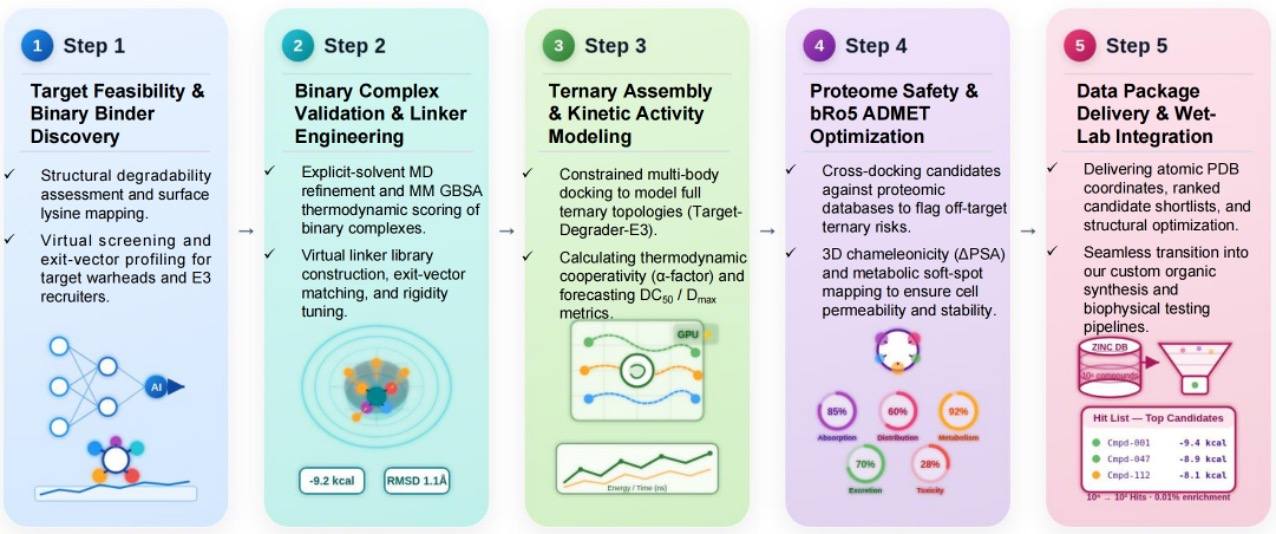
Workflow of In Silico Protein Degrader Molecule Design & Evaluation Services
Stage 1
Target Feasibility & Binary Binder Discovery
Structural degradability assessment and surface lysine mapping of the target protein.
Virtual screening and exit-vector profiling for target warheads and E3 recruiters.
Stage 2
Binary Complex Validation & Linker Engineering
Explicit-solvent MD refinement and MM/GBSA thermodynamic scoring of binary complexes.
Virtual linker library construction, exit-vector matching, and rigidity tuning.
Stage 3
Ternary Assembly & Kinetic Activity Modeling
Constrained multi-body docking to model full ternary topologies (Target-Degrader-E3).
Calculating thermodynamic cooperativity (α-factor) and forecasting DC50 / Dmax metrics.
Stage 4
Proteome Safety & bRo5 ADMET Optimization
Cross-docking candidates against proteomic databases to flag off-target ternary risks.
3D chameleonicity (ΔPSA) and metabolic soft-spot mapping to ensure cell permeability and stability.
Seamless transition into Creative Biolabs' custom organic synthesis and biophysical testing pipelines.
Advantages of Our Services
At Creative Biolabs, our integrated computational drug discovery suite offers a sophisticated, end-to-end framework purpose-built to navigate the multi-body physics and bRo5 chemistry of targeted protein degradation. By replacing empirical trial-and-error iteration with predictive structural modeling, we enable research teams to advance candidate degraders with speed and precision.
Purpose-Built for Degradation Physics
Workflows explicitly engineered to model three-body thermodynamics, inter-protein cooperativity (α-factor), and ubiquitination spatial dynamics.
Full-Spectrum Computational Coverage
Covers every stage of TPD discovery-from initial target feasibility and binder screening to ternary assembly, proteomic safety, and 3D ADMET tuning.
Mastery of bRo5 Pharmacokinetics
Advanced 3D chameleonicity and dynamic PSA modeling to unlock cell-permeable, orally bioavailable chimeric leads.
Dramatically Compressed Timelines
Evaluates millions of virtual structures and multi-body configurations computationally, shortening early lead optimization from months to weeks.
Q1: How does an integrated in silico TPD pipeline accelerate discovery compared to empirical chemistry?
A1: Empirical TPD optimization requires synthesizing and testing dozens of discrete chimeric variations to evaluate warheads, linkers, and recruiters. An integrated computational pipeline screens thousands of virtual combinations in silico-predicting ternary stability, ubiquitination rates, cell permeability, and off-target safety beforehand-drastically reducing wet-lab chemistry cycles and R&D costs.
Q2: Can your computational platform evaluate novel target proteins or E3 ligases lacking crystal structures?
A2: Yes. We combine state-of-the-art AI structure prediction tools (e.g., AlphaFold3, ESMFold) with enhanced sampling molecular dynamics to build dynamic, high-confidence 3D models of uncharacterized targets, mutated variants, and novel E3 ligases, enabling virtual screening and ternary modeling to proceed smoothly.
Q3: How do your in silico services address the autoinhibitory "hook effect"?
A3: The hook effect occurs when binary species outcompete ternary complex assembly at high compound concentrations. By scoring for strong positive thermodynamic cooperativity (α > 1) and performing quantitative systems pharmacology (QSP) kinetic simulations, our services identify molecules that stabilize the ternary complex, widening the active therapeutic window.
Q4: How does 3D chameleonicity modeling improve the permeability of large degrader molecules?
A4: Flexible bivalent degraders often cross cell membranes by adopting compact 3D folded conformations that form intramolecular hydrogen bonds (IMHB), burying polar surface area. Our algorithms simulate conformational ensembles in aqueous vs. lipophilic environments to measure this dynamic PSA shift (ΔPSA), prioritizing candidates with high passive membrane permeability.
Q5: What downstream experimental validation services does Creative Biolabs offer after computational evaluation?
A5: Creative Biolabs provides complete downstream CRO capabilities. Computationally prioritized degrader leads can directly enter our custom organic synthesis pipeline, followed by biophysical binding characterization (SPR, BLI, ITC), ternary complex structural analysis, quantitative proteomics, and cell-based degradation assays (Western blot, flow cytometry).
Navigating the multi-body complexities and pharmacokinetic hurdles of targeted protein degradation demands data-driven structural precision. Partnering with Creative Biolabs grants you direct access to world-class computational chemistry, AI structural modeling, and a dedicated team of computational structural biologists focused on maximizing your degrader potency and safety profile. Please do not hesitate to contact us for more details.
Contact Our Team for More Information and to Discuss Your Project →
Reference
Tewari, Aishani, Aiswarya Pawar, and Sudip Roy. "Targeted Protein Degradation in the Digital Era: Computational Challenges and Opportunities for PROTACS." In Silico Research in Biomedicine (2026): 100372. Distributed under Open Access license CC BY 4.0, without modification. https://doi.org/10.1016/j.insi.2026.100372


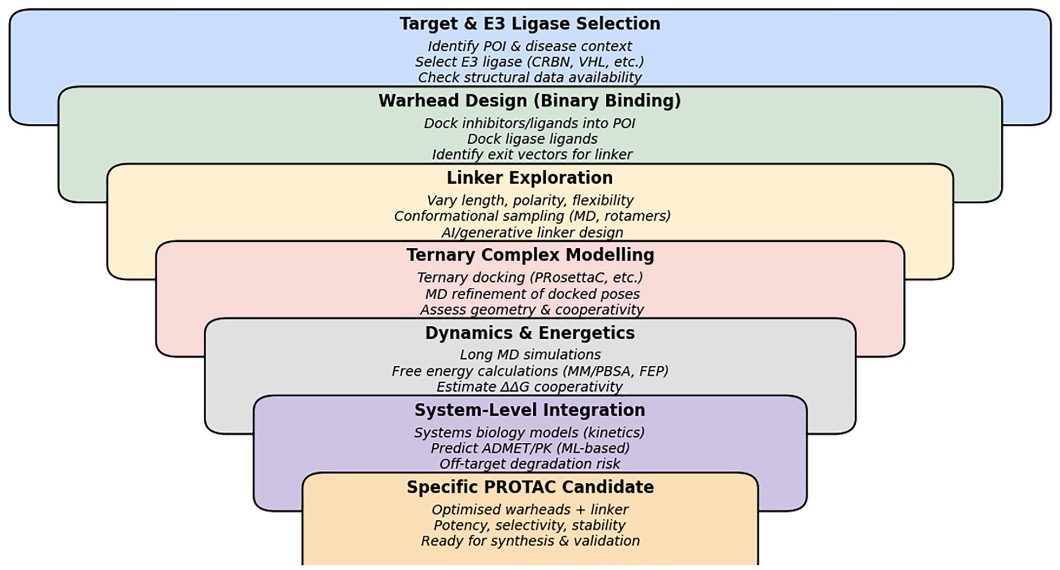 Fig.1 Computational workflow for Protein Degrader Molecule design.1