BackgroundWhat We Can Offer?WorkflowWhy Us?FAQRelated Services
Targeted protein degradation (TPD) has redefined modern drug discovery by transitioning from conventional active-site inhibition to event-driven catalytic degradation. At the core of a successful heterobifunctional degrader lies the Target Protein Ligand-the specialized "warhead" responsible for selective binder recruitment. Unlike traditional inhibitors, a ligand designed for bivalent degrader development does not merely require high thermodynamic binding affinity; it must present accessible attachment points for linkers and promote productive ternary complex formation (Target Protein-Bivalent Degrader-E3 Ligase). At Creative Biolabs, our In Silico Target Protein Ligand Screening Service leverages cutting-edge computational chemistry, structural bioinformatics, and biophysical modeling to rapidly identify, optimize, and evaluate target-binding ligands tailored specifically for targeted degradation frameworks.
Introduction of In Silico Target Protein Ligand Screening
Targeted protein degradation (TPD) represents a fundamental departure from classical occupancy-driven pharmacology. Traditional small-molecule inhibitors rely on sustained, high-affinity active-site occupancy to blockade downstream signaling pathways-a mechanism constrained by competitive stoichiometry and susceptible to target overexpression or mutated binding pockets. In contrast, heterobifunctional degraders operate through an event-driven catalytic mechanism. By acting as a molecular bridge, a bivalent molecule forces transient proximity between a target protein of interest (POI) and an E3 ubiquitin ligase machinery (e.g., CRBN, VHL, IAP, or MDM2). This spatial juxtaposition triggers enzymatic polyubiquitination of lysine residues on the target surface, marking it for irreversible degradation via the 26S ubiquitin-proteasome system (UPS). Because the degrader dissociates intact following ubiquitination, a single molecule can catalyze the destruction of multiple target proteins in a sub-stoichiometric manner.
Unlike traditional inhibitors that only require active-site blockage, a successful Target Protein Ligand must satisfy specific structural and biophysical criteria to enable downstream degradation-making In Silico modeling an essential filter early in discovery.
Fig.1 Protein Degrader-induced ternary complexes and their biophysical properties.1
How Creative Biolabs' In Silico Target Protein Ligand Screening Service Can Assist Your Project?
In the rapidly evolving landscape of targeted degradation, traditional high-throughput screening often falls short when identifying optimal target protein ligands-failing to account for ternary complex mechanics, exit vector compatibility, and inter-protein cooperativity. At Creative Biolabs, our computational drug discovery platform bridges this gap by combining advanced structure-based drug design (SBDD), physics-based molecular dynamics (MD), and machine learning algorithms into a purpose-built in silico pipeline. By simulating the intricate multi-body thermodynamics of degradation frameworks prior to chemical synthesis, we eliminate non-viable candidate molecules early, drastically lower R&D expenditure, and de-risk your development pipeline.
Structure-Based Virtual High-Throughput Screening (vHTS): Screening multi-million compound libraries against target crystal structures, cryo-EM models, or high-accuracy homology/AI-predicted models.
Exit Vector & Solvent Accessibility Mapping: Systematic mapping of solvent-exposed positions on candidate ligands to evaluate linker attachment sites without causing steric hindrance.
Ternary Complex Modeling & Cooperativity Assessment: In silico assembly and energy minimization of the full ternary interface (Target-Degrader-E3) to predict degradation efficiency (α-cooperativity factor).
De Novo Ligand Design & Fragment Growing: AI-guided design and fragment-based discovery targeting novel pockets on undruggable proteins.
ADMET & Druggability Filtering: Early computational profiling to filter out pan-assay interference compounds (PAINS) and optimize physicochemical properties (MW, LogP, PSA) for improved cell permeability.
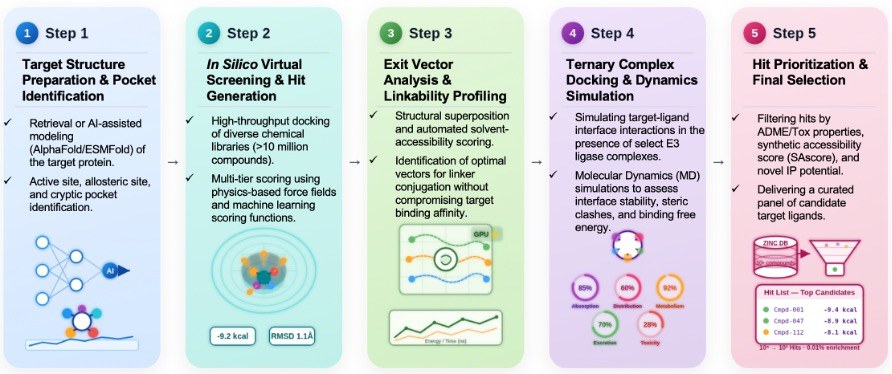
Workflow of In Silico Target Protein Ligand Screening Service
Retrieval or AI-assisted modeling (AlphaFold/ESMFold) of the target protein.
Active site, allosteric site, and cryptic pocket identification using molecular dynamics and surface cavity mapping.
Stage 2
In Silico Virtual Screening & Hit Generation
High-throughput docking of diverse chemical libraries (>10 million compounds).
Multi-tier scoring using physics-based force fields and machine learning scoring functions.
Stage 3
Exit Vector Analysis & Linkability Profiling
Structural superposition and automated solvent-accessibility scoring.
Identification of optimal vectors for linker conjugation without compromising target binding affinity.
Stage 4
Ternary Complex Docking & Dynamics Simulation
Simulating target-ligand interface interactions in the presence of select E3 ligase complexes (e.g., CRBN, VHL, IAPs, MDM2).
Molecular Dynamics (MD) simulations to assess interface stability, steric clashes, and binding free energy.
Stage 5
Hit Prioritization & Final Selection
Filtering hits by ADME/Tox properties, synthetic accessibility score (SAscore), and novel IP potential.
Delivering a curated panel of candidate target ligands ready for chemical synthesis and wet-lab validation.
Advantages of Our Services
At Creative Biolabs, our computational drug discovery platform is specifically optimized to overcome the unique structural and biophysical challenges of targeted protein degradation. By replacing traditional, trial-and-error inhibitor screening with advanced physics-based modeling and AI-driven structural analytics, we help clients rapidly identify high-quality target protein ligands that possess high linkability and strong degradation potential.
Tailored for Degradation Chemistry
Unlike general screening workflows, our platform is explicitly calibrated for bivalent degrader architecture and ternary complex thermodynamics.
Expedited Discovery Timelines
Shrink the target ligand discovery phase from 6-12 months down to 4-6 weeks.
Broad Target Coverage
Applicable to classic active sites, allosteric sites, protein-protein interfaces, and computationally mapped non-enzymatic targets.
Comprehensive Chemical Space
Access to curated virtual databases containing over 20 million lead-like, fragment, and novel structural entities.
Interdisciplinary Expertise
Seamless integration with our downstream wet-lab biophysical assay services (SPR, FP, ITC) and chemistry synthesis teams.
Frequently Asked Questions
Q1: How does in silico ligand screening for targeted protein degradation differ from traditional inhibitor screening?
A1: Traditional screening focuses solely on optimizing binary binding affinity (Target-Ligand) to block functional sites. Screening for targeted degradation requires evaluating "linkability"-ensuring the ligand has accessible vectors for linker attachment-and predicting how the bound ligand influences productive ternary complex formation (Target-Degrade-E3 Ligase). High binary affinity alone is insufficient if the ligand impedes E3 recruitment or lacks a functional exit vector.
Q2: What target protein structural data is required to initiate the screening project?
A2: High-resolution X-ray crystallography or Cryo-EM structures bound to co-factors/ligands are ideal. However, if an experimental structure is unavailable, Creative Biolabs can utilize state-of-the-art AI structure prediction platforms alongside enhanced sampling molecular dynamics to generate high-confidence target models suitable for virtual screening.
Q3: Can your platform identify ligands for targets without known active sites or known small-molecule binders?
A3: Yes. We utilize advanced cryptic pocket detection algorithms and fragment-based computational docking to identify novel allosteric and surface binding sites. This enables candidate ligand discovery for traditionally "undruggable" targets, such as transcription factors, scaffold proteins, and non-enzymatic targets.
Q4: How does Creative Biolabs evaluate the linkability of screened hits?
A4: During the computational pipeline, every top-scoring ligand undergoes automated exit vector analysis. We evaluate solvent exposure, conformational rigidity, and local steric environments at potential conjugation sites to ensure a linker can be attached without disrupting target binding or inducing unwanted clashes with the target surface.
Q5: What downstream services can Creative Biolabs provide after computational hit identification?
A5: Creative Biolabs offers a fully integrated platform. Following in silico hit identification, we can provide custom chemical synthesis of the target ligands, linker-degrader assembly, biophysical binding validation (via SPR, BLI, ITC), cellular degradation assays (Western Blot), and full ternary complex structural characterization.
Accelerate your targeted degradation program with data-driven computational precision. By partnering with Creative Biolabs, you gain direct access to advanced in silico modeling, bespoke virtual screening, and a multidisciplinary team of computational chemists dedicated to delivering high-performance target ligands with pre-validated linkability and superior degradation potential. Contact our computational drug discovery experts today to receive a confidential consultation and customized project proposal tailored to your specific target goals.
Contact Our Team for More Information and to Discuss Your Project →
Reference
Hughes, Scott J., and Alessio Ciulli. "Molecular recognition of ternary complexes: a new dimension in the structure-guided design of chemical degraders." Essays in biochemistry 61.5 (2017): 505-516. Distributed under Open Access license CC BY 4.0, without modification. https://doi.org/10.1042/EBC20170041

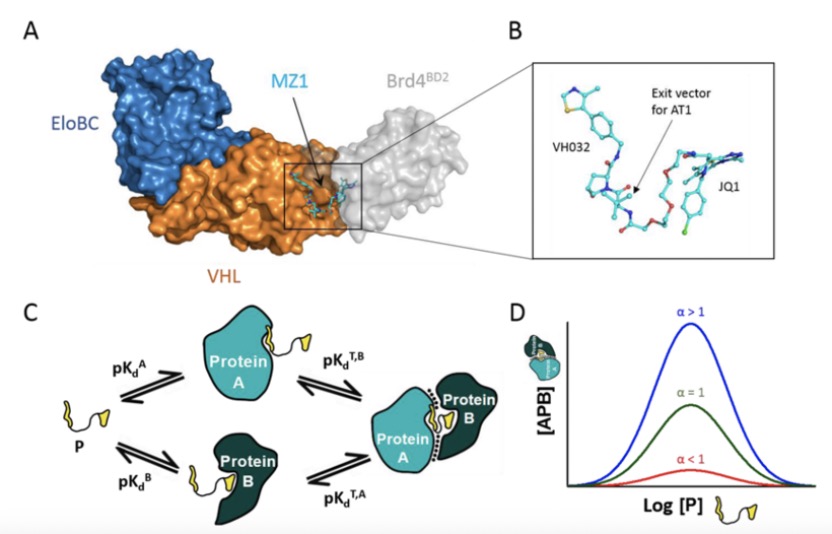 Fig.1 Protein Degrader-induced ternary complexes and their biophysical properties.1