In Silico Ternary Structure Prediction & Evaluation Service
BackgroundWhat We Can Offer?WorkflowWhy Us?FAQRelated Services
The hallmark of targeted protein degradation lies in assembling a functional three-body entity: the Ternary Complex (Target Protein-Chimeric Molecule-E3 Ubiquitin Ligase). Unlike conventional drug discovery, where success hinges on binary binding affinity, degrader potency is governed by the structural stability, inter-protein contact packing, and thermodynamic cooperativity of this short-lived macromolecular ensemble. At Creative Biolabs, our In Silico Ternary Structure Prediction & Evaluation Service deploys specialized multi-body docking, explicit-solvent molecular dynamics, and free-energy profiling to reconstruct, analyze, and optimize three-body assemblies-providing actionable insights that predict degradation capacity (DC50) before committing to wet-lab synthesis.
Background of In Silico Ternary Structure Prediction & Evaluation
A bivalent degrader operates by acting as a molecular matchmaker, forcing non-native proximity between a target protein and an E3 ligase machinery. The resulting degradation velocity (kdeg) does not correlate directly with how tightly the individual ligands bind their isolated targets; rather, it depends on whether the chimeric molecule stabilizes a productive ternary architecture. Evaluating this multi-protein assembly is vital to verify that newly formed protein-protein interaction (PPI) interfaces yield favorable thermodynamic cooperativity (α > 1) while keeping target surface lysines within the active ubiquitination zone (10-30 A) of the E2-conjugating enzyme.
Determining three-body assemblies experimentally via X-ray crystallography or Cryo-EM is notoriously difficult due to the transient, dynamic nature of degrader-induced complexes. In silico ternary modeling circumvents this obstacle by simulating the complete conformational landscape computationally. By integrating rigid-body protein-protein docking, flexible linker sampling, and atomistic force-field refinement, our platform pinpoints productive binding modes, identifies destabilizing steric clashes, and explains observed non-linear SAR or autoinhibitory hook effects.
Fig.1 Schematic of the PCG workflow, showing the superimposition of the POI and the E3.1
How Creative Biolabs' In Silico Ternary Structure Prediction & Evaluation Service Can Assist Your Project?
Navigating multi-protein docking and chimeric flexibility demands computational tools built specifically for three-body thermodynamics. Creative Biolabs offers an integrated suite of advanced computational capabilities:
Macro-Protein Global & Local Ternary Docking: Simultaneous positioning of target protein and E3 ligase structures guided by chimeric linker constraints and exit vector trajectories to capture realistic ensemble geometries.
Thermodynamic Cooperativity (α-Factor) Quantification: Physics-based free-energy scoring (ΔG) to calculate binding cooperativity, distinguishing designs with positive cooperativity (α > 1) from those hampered by inter-protein electrostatic or steric repulsion (α < 1).
Ubiquitination Trajectory & Lysine Accessibility Profiling: Dynamic spatial mapping of surface-exposed target lysines relative to the E2-ubiquitin catalytic domain, verifying that candidate assemblies adopt geometries favorable for ubiquitin transfer.
Explicit-Solvent MD & Interface Longevity Simulation: Running extended Molecular Dynamics (MD) trajectories to test ternary complex residence time, analyze transient hydrogen-bond networks, and map inter-protein packing stability.
Hook-Effect Mitigation & SAR Rationalization: Modeling concentration-dependent binary vs. ternary species equilibrium to predict the therapeutic window and guide structural modifications that suppress autoinhibition.
Workflow of In Silico Ternary Structure Prediction & Evaluation Service
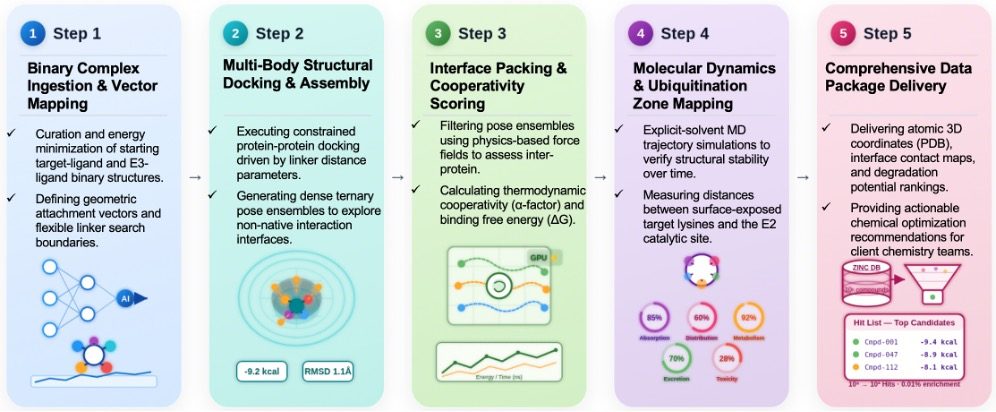
Stage 1
Binary Complex Ingestion & Vector Mapping
Curation and energy minimization of starting target-ligand and E3-ligand binary structures.
Defining geometric attachment vectors and flexible linker search boundaries.
Stage 2
Multi-Body Structural Docking & Assembly
Executing constrained protein-protein docking driven by linker distance parameters.
Generating dense ternary pose ensembles to explore non-native interaction interfaces.
Stage 3
Interface Packing & Cooperativity Scoring
Filtering pose ensembles using physics-based force fields to assess inter-protein surface contact area.
Calculating thermodynamic cooperativity (α-factor) and binding free energy (ΔG).
Stage 4
Molecular Dynamics & Ubiquitination Zone Mapping
Explicit-solvent MD trajectory simulations to verify structural stability over time.
Measuring distances between surface-exposed target lysines and the E2 catalytic site.
Stage 5
Comprehensive Data Package Delivery
Delivering atomic 3D coordinates (PDB), interface contact maps, and degradation potential rankings.
Providing actionable chemical optimization recommendations for client chemistry teams.
Advantages of Our Services
At Creative Biolabs, our computational structural suite delivers a purpose-built, data-driven methodology tailored to master the unique physics of multi-body degradation assemblies. By combining macromolecular docking, dynamic trajectory analysis, and thermodynamic scoring, we provide clear structural rationales that empower research teams to optimize degradation potency with uncompromised speed.
Specialized for Three-Body Thermodynamics
Purpose-built algorithms that explicitly model inter-protein cooperativity, entropic loss, and complex stability rather than simple binary binding.
Overcoming Experimental Barriers
Generates reliable 3D structural models for transient assemblies that are difficult or impossible to capture via traditional X-ray/Cryo-EM methods.
De-Risking Chemical Synthesis
Prioritizes chimeric candidates with high degradation potential before entering wet-lab organic chemistry, saving months of trial-and-error iterations.
Explaining Complex SAR Trends
Rationalizes unexpected non-linear degradation data, loss of cellular activity, or pronounced hook-effect behaviors.
Seamless CRO Workflow Integration
Computational results transition directly into Creative Biolabs' custom synthesis, SPR/ITC biophysical assays, and cellular degradation testing pipelines.
Frequently Asked Questions
Q1: How does ternary complex prediction differ from standard protein-protein docking?
A1: Standard protein-protein docking models two rigid proteins without external constraints. Ternary prediction for degraders incorporates the flexible chemical linker as an explicit spatial constraint while simultaneously scoring de novo inter-protein contact interfaces, thermodynamic cooperativity (α-factor), and target lysine orientation relative to the E3 ligase machinery.
Q2: Can your platform model ternary structures if experimental co-crystals of the binary binders are unavailable?
A2: Yes. We utilize high-confidence binary models generated via AI structure prediction (e.g., AlphaFold3) and flexible ligand docking as starting structures for our ternary assembly pipeline, enabling robust multi-body modeling even in the absence of published crystal data.
Q3: How does predicting ternary complex stability help prevent the "hook effect"?
A3: The hook effect occurs when uncomplexed degrader molecules outcompete ternary complex formation at high concentrations. By scoring for strong positive cooperativity (α > 1) and favorable inter-protein contact packing, our platform identifies chimeric architectures that stabilize the three-body assembly, effectively widening the active therapeutic window.
Q4: What structural metrics indicate that a predicted ternary complex will lead to successful target degradation?
A4: Key indicators include positive thermodynamic cooperativity (α > 1), a stable protein-protein interface during explicit-solvent MD simulations, low steric strain across the linker, and at least one surface-exposed target lysine positioned within 10-30 Å of the E2-conjugating enzyme's catalytic site.
Q5: What downstream services can Creative Biolabs offer following ternary complex evaluation?
A5: Creative Biolabs provides comprehensive downstream CRO support. Computational predictions can directly guide our custom organic synthesis of optimized degraders, followed by biophysical validation (SPR, BLI, ITC), ubiquitination testing, and cellular degradation assays (Western blot).
Unlock the structural secrets of your chimeric degrader assemblies with predictive computational precision. Partnering with Creative Biolabs provides direct access to advanced ternary docking, multi-body molecular dynamics, and a dedicated team of computational structural biologists focused on maximizing your degradation potency. Please do not hesitate to contact us for more details.
Contact Our Team for More Information and to Discuss Your Project →
Reference
Montisci, Fabio, et al. "Data-driven generation of conformational ensembles and ternary complexes for PROTAC and other chimera systems." Journal of Chemical Information and Modeling 65.18 (2025): 9541. Distributed under Open Access license CC BY 4.0, without modification. https://doi.org/10.1021/acs.jcim.5c00880


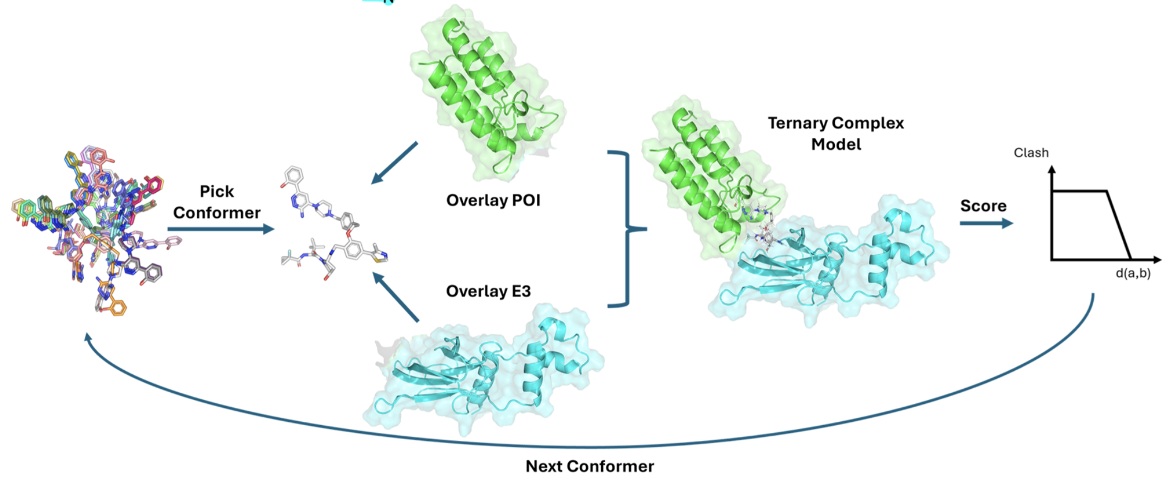 Fig.1 Schematic of the PCG workflow, showing the superimposition of the POI and the E3.1