At Creative Biolabs, we provide comprehensive Novel E3 Ligase Ligand Screening Services to propel the next generation of targeted protein degradation (TPD) therapeutics. While traditional degradation technologies heavily rely on a limited set of conventional E3 ligases (such as CRBN and VHL), expanding the accessible E3 ligase repertoire is paramount to overcoming drug resistance, achieving tissue-selective degradation, and targeting previously "undruggable" disease drivers. Leveraging our advanced biophysical screening technologies, structural biology engine, and extensive chemical libraries, we offer tailored screening platforms for a wide spectrum of emerging E3 ligases.
Background of Novel E3 Ligase Ligand in Protein Degradation
The human genome encodes over 600 E3 ubiquitin ligases, yet the vast majority of heterobifunctional degraders in clinical development recruit only CRBN or VHL. Relying on such a narrow subset introduces significant therapeutic vulnerabilities, including acquired resistance via ligase mutations or downregulation, lack of tissue specificity, and limited efficacy against certain cellular compartments.
Co-opting novel, alternative E3 ligases through Creative Biolabs' screening platform offers transformative pharmacological advantages:
Overcoming Resistance: Bypasses genomic loss-of-function alterations, point mutations, or epigenetic silencing associated with CRBN and VHL.
Tissue & Cellular Selectivity: Taps into tissue-restricted or compartment-specific E3 ligases (e.g., muscle-enriched or nuclear-localized ligases) to restrict target clearance to disease-relevant tissues and minimize systemic toxicities.
Structural Diversity: Accesses distinct binding modes—including non-covalent hydrophobic pockets, electrophilic covalent cysteine targets, and degron-recognition cavities—to expand chemical space and optimize ternary complex formation.
Fig.1 Ternary complex structure in protein degradation.
Comprehensive Novel E3 Ligase Screening Portfolio
At Creative Biolabs, our service goes beyond routine high-throughput screening. We provide an end-to-end, milestone-driven discovery engine designed to overcome the structural and chemical challenges of hijacking the CUL3-KEAP1 machinery. By partnering with us, clients can seamlessly advance their degrader pipeline across key project stages:
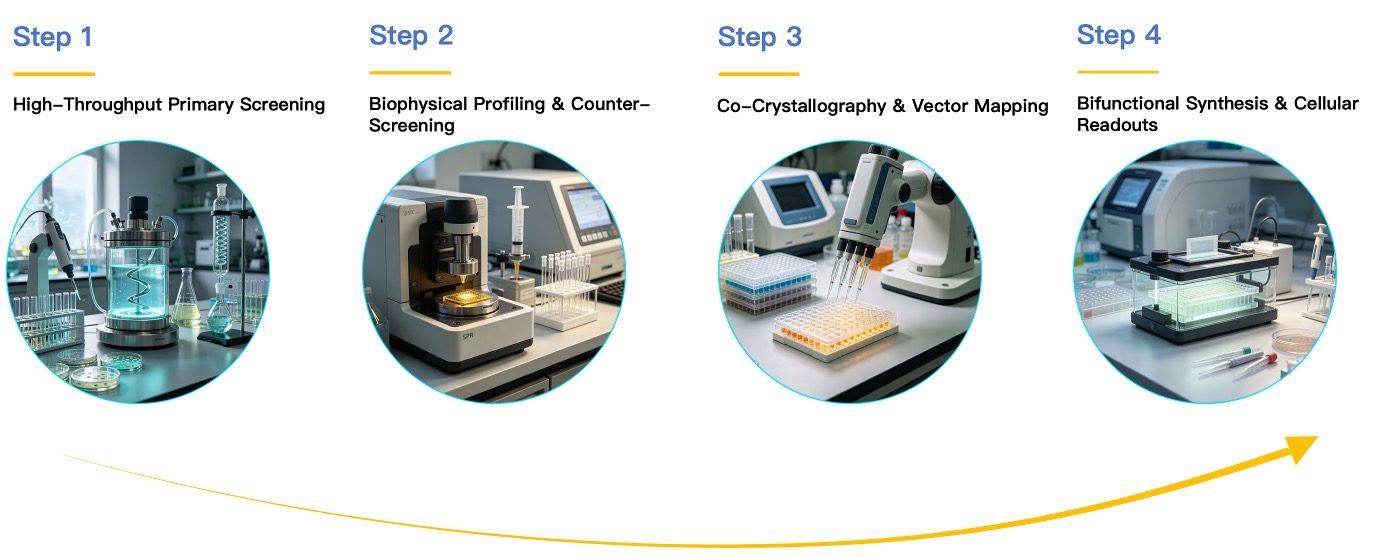
Creative Biolabs delivers a fully integrated, multi-phase operational workflow that transitions projects seamlessly from initial hit identification to full cellular degradation confirmation.
Stage 1
High-Throughput Primary Screening
Screening diverse chemical libraries, DNA-Encoded Libraries (DEL), fragment sets, or targeted peptide/peptidomimetic collections via Fluorescence Polarization (FP), TR-FRET, or Surface Plasmon Resonance (SPR).
Stage 2
Biophysical Profiling & Counter-Screening
Quantifying precise binding affinities (KD) and kinetic parameters using SPR, Isothermal Titration Calorimetry (ITC), or MicroScale Thermophoresis (MST), alongside counter-screening against off-target E3 family members.
Stage 3
Co-Crystallography & Vector Mapping
Solving high-resolution X-ray or Cryo-EM structures of candidate ligands bound to the target E3 ligase to establish precise exit vectors for linker attachment.
Stage 4
Bifunctional Synthesis & Cellular Readouts
Conjugating optimized E3 ligands to target-binding moieties to build functional degraders, followed by cellular validation (Western blot, quantitative mass-spectrometry proteomics) and mechanism-of-action testing.
Advantages of Our Services
As a recognized pioneer in targeted protein degradation technologies, Creative Biolabs combines advanced screening infrastructures with extensive drug discovery expertise to accelerate novel E3 ligase ligand discovery. Our platform provides clients with unparalleled capabilities to streamline early-stage degrader development through the following key strengths:
Broadest Novel E3 Portfolio
Pre-validated assays and deep structural expertise across an unmatched panel of Cullin-RING, RING, HECT, and RBR E3 ligases.
In-House Structural Biology Engine
Co-crystallization and Cryo-EM capabilities providing high-resolution atomic structures to drive structure-based drug design (SBDD).
Advanced Screening Modalities
Seamless integration of DEL technology, targeted covalent chemoproteomics, and high-throughput biophysical profiling platforms.
End-to-End Execution
Comprehensive support bridging hit discovery, biophysical kinetic profiling, linker chemistry optimization, and cellular degradation kinetics.
Frequently Asked Questions
Q1: Why should I explore novel E3 ligases instead of established options like CRBN or VHL?
A: Conventional E3 ligases are susceptible to acquired resistance mechanisms through point mutations or downregulations in clinical settings. Novel E3 ligases provide alternative degradation pathways, access to tissue-restricted or compartment-specific expression profiles, and distinct binding geometries capable of clearing targets refractory to standard ligases.
Q2: Can Creative Biolabs screen for both covalent and non-covalent novel E3 recruiters?
A: Yes. We offer electrophilic small-molecule screening platforms targeting reactive nucleophilic residues (e.g., cysteine, lysine) for targeted covalent ligand discovery (e.g., RNF114, KEAP1), as well as reversible small-molecule, fragment, and peptidomimetic platforms for non-covalent pockets.
Q3: How do you confirm that target degradation is driven specifically by the recruited novel E3 ligase?
A: We validate mechanism-of-action via CRISPR/Cas9 genetic knockouts, RNAi-mediated knockdowns, proteasome/cullin pathway inhibition, and competitive E3 ligand rescue experiments to demonstrate that target clearance relies strictly on the targeted novel E3 ligase.
Whether your objective is to overcome clinical resistance, achieve precise tissue-selective degradation, or unlock previously refractory therapeutic targets, our team is equipped to tailor an optimal novel E3 ligase ligand screening strategy to meet your exact scientific goals. Contact our expert scientific team today to discuss your project requirements or to request a custom project proposal.
Contact Our Team for More Information and to Discuss Your Project →

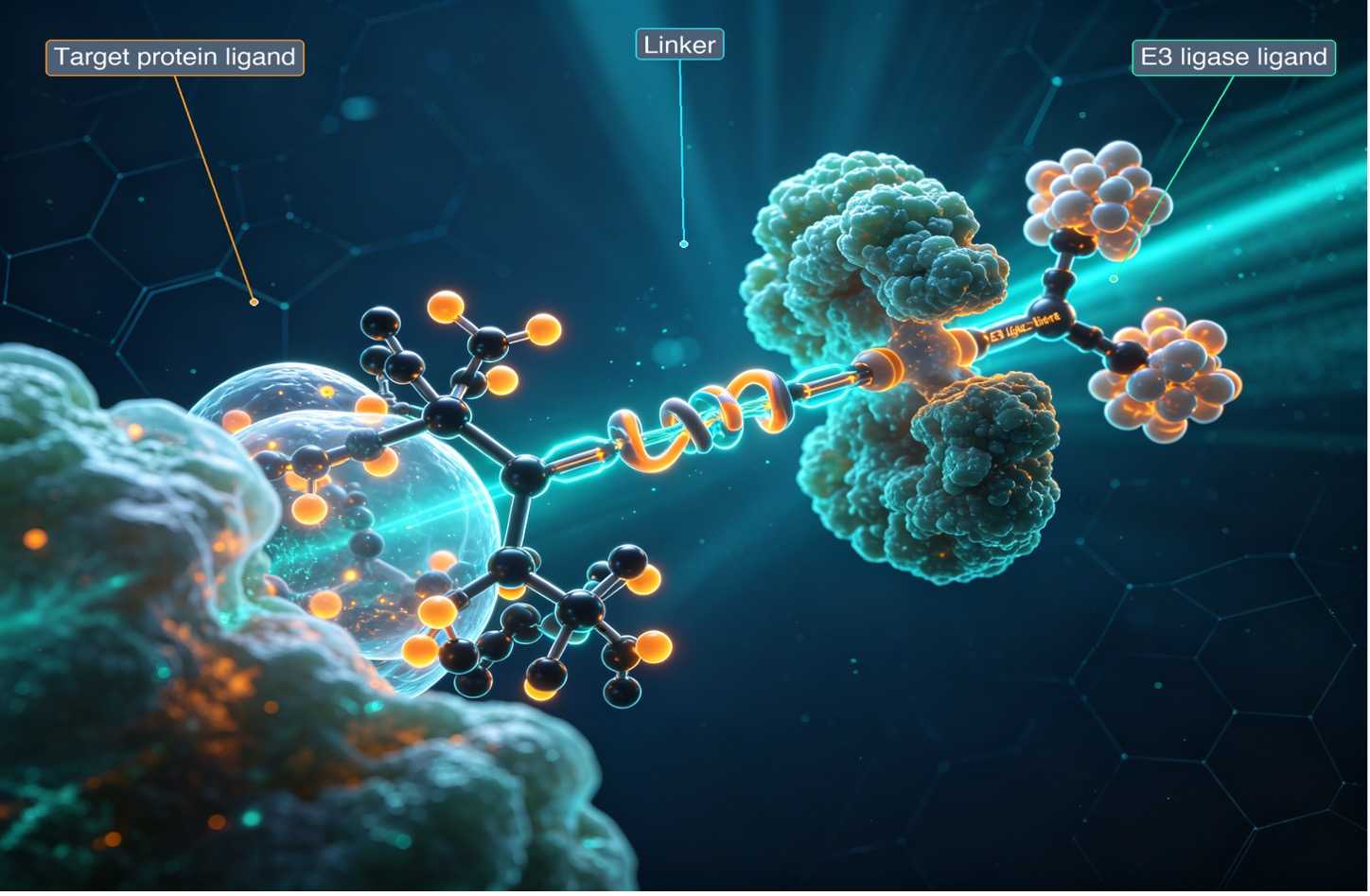 Fig.1 Ternary complex structure in protein degradation.