In Silico Target Protein Structural & Degradability Feasibility Assessment Service
BackgroundWhat We Can Offer?WorkflowWhy Us?FAQRelated Services
Creative Biolabs provides the novel In Silico Target Protein Structural & Degradability Feasibility Assessment Service deploys AI-driven structural prediction, atomistic loop dynamics, and surface topography mapping to evaluate, score, and validate target degradability-delivering definitive Go/No-Go decision gates before embarking on chemical synthesis.
Background of In Silico Target Protein Structural & Degradability Feasibility Assessment
Not all proteins are equally amenable to proteasomal clearance. In targeted protein degradation (TPD), embarking on a costly wet-lab chemistry campaign without first verifying the structural feasibility and intrinsic "degradability" of a Target Protein of Interest (POI) presents a major strategic risk. A POI may possess high-affinity ligands yet completely resist degradation due to buried surface lysines, unfavorable ubiquitin-transfer geometry, rapid protein turnover, or an excessively rigid tertiary fold.
Traditional drug discovery evaluates targets based on pocket druggability and binding site availability. TPD, however, demands a multi-factor structural evaluation. For successful polyubiquitination and 26S proteasomal processing, a target protein must fulfill specific structural prerequisites:
Surface Lysine Spatial Accessibility: Presenting exposed, reactive lysine (Lys) residues within a flexible loop or disordered region capable of entering the 10-30Å catalytic window of an E2-E3 ligase ensemble.
Structural Plasticity & Unfolding Energy: Possessing local conformational flexibility or an adaptable domain structure that permits partial unfolding required for proteasomal entry.
Endogenous Turnover & Abundance Balance: Exhibiting baseline half-life (t1/2) and synthesis kinetics that allow event-driven catalytic degradation to outpace target resynthesis.
Investigating target degradability empirically through high-throughput Western blotting, mass spectrometry, or cell line engineering is time-consuming and expensive-especially for novel, non-enzymatic, or membrane-associated targets. In silico degradability assessment intercepts undruggable or non-degradable targets computationally. By integrating structural bioinformatics, molecular dynamics (MD), and surface electrostatics, our platform establishes target feasibility, identifies optimal binder attachment pockets, and highlights potential structural liabilities early in R&D.
Fig.1 Schematic overview of the three strategies to predict the 3D structure of a ternary complex.1
How Creative Biolabs' In Silico Target Protein Structural & Degradability Feasibility Assessment Service Can Assist Your Project?
Evaluating a target's intrinsic structural feasibility requires combining deep-learning structural modeling with dynamic biophysical simulations. Creative Biolabs provides a comprehensive suite of assessment tools:
AI-Powered 3D Structural Resolution: Utilizing advanced structural prediction algorithms (e.g., AlphaFold3, ESMFold) and homology modeling to generate high-fidelity 3D models for targets, mutated variants, and flexible protein complexes lacking experimental X-ray/Cryo-EM structures.
Proteome-Wide Surface Lysine & Ubiquitination Zone Mapping: Algorithmic scoring of surface-accessible solvent area (SASA), pKa shifts, and spatial distribution of all surface lysines to map high-probability polyubiquitination zones.
Cryptic Pocket Discovery & Allosteric Site Profiling: Enhanced sampling molecular dynamics (MD) to uncover transient, allosteric, or cryptic surface grooves on "undruggable" non-enzymatic proteins suitable for warhead recruitment.
Structural Plasticity & Proteasomal Entry Assessment: Normal Mode Analysis (NMA) and thermodynamic stability modeling (ΔGunfolding) to evaluate whether target domains can undergo proteasome-mediated translocation and unfolding.
Target Turnover & Kinetic Feasibility Modeling: Quantitative systems biology modeling factoring baseline protein expression, synthesis rates, and half-life (t1/2) to predict achievable degradation maximums (Dmax).
Workflow of In Silico Target Protein Structural & Degradability Feasibility Assessment Service
Stage 1
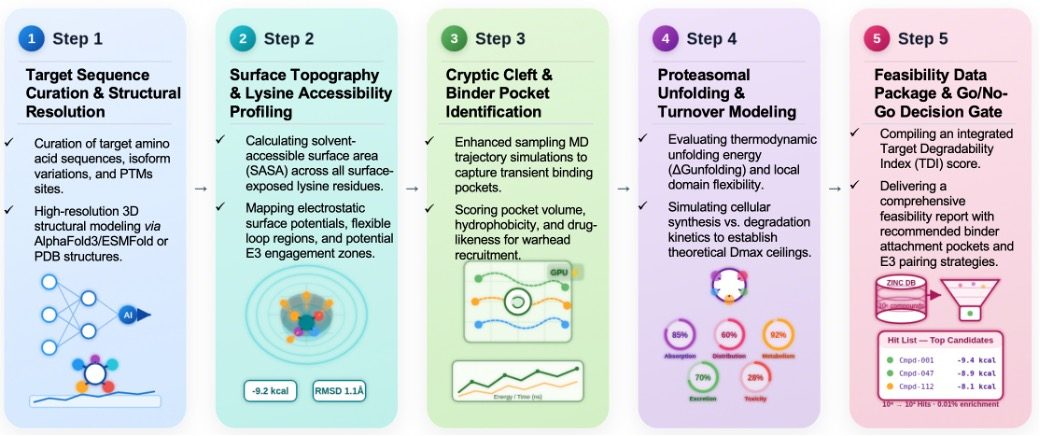
Target Sequence Curation & Structural Resolution
Curation of target amino acid sequences, isoform variations, and post-translational modification (PTM) sites.
High-resolution 3D structural modeling via AlphaFold3/ESMFold or energy minimization of PDB structures.
Enhanced sampling MD trajectory simulations to capture transient binding pockets and cryptic grooves.
Scoring pocket volume, hydrophobicity, and drug-likeness for warhead recruitment.
Stage 4
Proteasomal Unfolding & Turnover Modeling
Evaluating thermodynamic unfolding energy (ΔGunfolding) and local domain flexibility.
Simulating cellular synthesis vs. degradation kinetics to establish theoretical Dmax ceilings.
Stage 5
Feasibility Data Package & Go/No-Go Decision Gate
Compiling an integrated Target Degradability Index (TDI) score.
Delivering a comprehensive feasibility report with recommended binder attachment pockets and E3 pairing strategies.
Advantages of Our Services
At Creative Biolabs, our computational structural framework offers a purpose-built platform designed specifically to evaluate target feasibility through the lens of event-driven degradation mechanics. By combining deep-learning structural prediction with dynamic surface analysis, we help research teams select high-confidence targets and de-risk early discovery campaigns with speed and clarity.
Targeted Specifically for TPD Mechanics
Evaluates targets based on multi-body degradation criteria-such as surface lysine SASA and unfolding dynamics-rather than simple active-site occupancy.
Resolving "Undruggable" Targets
Specialized in identifying transient pockets, allosteric sites, and cryptic clefts on non-enzymatic proteins, transcription factors, and scaffolding units.
Data-Driven Go/No-Go Decision Gates
Delivers quantitative feasibility scores that prevent resource allocation to structurally resistant target candidates.
Rapid Turnaround & High Capacity
Delivers fully validated target degradability profiles within 1-2 weeks to accelerate portfolio prioritizing.
Seamless CRO Integration
Computational feasibility insights transition directly into Creative Biolabs' downstream ligand screening, binary/ternary modeling, custom synthesis, and cellular degradation validation.
Frequently Asked Questions
Q1: Why is a structural degradability assessment necessary if high-affinity ligands for the target already exist?
A1: High-affinity binding does not guarantee target degradation. If a target lacks accessible surface lysines near the E3 engagement zone, possesses an excessively rigid domain that resists proteasomal translocation, or exhibits rapid cellular resynthesis, degrader molecules will fail to induce robust knockdown Dmax. Assessing degradability beforehand avoids unproductive synthetic chemistry.
Q2: Can your platform assess targets that lack published experimental 3D structures?
A2: Yes. We combine state-of-the-art AI protein structure prediction algorithms (e.g., AlphaFold3, ESMFold) with enhanced sampling molecular dynamics to build dynamic, high-confidence 3D structural models of uncharacterized targets, mutated variants, and flexible protein domains.
Q3: How does the platform identify optimal surface lysines for polyubiquitination?
A3: Our trajectory algorithms analyze the solvent-accessible surface area (SASA), local electrostatic environment, conformational flexibility, and pKa shifts of every lysine residue on the target protein, ranking them by their probability of accepting ubiquitin transfer from an E2-E3 complex.
Q4: What structural features make a target "resistant" to proteasomal degradation?
A4: Common structural liabilities include a total absence of surface-exposed lysines, lysines buried within rigid hydrophobic cores, highly stable secondary structures that resist proteasomal unfolding, or sterically hindered surfaces that prevent ternary complex assembly.
Q5: What downstream services are available once a target is confirmed feasible for degradation?
A5: Creative Biolabs provides a complete continuum of TPD CRO services. Validated targets can seamlessly transition into our in silico target ligand screening, E3 recruiter selection, linker design, custom organic synthesis, and cell-based degradation assays (Western blot).
Launching a successful targeted protein degradation program requires establishing a rock-solid structural foundation. Creative Biolabs' computational target degradability assessment suite provides the predictive clarity, surface mapping, and biophysical insight needed to prioritize high-confidence targets-ensuring your R&D resources are focused on candidates with maximum clinical promise. If you have any problems, please do not hesitate to contact us for more details.
Contact Our Team for More Information and to Discuss Your Project →
Reference
Solazzo, Riccardo, Shu-Yu Chen, and Sereina Riniker. "Machine learning, docking, or physics for structure prediction of ligand-induced ternary complexes." Current Opinion in Structural Biology 97 (2026): 103217. Distributed under Open Access license CC BY 4.0, without modification. https://doi.org/10.1016/j.sbi.2025.103217


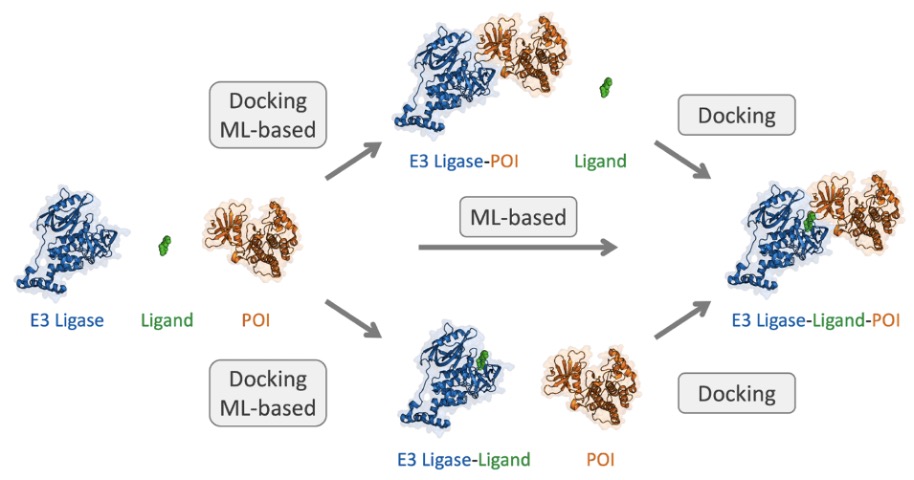 Fig.1 Schematic overview of the three strategies to predict the 3D structure of a ternary complex.1