Agonist Neurite Outgrowth Assay Service
The agonist neurite outgrowth assay is a laboratory technique used to assess the ability of specific compounds (agonists) to promote the extension of neurites from neuronal cells, indicating their potential to stimulate neuronal growth and differentiation.
A Critical Process: Extension of Neurites
The extension of neurons, a crucial process in the development and functioning of the nervous system, involves the growth of long, slender projections known as axons and dendrites. During neural development, these extensions emerge from the neuronal cell body and are guided by a complex interplay of molecular signals and environmental cues. Axons are responsible for transmitting electrical impulses away from the cell body to communicate with other neurons or target tissues, while dendrites receive signals from other neurons, facilitating synaptic connections. The proper growth and branching of these extensions are essential for forming intricate neural networks, enabling efficient information processing, and ensuring that the nervous system can adapt to changes and injuries. Disruptions in this process can lead to developmental disorders and neurological diseases, underscoring the importance of understanding neuronal extension in both health and disease.
Agonist Neurite Outgrowth Assay at Creative Biolabs
Our service provides you with a robust platform to evaluate the effects of various compounds on neuronal growth and differentiation. Utilizing established neuronal cell lines or primary neurons, this assay measures neurite outgrowth in response to agonist treatments, enabling the identification of potential neuroregenerative therapeutics. By quantifying parameters such as neurite length, branching, and overall cell morphology, the service delivers comprehensive insights into the efficacy of test compounds. The assay is adaptable to various experimental conditions, allowing for the assessment of different dosages, treatment durations, and environmental factors.
Alpha-Synuclein A53T Parkinson's Disease Genetic Cell-Based Assay
The Alpha-Synuclein A53T mutation is one of the genetic variants associated with familial Parkinson's disease, characterized by the misfolding and aggregation of alpha-synuclein protein, leading to neurodegeneration. Research on this mutation often involves various cell-based assays to investigate its effects on cellular functions, including neurite outgrowth, which is an important indicator of neuronal health and development.
APOEε4 C130R Sporadic Alzheimer's Disease Genetic Cell-Based Assay
The APOEε4 allele is associated with an increased risk of sporadic Alzheimer's disease (AD) and plays a significant role in neurodegeneration and neurite outgrowth pathways. Studying the effects of this allele in cellular models can provide insights into the molecular mechanisms underlying AD. A neurite outgrowth assay can help investigate how genetic factors influence neuronal health and connectivity.
APP- PS1- MAPT Familial Alzheimer's Disease Genetic Cell-Based Assay
The APP-PS1-MAPT familial Alzheimer's disease genetic cell-based agonist neurite outgrowth assay is a specialized laboratory technique used to study the cellular mechanisms associated with familial AD and the effects of potential therapeutic agents on neuronal growth and development.
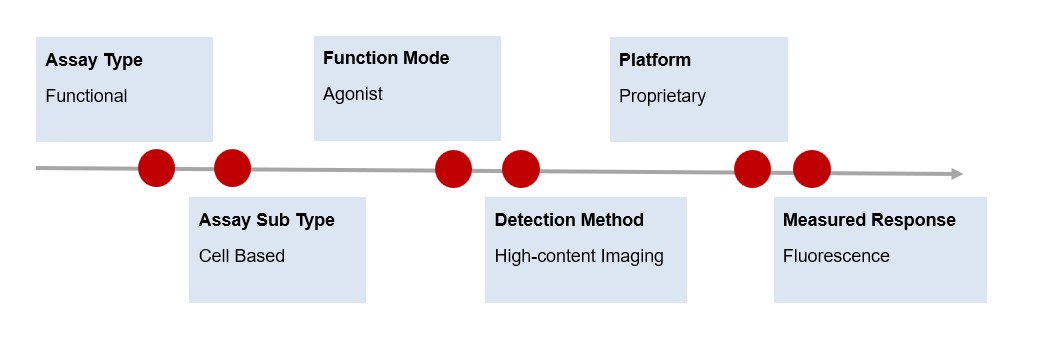

Neuronal cells, often derived from rodent or human sources, are cultured under specific conditions to ensure optimal health and viability.
The cells are treated with different agonists (test compounds) that are hypothesized to promote neurite outgrowth. Control groups may be included without treatment for comparison.
The cells are incubated for a defined period, allowing time for the agonists to exert their effects on neurite growth.
After the incubation, the cells are stained with specific dyes that highlight neurites, making them visible under a microscopy setup.
Using image analysis software, parameters such as neurite length, branching points, and overall morphology are quantified to assess how the agonist impacted neurite outgrowth.
The results are analyzed statistically to determine the significance of the agonists on neuronal growth compared to control conditions.
Frequently Asked Question
Q1: What is the time period for agonist neurite outgrowth assay?
A1: The agonist neurite outgrowth assay is typically performed over a month and can vary depending on the specific experimental design and the type of neurons or neuroblastoma cells being studied. It's essential to optimize the conditions for each specific assay, as different cell types and agonists may require different timelines for optimal results.
Contact Us
At Creative Biolabs, we specialize in advanced neurobiological research and are proud to offer our Agonist Neurite Outgrowth Assay services. Our cutting-edge assays are designed to support researchers and laboratories in exploring neurite development and enhancing understanding of neurodegenerative diseases. Whether you're seeking to evaluate potential therapeutic compounds or gain insights into neuronal growth mechanisms, our expert team is here to assist you. For inquiries or to discuss how we can tailor our services to meet your specific research needs, please contact us. We look forward to collaborating with you in advancing neuroscience research!
For Research Use Only | Not For Clinical Use


 Download our brochure