Fighting cancer resistance? Creative Biolabs offers immune checkpoint blocking (ICB)-based therapy development services. Get expert second opinions for truly personalized cancer treatment strategies.
Learn More →Nanomaterial based Sonosensitizer Development Service for Advanced Sono-Immunotherapy
Background How We Assist Publication Why Choose Us FAQs Customer Review Related Services Contact Us
Accelerate Your Cancer Immunotherapy Innovations!
The nanomaterials-based sonosensitizer development service focuses on creating advanced agents that harness ultrasound energy to precisely target and treat cancer. This innovative approach, known as sono-immunotherapy, combines direct tumor cell destruction with the activation of the body's immune system. By leveraging the unique properties of nanomaterials, such as enhanced tumor accumulation and diverse activation mechanisms, Creative Biolabs overcomes limitations of traditional therapies. Creative Biolabs' service is grounded in extensive research, as highlighted by recent advancements in sonodynamic therapy, piezoelectric nanomaterials, and microbubble-mediated drug delivery, demonstrating the profound potential of this synergistic strategy.
Workflow
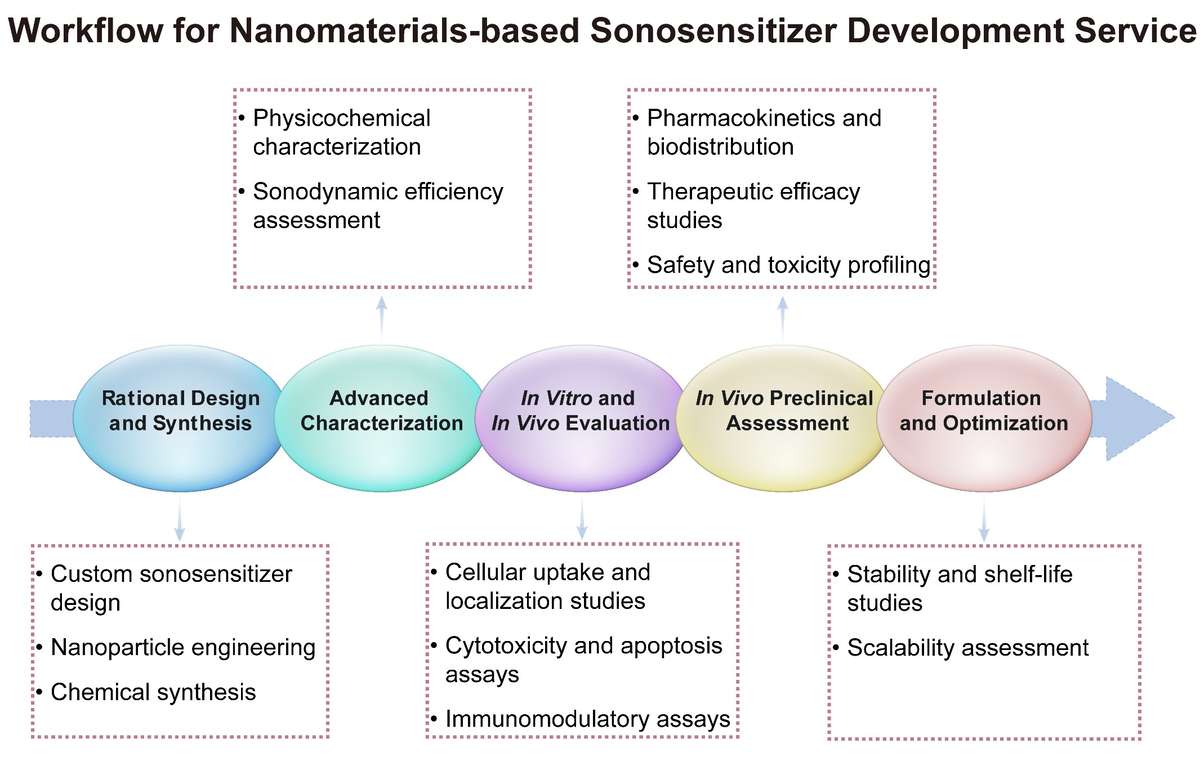
Our comprehensive workflow is designed for clarity, efficiency, and successful outcomes, making it ideal for visualization as a flowchart. Creative Biolabs ensures each step is meticulously executed to meet your project's unique demands.
Publication
This review introduces the challenge of poor therapeutic effects from hydrophobic organic sonosensitizers. Huang's group designed phthalocyanine-artesunate couplets (e.g., ZnPcT4A), demonstrating that their aggregated forms significantly enhance sonodynamic reactive oxygen species generation compared to non-aggregated states. For instance, ZnPcT4A aggregates in water showed 60 times higher ROS production. This aggregation-enhanced sonodynamic activity was also observed in other sonosensitizers, suggesting a common phenomenon. This discovery fundamentally shifts the conventional design strategy, which typically avoids aggregation. Both in vitro and in vivo studies confirmed that ZnPcT4A aggregates exhibit high biosafety and achieve a remarkable 98% tumor growth inhibition, paving a new path for developing highly efficient organic sonosensitizers.
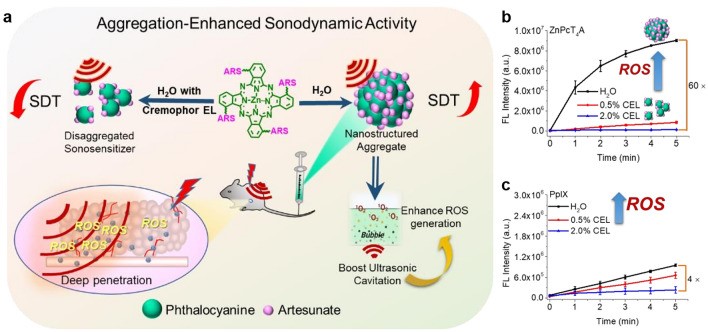 Fig.1 Phthalocyanine-artesunate couplets enhance SDT activity.1
Why Choose Us?
Creative Biolabs stands as a leader in nanomedicine and immunotherapy, offering unparalleled expertise in nanomaterials-based sonosensitizer development. We offer a vast nanomaterial library, integrated therapeutic and immunological insights, advanced characterization platforms, and regulatory guidance. Our commitment ensures intelligent design, rapid prototyping, and scalable solutions, accelerating groundbreaking sono-immunotherapies toward clinical success. Our commitment to scientific rigor, innovative solutions, and unwavering client success sets us apart. We don't just provide a service; we become an extension of your research team, dedicated to overcoming your most challenging therapeutic hurdles and bringing groundbreaking therapies to fruition.
Frequently Asked Questions (FAQs)
Q1: How do your nanomaterials ensure targeted delivery to tumors and minimize side effects?
A1: Creative Biolabs ensures high tumor specificity by leveraging the EPR effect for passive accumulation. We also functionalize nanomaterials with active targeting ligands (antibodies, peptides, aptamers) for exclusive binding to cancer cells, significantly enhancing precision and reducing systemic toxicity.
Q2: What kind of support does Creative Biolabs offer beyond the initial development of the sonosensitizer?
A2: Our Creative Biolabs partnership offers comprehensive analytical support, data interpretation, and expert recommendations. Our capabilities include process optimization for scalability and regulatory guidance, ensuring smooth transition to clinical trials.
Q3: What types of sonosensitizers can Creative Biolabs optimize or develop?
A3: Creative Biolabs optimizes diverse sonosensitizers: organic compounds, inorganic nanoparticles (TiO2, Bi-based, semiconductors, Fenton-like), MOFs, and cellular sonosensitizers. Our expertise provides tailored solutions and explores novel materials for your therapeutic goals.
Customer Reviews
-
Problem Solved.
Creative Biolabs helped us overcome the challenge of systemic toxicity associated with our previous sonosensitizer candidates. Their functionalization expertise allowed for the development of a highly tumor-specific nanoparticle, drastically reducing off-target effects and improving the therapeutic index. - Dr. P. A. S*nders
-
Streamlined Development.
Creative Biolabs' comprehensive in vitro evaluation of our sonosensitizer candidates streamlined our early-stage development, saving us time and resources by focusing on the most promising options. - Dr. E. R. Cl*rk
Related Services
To further support your research and development in advanced cancer therapies, Creative Biolabs offers a suite of complementary services that can be seamlessly integrated with our nanomaterials-based sonosensitizer development service. These offerings are designed to provide a holistic solution for your oncology and immunology projects.
Immune ICB Therapy Development
Antibody and Protein Pharmacology
As a leading contract research organization, Creative Biolabs offers comprehensive preclinical testing for cancer immunotherapy. This includes pharmacology, toxicology, and efficacy models, accelerating your therapeutic development.
Learn More →How to Contact Us
Ready to revolutionize your cancer therapy project? Our team of experienced scientists at Creative Biolabs is eager to discuss your specific needs and demonstrate how our Nanomaterials-based Sonosensitizer Development Service can accelerate your breakthroughs. Don't miss the opportunity to partner with a leader in the field.
Learn More & Discuss. Contact Our Team.
Reference
- Yang, Mengyao, et al. "Nanomaterials enhanced sonodynamic therapy for multiple tumor treatment." Nano-Micro Letters 17.1 (2025): 157. Distributed under Open Access license CC BY 4.0, without modification. DOI: https://doi.org/10.1007/s40820-025-01666-8
 Download our brochure
Loading case studies...
Online Inquiry