Creative Biolabs provides complete sonosensitizer development, from design to characterization, optimizing agents for enhanced tumor targeting and immune activation in sono-immunotherapy.
Learn More →Targeted Sonosensitizer Optimization Services for Advanced Sono-Immunotherapy
Background What We Offer Workflow Publication Why Choose Us FAQs Customer Review Related Services Contact Us
Targeted Sonosensitizer Optimization: Creative Biolabs' Expertise in Sono-Immunotherapy
At Creative Biolabs, we specialize in targeted sonosensitizer optimization services, providing bespoke solutions for your sono-immunotherapy projects. We overcome the complexities of sonosensitizer development, transforming your therapeutic concepts into tangible advancements. This critical advancement in cancer treatment focuses on precisely engineering agents that amplify ultrasound's therapeutic effects while specifically targeting tumor cells. By optimizing sonosensitizer properties through advanced design and rigorous testing, we enhance tumor-specific accumulation, boost reactive oxygen species generation, and promote robust anti-tumor immune responses, offering a highly promising avenue for future cancer therapies. Creative Biolabs is at the forefront of these developments.
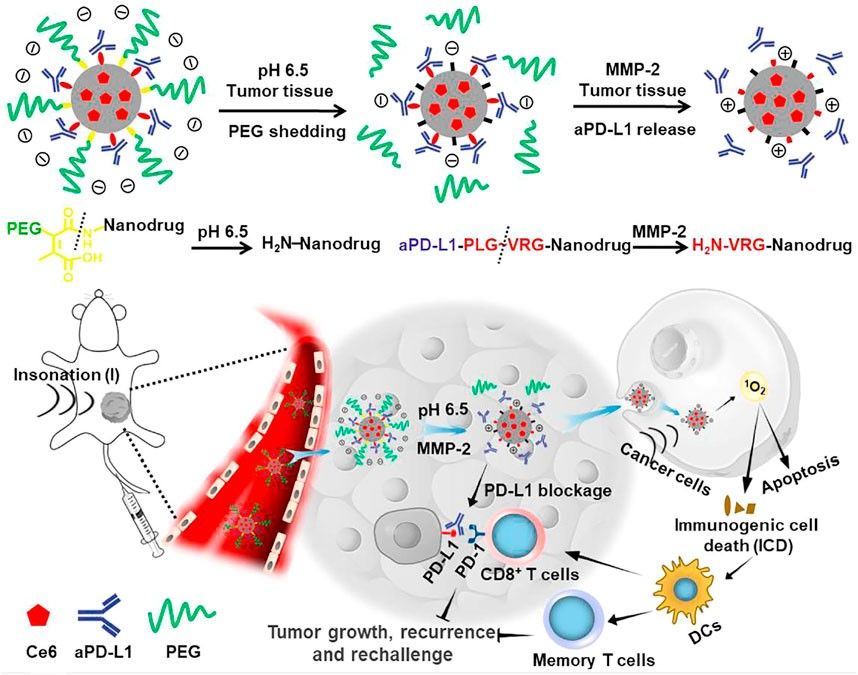 Fig.1 The PEG-coated nanodrugs for tumor-targeting combinational SDT and immunotherapy of cancer.1,3
Discover How Creative Biolabs Can Help
Comprehensive Sonosensitizer Development Services
Advanced Sonosensitizer Structure Optimization Service
Creative Biolabs meticulously optimizes sonosensitizer structures, enhancing their targeting precision and reactive oxygen species generation for superior therapeutic outcomes in advanced sono-immunotherapy.
Learn More →Sonosensitizer Chemical Enhancement Service
Creative Biolabs' chemical enhancement service refines sonosensitizer properties like solubility and stability, boosting reactive oxygen species generation and tumor-targeted delivery. This optimizes your advanced sono-immunotherapy for a more potent anti-tumor immune response.
Learn More →A Systematic Approach to Sonosensitizer Optimization
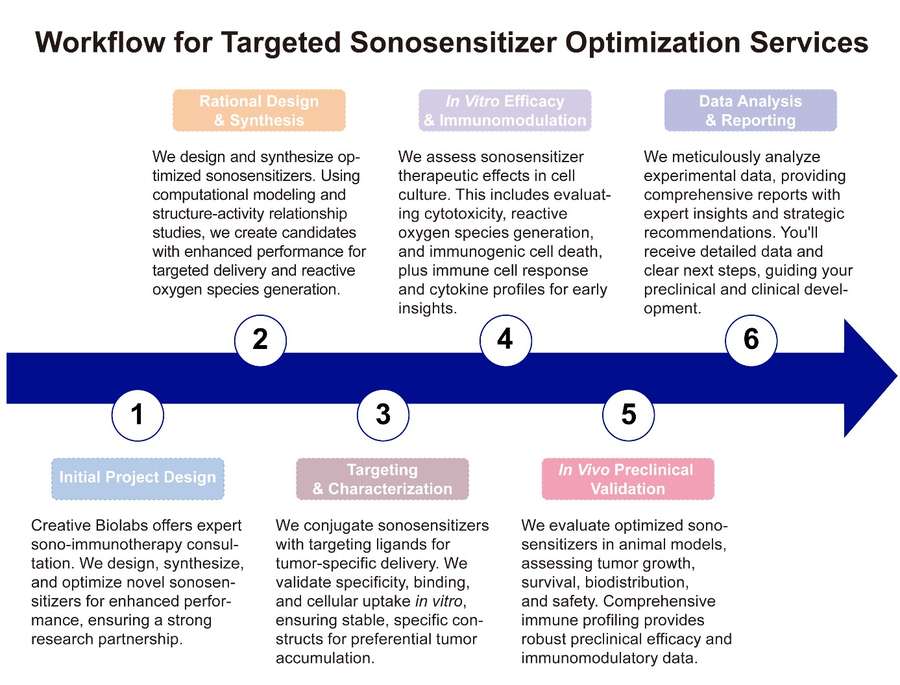
Our refined workflow transforms your concept into a validated therapeutic agent through a collaborative and efficient journey. Each meticulously managed stage ensures transparency and delivers measurable outcomes, all easily visualized in a clear, step-by-step flowchart.
Publication
The combination of sonodynamic therapy (SDT) and immunotherapy is a promising cancer treatment strategy. SDT, which uses ultrasound-activated sonosensitizers to generate reactive oxygen species (ROS), can enhance antitumor immunity. For instance, combining HMME-directed SDT with programmed cell death ligand 1 (PD-L1) antibodies has been shown to increase dendritic cell production and pro-inflammatory cytokines, leading to reduced tumor volume and metastatic nodules, alongside increased CD8+ T effector cells.
Furthermore, novel sonosensitizers like TiO2-based nanoparticles are being developed for dual targeting, enhancing SDT. These functionalized sonosensitizers demonstrate precise tumor targeting and high cellular uptake, leading to significant ROS-mediated killing of cancer cells in vitro. In animal models of melanoma, these compounds exhibit long-term tumor retention, contributing to synergistic immune checkpoint targeting and enhanced SDT in vivo.
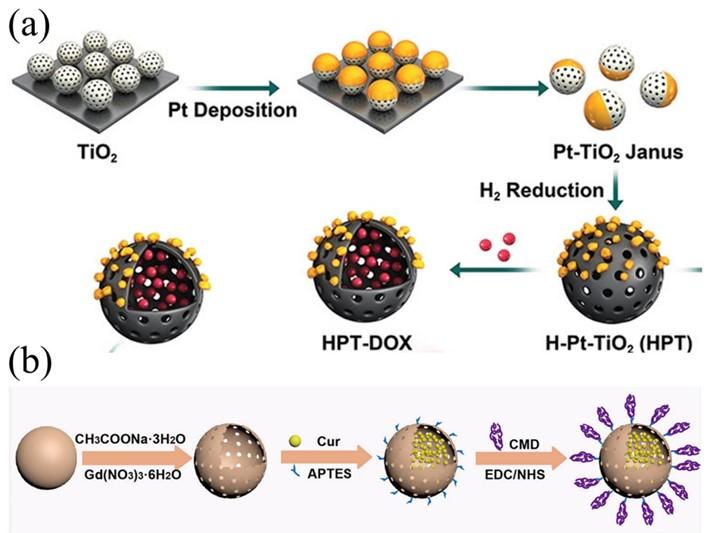 Fig.2 Designing smart nanocarriers for targeted delivery and enhanced sono-dynamic therapy (SDT) in diverse cancer therapeutic modalities.2,3
Why Choose Us?
Choosing Creative Biolabs for targeted sonosensitizer optimization means partnering with a leader dedicated to accelerating your breakthroughs. Our unparalleled expertise stems from a multidisciplinary team with deep knowledge in ultrasound physics, materials science, immunology, and oncology, ensuring holistic solutions to complex challenges.
We offer cutting-edge technology, including advanced instrumentation and proprietary methodologies for sonosensitizer synthesis, characterization, and in vivo evaluation. This infrastructure enables precise and efficient development. Our accelerated research and development through streamlined workflows significantly reduce timelines, helping you innovate faster. We provide tailored solutions, highly customizable to your unique research objectives, and comprehensive support from initial concept to preclinical validation, ensuring robust data and clear insights for your success.
FAQs
Q1: What types of sonosensitizers can Creative Biolabs optimize?
A1: Creative Biolabs specializes in optimizing diverse sonosensitizers—nanoparticles (polymeric/lipid/metallic), microbubbles, and small molecules—adapting novel or existing compounds to enhance targeted delivery and therapeutic efficacy for varied applications.
Q2: How does your service ensure tumor-specific targeting?
A2: Our services use advanced strategies for sono-immunotherapy to target tumors, including conjugating sonosensitizers with specific ligands that recognize tumor-associated antigens. This ensures preferential accumulation at the tumor site, minimizing off-target effects and maximizing therapeutic impact.
Q3: What kind of data will I receive from your in vivo efficacy studies?
A3: Our in vivo efficacy studies provide comprehensive data, including tumor growth inhibition curves, animal survival rates, and biodistribution profiles. This robust data package supports preclinical and potential clinical development, providing clear evidence of safety and efficacy.
Customer Review
-
Enhanced Specificity
Using Creative Biolabs' targeted sonosensitizer optimization services in our research has significantly improved the tumor-specific delivery of our lead compound. Their expertise in ligand conjugation and in vitro validation was instrumental in achieving this critical milestone, providing us with highly targeted agents. - Prof. M. J*ckson
-
Accelerated Development
The comprehensive in vivo efficacy studies conducted by Creative Biolabs for our sonosensitizer candidate drastically accelerated our preclinical development timeline. Their detailed reports and expert recommendations were invaluable for our next steps, allowing us to progress our therapy much faster than anticipated. - Prof. S. L*wis
-
Reduced Toxicity
Creative Biolabs' meticulous optimization of our sonosensitizer's activation profile led to a remarkable reduction in off-target effects. This precision engineering has opened new avenues for safer and more effective sono-immunotherapy applications, a crucial factor for clinical translation. - Dr. R. G*bson
Related Services
To further support your comprehensive research and development needs in oncology and immunotherapy, Creative Biolabs offers a suite of complementary services designed to accelerate your scientific progress:
Programming CAR Technologies
Creative Biolabs engineers CAR-T cells to overcome toxicity and recurrence, significantly improving cancer treatment efficacy. Our advanced modifications aim for safer, more durable responses in difficult-to-treat cancers, pushing the boundaries of cellular immunotherapies.
Learn More →Syngeneic Models
Creative Biolabs provides comprehensive syngeneic mouse models for evaluating cancer immunotherapies. These models offer functional immune systems, enabling robust assessment of your therapeutic candidates' efficacy in a relevant in vivo environment.
Learn More →How to Contact Us
Ready to advance your sono-immunotherapy project with a trusted partner? Our team of experts at Creative Biolabs is eager to discuss your specific needs and provide tailored solutions that align with your scientific and business objectives.
Welcome to Your Inquiry. Contact Us to Learn More and Discuss Your Project.
References
- Cheng, Danling, et al. "Nanosonosensitizers with ultrasound-induced reactive oxygen species generation for cancer sonodynamic immunotherapy." Frontiers in Bioengineering and Biotechnology 9 (2021): 761218. DOI: https://doi.org/10.3389/fbioe.2021.761218
- Chen, Peng, et al. "A comprehensive review of inorganic sonosensitizers for sonodynamic therapy." International journal of molecular sciences 24.15 (2023): 12001. DOI: https://doi.org/10.3390/ijms241512001
- Distributed under Open Access license CC BY 4.0, without modification.
 Download our brochure
Loading case studies...
Online Inquiry