RAW 264.7 Cell based Antagonist Assay Service
Creative Biolabs offers state-of-the-art RAW 264.7 cell-based antagonist assays tailored to evaluate the antagonistic effects of various compounds on inflammatory mediators. Our services include precisely controlled conditions to ensure the reliability of data. Stimulation of RAW 264.7 cells with agents such as lipopolysaccharides (LPS) and subsequent inhibition assays are conducted utilizing advanced methodologies. We perform spectrophotometric measurements of nitric oxide (NO), enzyme-linked immunosorbent assays (ELISA) for prostaglandin E2 (PGE2) levels, and Western blots for cyclooxygenase-2 (COX-2) and inducible nitric oxide synthase (iNOS) expression.
Introduction of the RAW 264.7 Cell-based Antagonist Assay
RAW 264.7 cells, derived from BALB/c mice, are a widely recognized and indispensable model for studying macrophage biology and inflammatory responses. Displaying macrophage-like features such as phagocytosis and inflammatory mediator production upon stimulation, they serve as the gold standard cellular model for screening anti-inflammatory drugs. Their robust response to LPS activates the signaling cascade, leading to the synthesis and release of key inflammatory mediators like NO, PGE2, TNF-α, and IL-6. Creative Biolabs leverages this model to screen antagonists that block inflammation initiation, providing critical preclinical evidence for therapeutic potential.
Key Inflammatory Markers and Advanced Readouts
| Inflammatory Mediator | Detection Methodology | Therapeutic Relevance |
|---|---|---|
| NO | Spectrophotometric Measurement (e.g., Griess Assay) | Key driver of vasodilation, implicated in septic shock and neurodegeneration. |
| PGE2 | High-Sensitivity ELISA | Major mediator of pain, fever, and inflammation, often targeted by NSAIDs. |
| iNOS | Western Blot Analysis | The enzyme responsible for NO production, a prime target for anti-inflammatory drug development. |
| COX-2 | Western Blot Analysis | Rate-limiting enzyme in PGE2 synthesis; inhibition is crucial for reducing inflammation. |
| Pro-inflammatory Cytokines (TNF-α, IL-6) | Sensitive ELISA | Central regulators of the immune response and systemic inflammation. |
Experience the Creative Biolabs Advantage - Get a Quote Today and start translating your research into definitive drug leads.
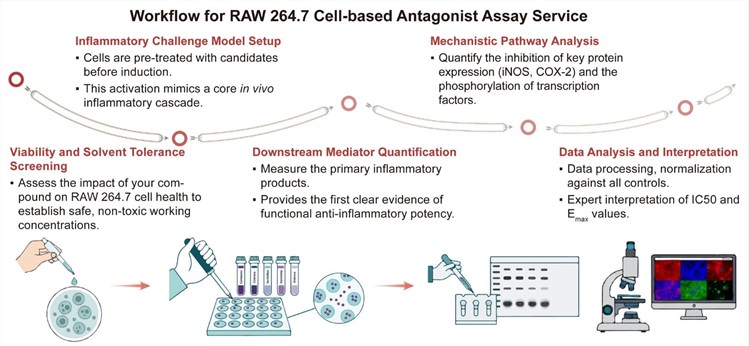
Comprehensive Workflow for High-Confidence Data Generation
We offer a systematic and highly controlled process that guarantees reliable, translational data, suitable for visualization as a flowchart. Understanding the flow ensures you know precisely where your compounds are at every stage of the evaluation.
Publication
| Summary | The utility of RAW 264.7 cell-based assays in studying inflammatory responses is well-documented. For example, DMSO has been shown to alleviate LPS-induced inflammatory responses in RAW 264.7 cells by inhibiting NF-κB and MAPK activation, showcasing the assay's capability to evaluate potential anti-inflammatory compounds accurately. |
| Result |
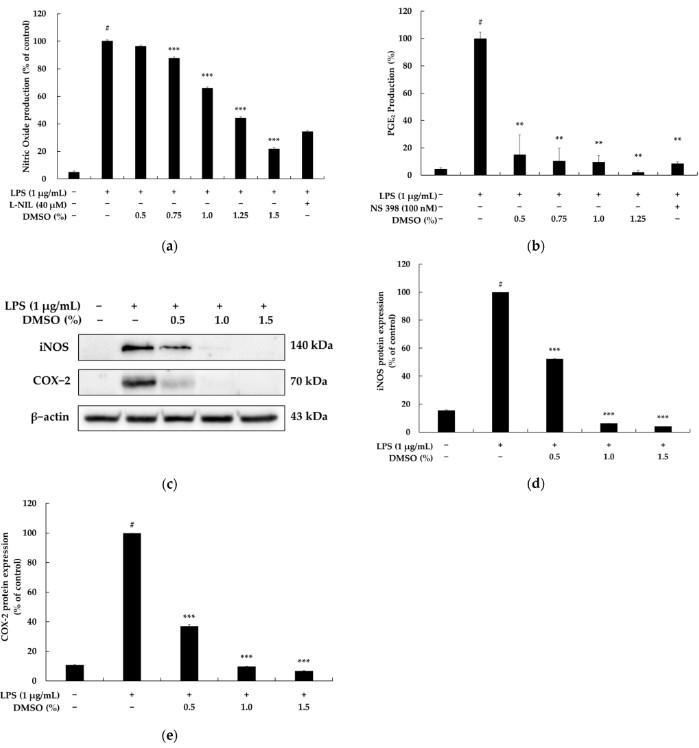 Fig.1 Influence of DMSO on the production of pro-inflammatory mediators in LPS-stimulated RAW 264.7 cells.1 |
Why Choose Us
Choosing Creative Biolabs means partnering with a team offering unparalleled scientific rigor and mechanistic insight, converting your research investment into high-confidence drug leads. We leverage 20+ years of pioneering expertise to accelerate your pipeline. Our rigorous quality assurance and solvent management ensure reliable, reproducible data by stringently controlling phenotypic stability, mycoplasma, and vehicle effects. We offer mechanistic depth and translational focus, designing assays to elucidate precise pathways like NF-κB and MAPK inhibition or TLR4 antagonism, providing crucial IND-enabling data. Our platform boasts high-throughput and customization capabilities, scalable for rapid HTS while remaining flexible for tailored assay development and optimization.
Experience the Creative Biolabs Advantage - Get a Quote Today and start translating your research into definitive drug leads.
FAQs
How does the RAW 264.7 assay compare to primary macrophage assays, and what are the advantages?
We frequently recommend starting with the RAW 264.7 assay for primary potency screening before validating leads in a customized primary cell assay, ensuring maximum efficiency and data quality.
My compounds are dissolved in DMSO. How can you ensure the results are not influenced by the solvent?
Our assay includes a viability screen for vehicle toxicity and vehicle-only controls to quantify solvent effects, ensuring reported antagonist activity is solely attributed to your test compound.
Is this assay suitable for both small-molecule inhibitors and large-molecule biologics?
Our RAW 264.7 platform is highly versatile, ideal for screening small molecules and biologics like antibodies targeting macrophage surface receptors or cytokines. We customize incubation protocols based on candidate molecular size.
Customer Review
-
Exceptional Potency Data
The detailed western blot data on iNOS and NF-κB p65 phosphorylation were instrumental in our patent application. We appreciated the precaution taken to correct for DMSO-related effects. - Dr. J***es P -
High-Throughput Efficiency
Their HTS capacity quickly filtered our 5,000-compound library down to 12 high-priority hits, achieving a faster result than our in-house systems. The final report clarity was outstanding. - Mr. G***ry K
Related Services
To further accelerate your pre-clinical development, we recommend integrating the following complementary services offered by Creative Biolabs:
Macrophage Immunophenotyping Service
Creative Biolabs offers precise macrophage immunophenotyping, leveraging two decades of experience and state-of-the-art technology. We provide deep insights into macrophage populations and functional capabilities for preclinical research and therapeutic development.
Learn More →Signaling Pathway-mediated Cancer Resistance Analysis Services
Creative Biolabs unravels cancer resistance signaling pathways, identifying critical molecules and generating systems to overcome tumor resistance. Our analysis services support diverse cancer types, advancing research and improving patient outcomes.
Learn More →Contact Us
Creative Biolabs is your trusted partner for definitive anti-inflammatory drug discovery. Our RAW 264.7 cell-based antagonist assay service provides the critical data on potency, mechanism of action, and high-quality assurance that will solidify your therapeutic lead series.
Contact Our Team for More Information and to Discuss Your Project
Reference
- Han, Hyunju, et al. "DMSO alleviates LPS-induced inflammatory responses in RAW264. 7 macrophages by inhibiting NF-κB and MAPK activation." BioChem 3.2 (2023): 91-101. Distributed under Open Access license CC BY 4.0, without modification. https://doi.org/10.3390/molecules27144603
 Download our brochure