Creative Biolabs provides reliable, rapid, and cost-effective tumor ferroptosis analysis services and platforms. We empower your research with crucial insights into this unique cell death mechanism.
Learn More →Redox-Sensitive Agent based Sonosensitizer Development Service for Advanced Sono-Immunotherapy
Background Service Content How We Assist Publication Why Choose Us FAQs Related Services Customer Review Contact Us
Revolutionizing Cancer Treatment Through Precision Sonosensitizer Design!
Creative Biolabs' redox-sensitive agent-based sonosensitizer development focuses on engineering smart therapeutic agents that specifically respond to the unique oxidative-reductive imbalance within the tumor microenvironment (TME). This strategy leverages the distinct characteristics of cancer cells, such as elevated glutathione (GSH) and hydrogen peroxide (H2O2) levels, to trigger enhanced reactive oxygen species (ROS) generation upon ultrasound activation. As demonstrated by published data and our research at Creative Biolabs, these intelligent agents can overcome TME-induced resistance, promote immunogenic cell death (ICD), and induce various forms of programmed cell death like ferroptosis, endoplasmic reticulum stress, and pyroptosis, ultimately leading to superior anti-tumor efficacy and robust immune activation.
Comprehensive Service at Creative Biolabs
Redox-sensitive agent-based sonosensitizers leverage the unique redox environment found in tumors (often characterized by high reducing agents like glutathione and low oxidizing agents) to enhance therapeutic effects. Based on their design, they can be categorized into the following general classes:
Metal Ion Valence Change-based Sonosensitizers
- Manganese (Mn)-based: Mn complexes designed to release Mn ions or alter their electronic structure under specific redox conditions, thereby impacting sonosensitization.
- Copper (Cu)-based: Specific Cu complexes (like Cu-S complexes) may dissociate under reducing conditions, releasing sonosensitizing components or inducing structural changes that yield reactive oxygen species.
- Iron (Fe)-based: Sonosensitizers incorporating iron ions where Fe(III) reduction to Fe(II), or vice-versa, promotes reactive oxygen species generation through Fenton/Fenton-like reactions ultimately enhancing sonodonamic effects.
Organic Structure Change-based Sonosensitizers
- Disulfide bond (-S-S-) modified sonosensitizers: Tumor-abundant glutathione reduces disulfide bonds, leading to molecular dissociation, conformational changes, or release of masked active sonosensitizing agents.
- Nitroreductase (NTR) and reductant-responsive nitro compounds: Certain nitroaromatic compounds undergo reduction of nitro groups, triggered by reductases, generating active species or releasing sonosensitizers.
C-loaded Redox-sensitive Enhancers
- Liposomes, polymeric micelles, mesoporous silica, and metal-organic frameworks (MOFs) are designed, with redox-sensitive bonds (such as disulfide bonds or metal centers with variable valency) incorporated, to disassemble or release sonosensitizers under tumor redox stimulation.
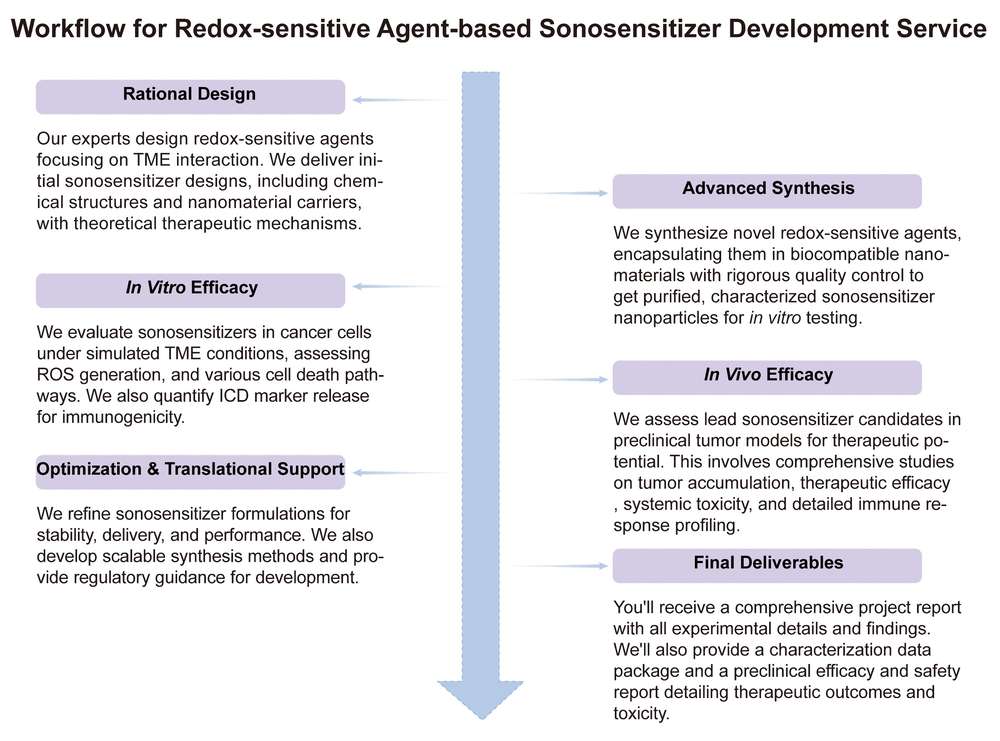
Workflow
We've perfected our workflow, taking your concept to a validated therapeutic agent through a collaborative and efficient process. Each stage is meticulously managed, ensuring transparency and delivering measurable outcomes you can easily visualize in a clear, step-by-step flowchart.
Publication
This publication introduces a novel approach to treating Glioblastoma multiforme (GBM), a highly challenging brain tumor. This study focuses on developing a new sonosensitizer for sonodynamic therapy (SDT) using copper-doped carbon dots (Cu-CDs). These Cu-CDs exhibit enhanced sonodynamic effects due to their p-n type semiconductor properties, which provide a narrower bandgap and prolonged lifespan, thereby improving electron and hole separation efficiency. Importantly, the Cu-CDs induce cuproptosis, a type of cell death, and demonstrate excellent permeability through the blood-brain barrier, effectively inhibiting glioblastoma tumor growth and prolonging survival in mice. This research supports the potential of carbon-based nanomaterials as sonosensitizers in tumor therapy.
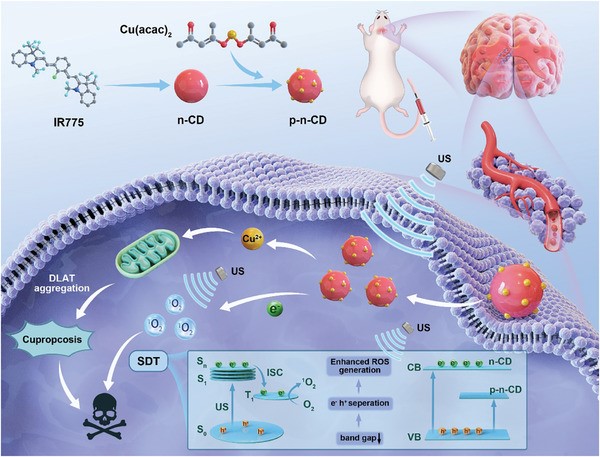 Fig.1 Optimized design and mechanism of Cu‐CDs for brain imaging and sonodynamic cancer therapy.1
Why Choose Us?
Creative Biolabs leads the way in redox-sensitive agent-based sonosensitizer development, offering unmatched expertise. With nearly two decades of dedicated experience and a relentless pursuit of scientific excellence, we ensure your project benefits from the highest standards in research and development. We're committed to delivering innovative solutions that push the boundaries of cancer therapy, making a real difference.
Frequently Asked Questions (FAQs)
Q1: What makes redox-sensitive sonosensitizers superior to conventional ones?
A1: Conventional sonosensitizers struggle with reductive, hypoxic TME. Creative Biolabs' redox-sensitive agents overcome this by modulating TME conditions, leading to enhanced, targeted ROS production, improved cell death, and stronger immune activation.
Q2: How do your sonosensitizers enhance anti-tumor immunity?
A2: Beyond direct tumor killing, Creative Biolabs' redox-sensitive sonosensitizers induce immunogenic cell death (ICD), activating the immune system. By modulating the TME's redox state, they promote DC maturation, increase T cell infiltration, and convert the environment to immune-stimulatory, enhancing anti-cancer defenses.
Q3: What types of cancer or tumor characteristics are most suitable for treatment with your redox-sensitive sonosensitizers?
A3: Our redox-sensitive sonosensitizers excel in reductive, hypoxic solid tumors, including aggressive, resistant types. Engineered to overcome these conditions, they can also be tailored to target specific tumor biomarkers, enhancing broad cancer applicability.
Related Services
To further support your comprehensive research and development goals, Creative Biolabs offers a strategic range of complementary services and specialized sub-options directly related to our photodynamic therapy agent-based sonosensitizer development service. These offerings are designed to provide an integrated solution for your therapeutic pipeline.
Tumor Cell Ferroptosis Services
Toxicity Assessment Service
Accelerate your drug pipeline with our comprehensive toxicology assessments. We provide critical safety data to de-risk development and ensure regulatory success for your novel therapies.
Learn More →Customer Reviews
-
Precise ROS Control and Novel Mechanisms!
Creative Biolabs' expertise in redox-sensitive nanoparticles and sono-photodynamic therapy helped achieve highly controllable ROS amplification for a prostate cancer SDT project. Their in vitro assays identified ER stress and pyroptosis induction as key mechanisms. The team's scientific rigor and attention to detail are highly commendable. - Prof. L. G. H*ll
-
Streamlined Development and High Biocompatibility!
Creative Biolabs solved our delivery issues with a challenging water-insoluble sonosensitizer using their innovative L-cystine derivative-based nanoparticle platform. This approach provided a highly biocompatible agent with excellent tumor accumulation, resulting in a swift project and a thorough final data package. - Dr. C. P*lmer
How to Contact Us
Ready to advance your cancer therapy research? Our team of seasoned experts at Creative Biolabs is eager to discuss your specific project needs and demonstrate how our redox-sensitive agent-based sonosensitizer development service can bring your vision to life.
For More Details and A Project Consultation, Please Reach Out to Our Team.
Reference
- Cheng, Mingming, et al. "Metal‐Doping Strategy for Carbon‐Based Sonosensitizer in Sonodynamic Therapy of Glioblastoma." Advanced Science 11.34 (2024): 2404230. Distributed under Open Access license CC BY 4.0, without modification. DOI: https://doi.org/10.1002/advs.202404230
 Download our brochure
Loading case studies...
Online Inquiry