The peptide is first anchored on the solid support, such as functionalized polypropylene and glass, by its amino acid at C-terminal. And the additional residues are successively added to constitute the whole epitope sequence.
B Cell based Microarray Assay Service
Creative Biolabs provides a powerful solution for projects requiring deep insight into the humoral immune response. You can expect to receive a comprehensive profile of a patient's or animal model's antibody repertoire, enabling the identification of key B cell epitopes, the evaluation of vaccine efficacy, and the discovery of novel biomarkers for disease. Our platform delivers high-resolution data on both IgM and IgG antibody responses from a single, minimal sample, a capability that is particularly critical for early disease detection and understanding the full scope of an immune response.
Introduction What We Can Offer Workflow Why Creative Biolabs Customer Reviews FAQs Related Services Contact Us
Application of Microarray Assay for Identification of B-Cell Epitope
Antibodies can recognize and bind to target protein antigens via linear or conformational epitopes exposed on molecular surfaces. Peptide microarrays consist of comprehensive proteomes of pathogens or cellular mutant proteins that are widely used for B and T cell epitope mapping and identification of targets for diagnosis and vaccine by the antibody. Serum from patients with an infectious disease or various cancers can be applied to screen peptide microarrays with a library of human proteins to identify disease-related antibodies. By analyzing the sequence of antibody-bound antigens or epitopes displayed on the array, epitope peptides showing higher reactivity can be determined.
Request a consultation to discover how we can assist.
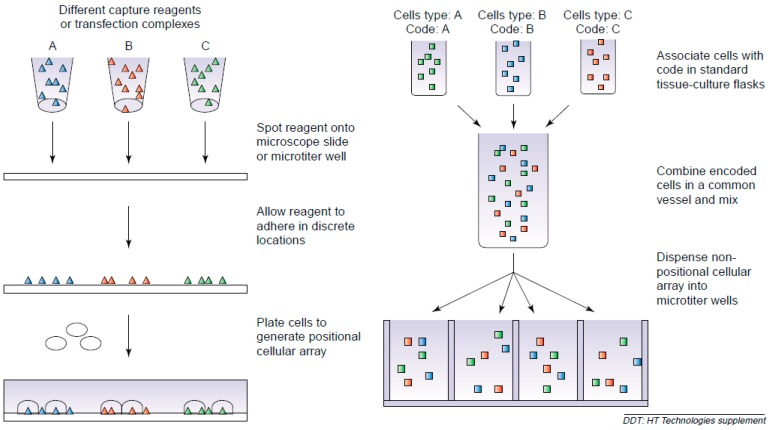 Fig.1 Schematic presentation of positional array and suspension microarray. 1
What We Can Offer
Peptide Library Generation
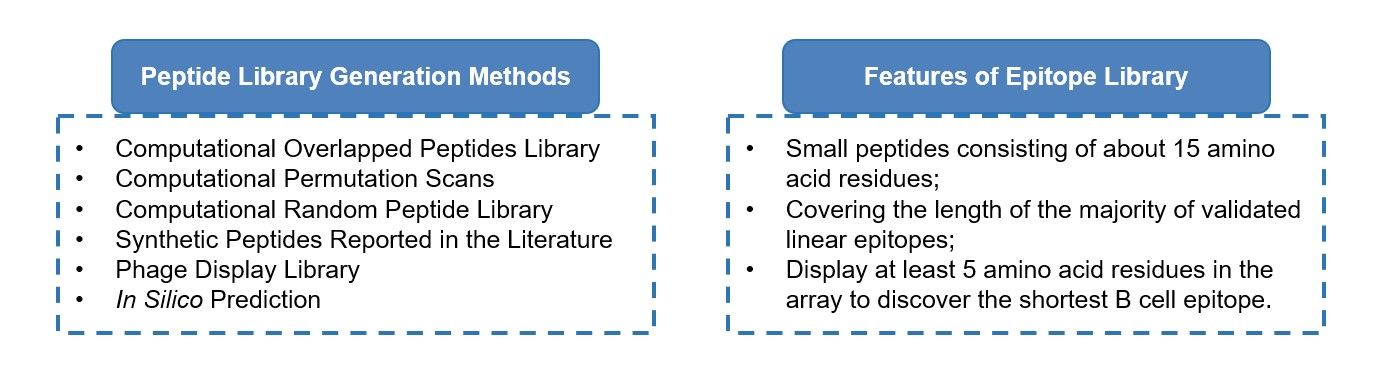
Epitope residue library consists of peptides generated from cancer protein antigens using at least one of the six methods below:
Peptide Microarray Synthesis
In Situ Synthesis of Peptides
Spot Peptides on a Solid Support
Peptides are first synthesized on the solid support of cellulose.
The soluble peptides are cleaved from the bound cellulose matrix and then spotted on the planar surfaces of glass using a non-contact printer or a contact printer.
Bead-bound Peptide Array
Antigens or peptides can be covalently conjugated to different magnetic bead identities. An equal number of beads is collected in a pool to create a bead-based array for epitope mapping.
| Methods | Advantages |
|---|---|
| In Situ Synthesis of Peptides |
|
| Spot Peptides on a Solid Support |
|
Microarray-based Screening Assay
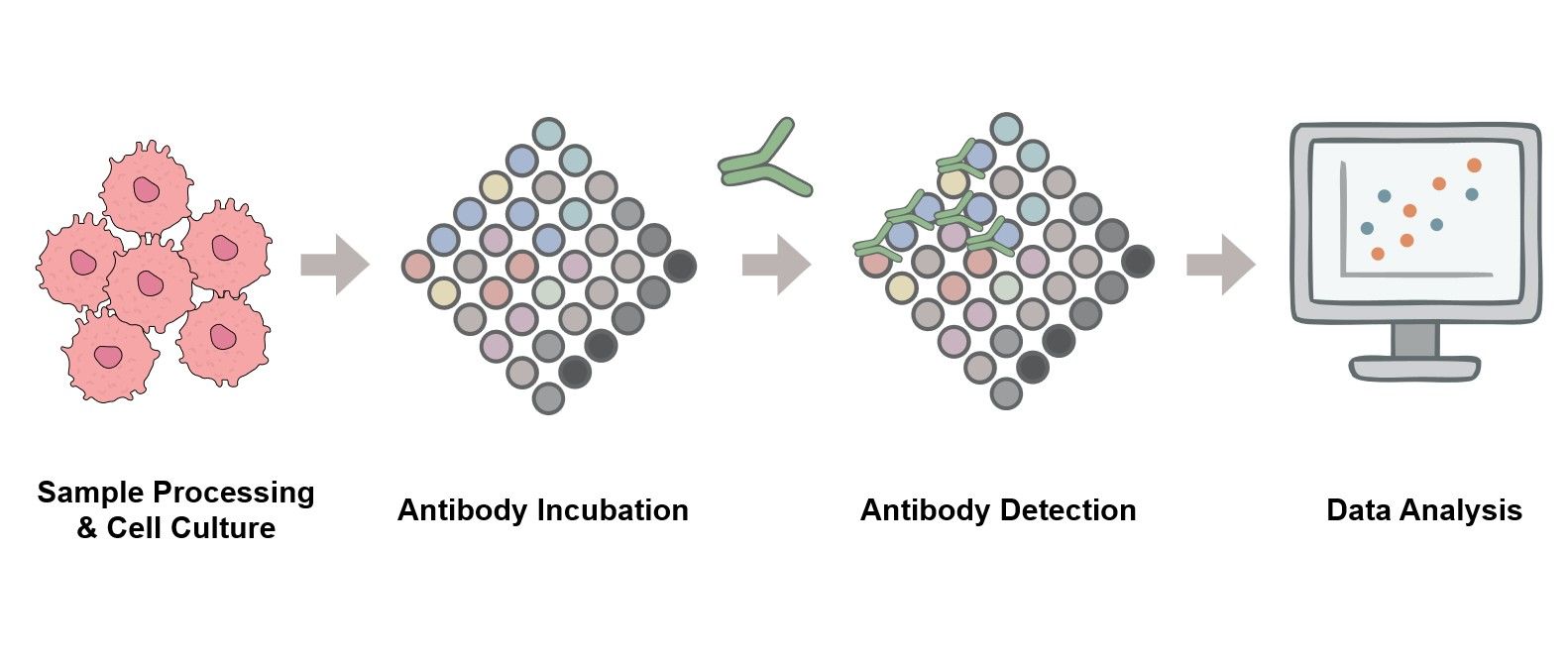
Our B Cell-based microarray assay offers an end-to-end service, from initial project design to final data delivery, providing a seamless and professional experience for your research team.
Highlights
Unparalleled Advantages
Creative Biolabs' B Cell-based microarray assay provides comprehensive, efficient, and cost-effective solutions for your research needs, offering distinct advantages over traditional methods.
High-Resolution Insights
Our platform provides an unparalleled, high-resolution view of the immune response, enabling a detailed understanding of antibody repertoires that traditional methods cannot match.

Multiplexed Profiling
A key differentiator is the ability to obtain multiplexed data from a single, minimal sample, saving time and resources while providing a holistic view of the immune system.
Differentiating Technology
The technology delivers a comprehensive and high-resolution view of the humoral immune response from a single sample, which is a significant advancement in immunological profiling.
To experience the full benefits of the Creative Biolabs advantage - Get a quote today.
Customer Reviews
-
Biomarker Discovery
The high-throughput platform enabled us to screen thousands of peptides and pinpoint disease-specific antibodies far faster than with ELISAs, which saved us months of work and significant budget. - J.D. M. -
Powerful Discovery Tool
We were impressed with the final report's clean, easy-to-interpret data. The team was instrumental in helping us validate the results. This platform is an essential part of our R&D pipeline. - A.R. T**.
FAQs
How does the B cell-based microarray assay compare to traditional ELISA or Western blot methods?
Unlike traditional methods that are typically low-throughput and require large sample volumes to screen for a single target, our B cell-based microarray assay is a high-throughput, multiplexed platform. It allows for the simultaneous screening of thousands of antigens from a single, minimal sample, providing a far more comprehensive view of the immune response in less time and at a lower cost.
What types of antibodies can be detected with your assay?
Our platform is highly versatile and can detect various types of antibodies, including both IgM and IgG, which is critical for distinguishing between a primary and a secondary immune response. The assay is also designed to identify specific B-cell epitopes within complex antigens, offering a level of detail that is difficult to achieve with other technologies.
Related Services
Immunogenicity Prediction
Our cutting-edge immunogenicity prediction services use advanced algorithms to predict the immunogenic potential of drug candidates before they are synthesized, saving you valuable time and resources.
Learn More →Microarray-based Tumor Profiling
Leveraging our microarray technology, we offer a specialized service for the high-throughput profiling of tumor-associated antigens (TAAs), providing insights into cancer subcategories, prognosis, and treatment response.
Learn More →How to Contact Us
As a professional service provider in antigen epitope discovery, Creative Biolabs offers comprehensive peptide microarray services to help clients identify B-cell epitopes within cancer antigens with rapid and cost-effective solutions. Our customized services and robust microarray platform will contribute greatly to your project development. Please contact us for more information.
Reference
- Hong, Hye Jin et al. "Cell Microarray Technologies for High-Throughput Cell-Based Biosensors." Sensors (Basel, Switzerland) vol. 17,6 1293. 5 Jun. 2017. Distributed under an Open Access license CC BY 4.0, without modification. https://doi.org/10.3390/s17061293
 Download our brochure
Loading case studies...
Online Inquiry