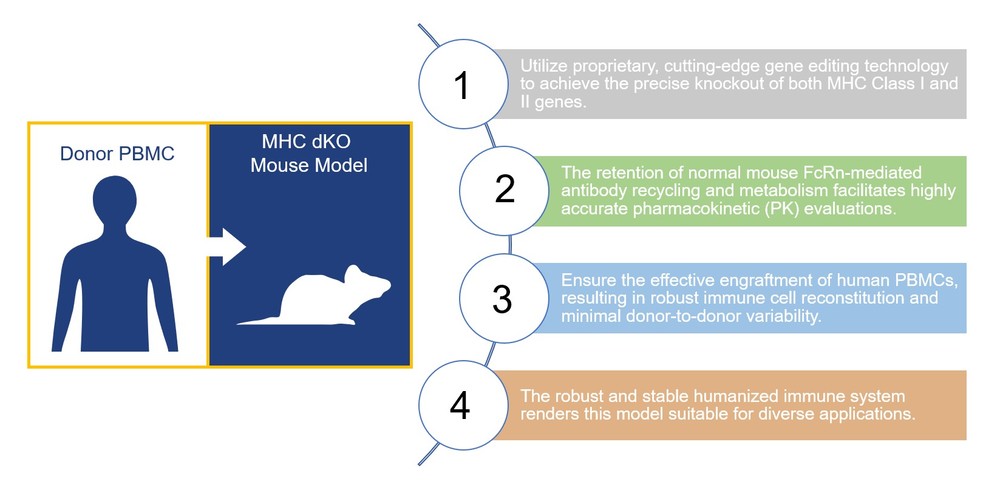
We utilize proprietary, cutting-edge gene editing technology to achieve the precise knockout of both MHC Class I and II genes, creating a xenogeneic platform optimized for human immune studies.
Human PBMC-MHC KO Mouse Modeling Service for Immuno-Oncology Study
Creative Biolabs' human PBMC-MHC KO mouse model for immuno-oncology study helps you accelerate immune-oncology development, uncouple efficacy from toxicity, and confirm human immunological memory through our advanced MHC Class I and II double knockout (dKO) technology. This proprietary platform provides the stable in vivo environment necessary for robust, long-term human immune assessment, generating data. Advanced technology has been used successfully, knocking out the H2-K1, H2-D1, and H2-Ab1 genes, creating a truly innovative platform for cancer immunotherapy research.
Introduction What We Can Offer Workflow Why Creative Biolabs Customer Reviews FAQs Related Services Contact Us
Human PBMC-MHC dKO Mouse Model
The conventional challenge with reconstituting human peripheral blood mononuclear cells (PBMCs) into immunodeficient mice, such as NOG or NSG strains, is the onset of severe graft-versus-host disease (GvHD). This acute immune reaction, driven by the interaction of human T cell receptors (TCRs) with murine major histocompatibility complex (MHC) proteins, significantly limits the lifespan of the animal models and the window for evaluating human immune cell functions. To address this limitation, Creative Biolabs has developed MHC class I and II dKO mouse models. These novel models eliminate murine MHC molecules, thus mitigating the risk of GvHD and facilitating longer and more accurate assessments of human immune responses in vivo.
Initiate project assessment - Request a formal consultation.
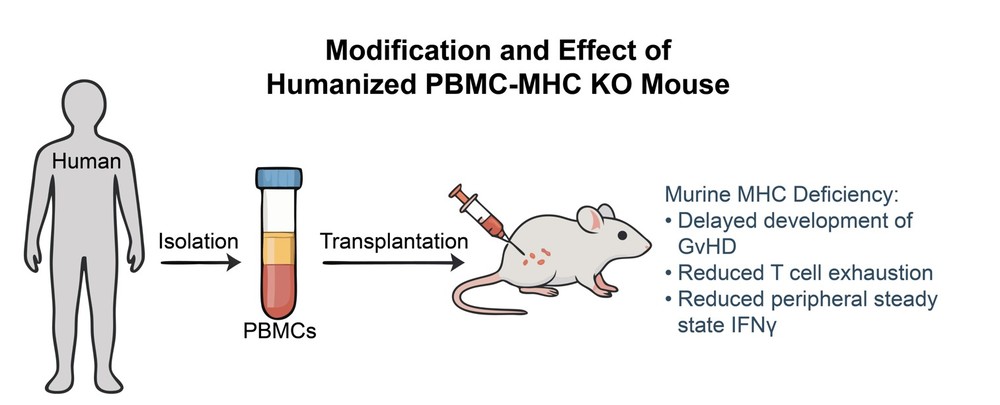 Fig.1 Modification and effect of humanized PBMC-MHC KO mouse.
What We Can Offer
| Versatile Applications | Description and Features |
|---|---|
| Extended Experimentation Window | The MHC dKO models allow for prolonged study durations due to the significant reduction in GvHD symptoms. This extended window is critical for monitoring chronic responses and the long-term efficacy of immunotherapies. |
| Human Immune Cell Reconstitution | The PBMC-MHC KO models serve as an excellent platform for studying human immune cell behaviors and their interactions with various antigens. Engrafted immunocytes, including T cells, B cells, NK cells, and dendritic cells (DCs), can be tracked over extended periods, providing more multifaceted insights. |
| Pharmacodynamic and Pharmacokinetic Studies | These models prove invaluable for evaluating the pharmacodynamics and pharmacokinetics of novel immunotherapeutic agents. The normal FcRn function retained in our MHC KO strains ensures accurate results for antibody metabolism studies, essential for preclinical testing of therapeutic antibodies and CAR-T cells. |
| Cancer Immunotherapy | The PBMC reconstituted MHC KO mouse models are highly instrumental in assessing the anti-tumor efficacy of T cell receptor-engineered therapies, such as those targeting melanoma-associated antigen MART-1. |
Human PBMC-MHC KO Mouse Model at Creative Biolabs
Key Advantages and Unique Features
Advanced Genetic Engineering
Extended Lifespan
The significant reduction in xenogeneic GvHD fundamentally extends the model's lifespan, enabling crucial long-term studies and comprehensive evaluation of therapeutic durability and immune memory.
Normal FcRn Function
The retention of normal mouse FcRn-mediated antibody recycling and metabolism facilitates highly accurate pharmacokinetic (PK) evaluations essential for the clinical translation of antibody-based therapeutics.
High-Fidelity Reconstitution
This model ensures the effective engraftment of human PBMCs, resulting in robust immune cell reconstitution and minimal donor-to-donor variability, guaranteeing highly reliable and consistent results.
Versatility
The robust and stable humanized immune system renders this model suitable for diverse applications, ranging from fundamental immunological research to advanced preclinical testing of complex immunotherapies.
Quantify your project requirements - Obtain a formal quotation.
Customer Reviews
-
Superior CPI Combination Testing
Using Creative Biolabs' human PBMC-MHC KO mouse model allowed our team to complete a 12-week dosing study for PD‑1/CTLA‑4 combinations. The drastically delayed GvHD onset successfully captured durable efficacy data previously confounded by mouse toxicity in standard PBMC models. - John Smi*. -
Clearer Bispecific Efficacy Signal
The MHC dKO platform is essential for screening T-cell engagers. We definitely showed our bispecific antibody was responsible for complete tumor regression, uncoupling efficacy from rapid xenogeneic GvHD toxicity. This clarity significantly accelerated lead optimization efforts. - Mar* Avo***.
FAQs
Q: How does the MHC KO model reduce GvHD?
A: By eliminating MHC class I and II molecules, the interaction that triggers GvHD is minimized. This allows the human PBMCs to persist and function in the mouse model without inducing a severe immune response.
Q: Can these models be used for studies beyond cancer immunotherapy?
A: Absolutely. These models are highly versatile and can be applied to various fields, including infectious diseases, autoimmune disorders, and transplantation research.
Related Services
ADEPT Pharmacokinetic and Pharmacodynamic Analysis Service
Advanced analysis using radiolabeled or fluorescent probes to quantify the precise accumulation and retention of the therapeutic agent within the tumor and other key tissues.
Learn More →Immuno-oncology Flow Cytometry Assay Service
Specialized in vitro and ex vivo assays utilizing FACS technology to quantify immune cell function, including cellular proliferation, target cell cytotoxicity, and intracellular cytokine production.
Learn More →How to Contact Us
Creative Biolabs remains committed to advancing immuno-oncology research through innovative and high-quality animal models, fostering breakthroughs in our understanding and treatment of cancer and immunological diseases. Contact our scientific team to discuss project scope and feasibility.
 Download our brochure
Loading case studies...
Online Inquiry