T Cell based Bioassay Service
Creative Biolabs provides a wide range of cancer epitope analysis assays to characterize tumor antigens. We now offer a T cell-based bioassay service to identify potential T cell epitopes by assessing the cytokines release category and levels elicited by epitope stimulation.
The Function of Cytokine Release Assay
Cytokines are the small molecules produced by immune cells engaged in transporting information between cells. Nature T cells are activated by the interaction between the T cell receptor and peptide-MHC complex, initiating cytokine secretion and specific cytotoxicity. Cytokine release assay has become a typical approach for evaluating risks and hazards of immunomodulatory cells and antibodies-induced cytokine release syndrome and predicting immunotoxicity. While cytokine release assay was originally used to evaluate drugs with known immunomodulatory function, the cytokine release bioassay has also been adopted for characterizing cell responses associated with other components of a molecule.
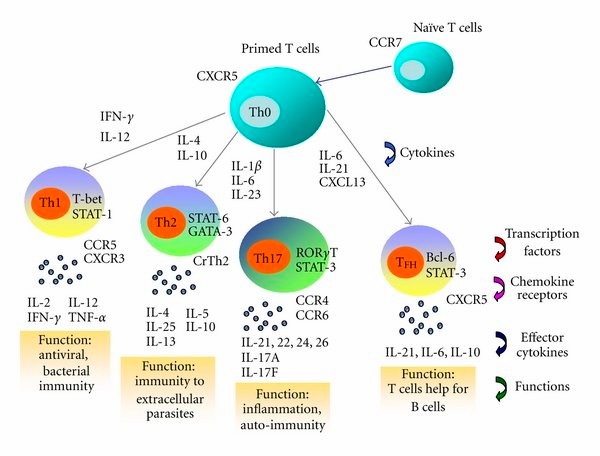 Fig.1 T cell-secreted cytokines.1
Comprehensive T Cell Bioassay Services
To meet the complex demands of preclinical research, Creative Biolabs offers a comprehensive suite of T cell-based bioassay services, supported by a range of advanced detection technologies. Our services are designed to provide a deep understanding of T cell function and therapeutic potential.
-
Cytometric Bead Array
A sensitive multiplex immunoassay for the simultaneous detection of multiple cytokines from a single sample. -
ELISA and ELISPOT Assays
Highly specific and quantitative methods for measuring cytokine levels or counting cytokine-secreting cells, respectively. Various types of cytokines are produced from T cells after cancer antigen stimulation. The following kinds of cytokines are often used to monitor specific T cell responses.GM-CSF IFN-γ IL-10 IL-2 IL-3 IL-4 IL-5 TNF IL-6 IL-8 IL-1β IL-12 IL-17A MIP-1α TNF-α -
High Throughput Multiplexed Assays
Enable the simultaneous screening of numerous drug candidates against various T cell targets, accelerating the drug discovery process. -
RNA/DNA Detection Assays
Provide insights into the underlying genetic and transcriptional changes that occur during T cell activation. -
Biological Activity Assays
Evaluate the overall biological function of a drug, such as its ability to induce target cell killing.
Partner with us to unlock the full potential of your immuno-oncology programs.
Workflow
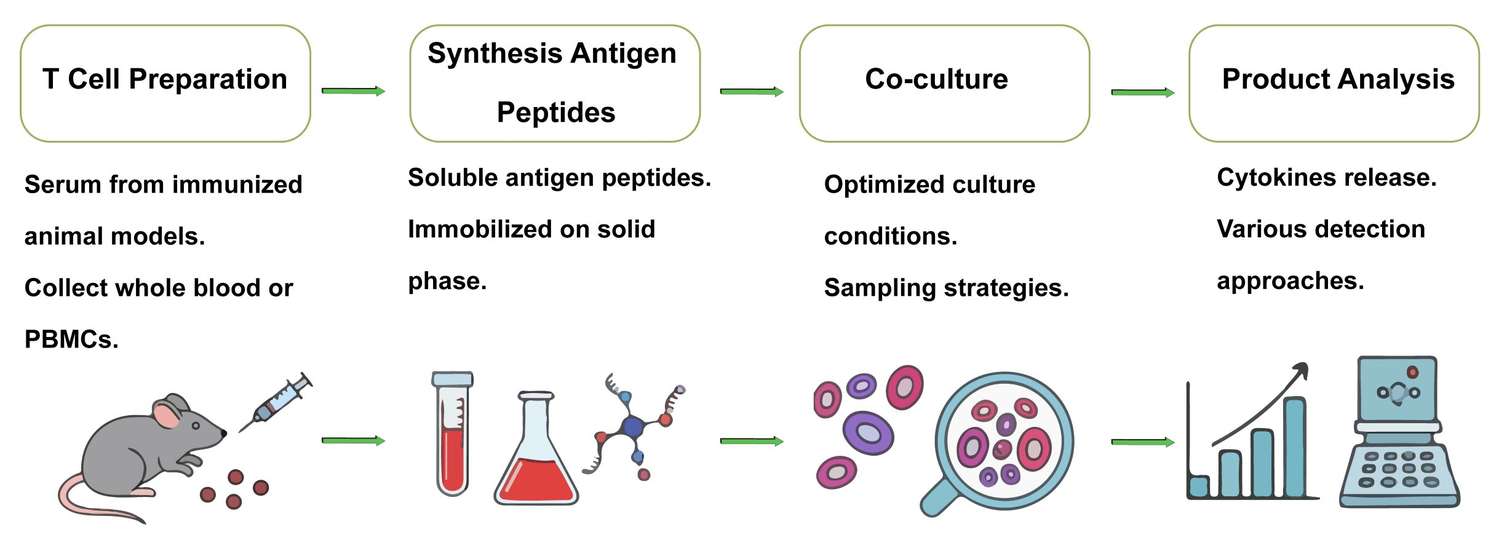
By detecting cytokine release from T cells cultured in vitro with different cancer epitopes, Creative Biolabs applies the assay to screen epitopes with anticipated agonist potential for inducing a significant T cell immune response in vivo.
Why Choose Us?
Partner with Creative Biolabs for your immuno-oncology drug development, a journey marked by our proven success. Our competitive edge is built on three pillars: deep expertise, advanced technology, and flexible customization. We bring together experienced immunologists and molecular biologists, deeply involved in cutting-edge T cell research. Our platforms, featuring multiplexed assays and high-throughput screening, provide the most comprehensive data sets. Recognizing project individuality, we collaborate closely to craft bespoke solutions tailored to your unique research objectives.
Experience the Creative Biolabs difference. Get a personalized quote today and see how our services empower your research.
FAQs
Q1: How do you ensure the reproducibility of your T cell-based assays?
A1: We use fully validated and standardized protocols, reagents, and instruments. Our commitment to quality control and our team's extensive experience ensure that the data we provide is sensitive, accurate, and highly reproducible.
Q2: Can your assays detect potential cytokine release syndrome risk early in development?
A2: Yes, our cytokine release assays are specifically designed for this purpose. By evaluating the cytokine profiles in a controlled in vitro environment, we can help you predict and mitigate the risk before moving into the application.
Q3: Is it possible to customize your T cell-based assays for a specific target or unique cell type?
A3: Absolutely. Our services are highly customizable. We specialize in designing and optimizing assays to meet the unique needs of your research, including the use of specific cell lines, primary cells, or specialized readouts.
Customer Review
-
Predictive Efficacy for Preclinical Testing
Using Creative Biolabs' service in our research has significantly improved our ability to predict the in vivo efficacy of our lead antibody candidate. Their cytokine release assays provided crucial data that allowed us to confidently advance our drug to the next stage of preclinical testing. - J. C*****l -
Efficiency Through Multiplexed Assays
The ability to perform multiplexed assays was a game-changer for our project. We were able to analyze multiple biomarkers simultaneously, saving us a tremendous amount of time and resources compared to our previous methods. - S. A****o
Related Services
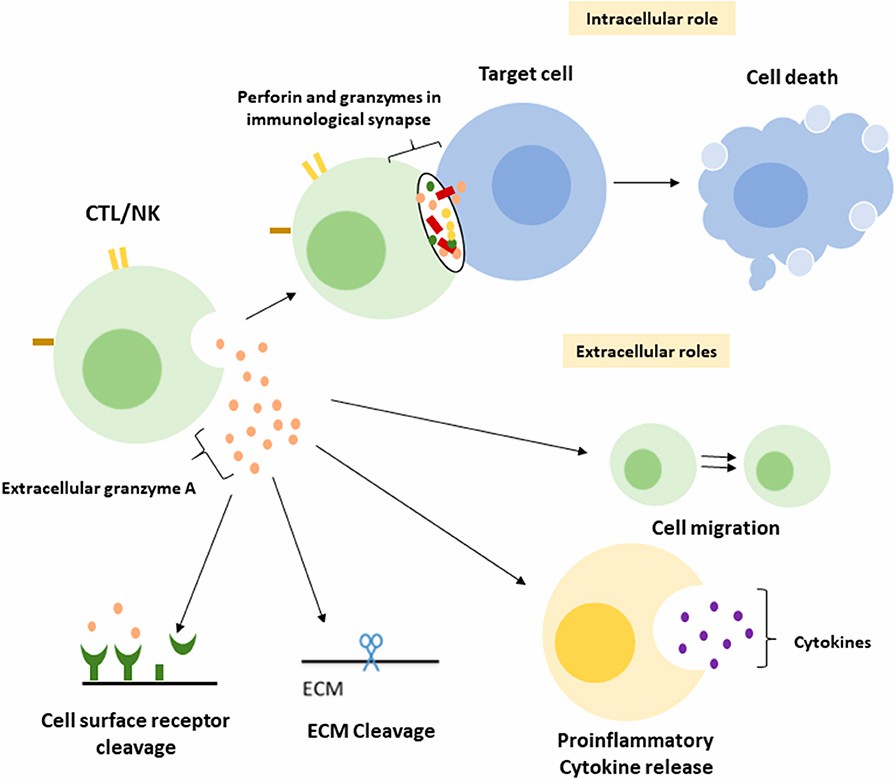 Fig.2 Granzyme A functions.2
T Cell-based Intracellular Staining Assay
At Creative Biolabs, intracellular protein markers, such as, perforin, granzyme B, and granzyme A, release from epitope-specific T cells can be monitored by intracellular staining assay.
Contact Us
For more information about our T cell-based bioassay services or to discuss your specific project needs, please contact our team. We look forward to partnering with you to unlock the full potential of your immuno-oncology programs.
Contact Our Team for More Information and to Discuss Your Project
Reference
- Yu, Shui-Lian, et al. "Immunopathological roles of cytokines, chemokines, signaling molecules, and pattern‐recognition receptors in systemic lupus erythematosus." Journal of Immunology Research 2012.1 (2012): 715190. Distributed under Open Access license CC BY 3.0, without modification. https://doi.org/10.1155/2012/715190
- Van Daalen, Kim R., Josephine F. Reijneveld, and Niels Bovenschen. "Modulation of inflammation by extracellular granzyme A." Frontiers in immunology 11 (2020): 931. Distributed under Open Access license CC BY 4.0, without modification. https://doi.org/10.3389/fimmu.2020.00931
 Download our brochure