Species-Matched Strategy
Canine and feline discovery paths reflect target species biology.

Developing therapeutic antibodies for pets requires more than transferring human antibody discovery logic into a veterinary setting. Species-specific immune responses, target conservation, receptor biology, Fc compatibility, assay availability, and preclinical sample limitations can all affect whether a promising binder becomes a practical canine or feline therapeutic candidate.
Creative Biolabs supports pet therapeutic antibody research with an integrated workflow that connects target discovery, veterinary antigen generation, platform selection, lead isolation, characterization, biological functionality assays, and optional antibody engineering. Programs can begin with only a target name or sequence, or with an existing antibody that needs caninization, felinization, affinity improvement, format conversion, or deeper functional validation.
Discovery success starts with target rationale and antigen quality. Creative Biolabs helps align target biology, species conservation, antigen format, and downstream screening feasibility before a full discovery campaign begins.
Target discovery and validation support integrates disease biology, sequence conservation, pathway relevance, tissue expression, accessibility, and assay readiness to prioritize actionable targets for pet antibody therapeutics.
Antigen services include peptide synthesis, recombinant protein design, expression, purification, sourcing, and quality checks to support immunization, display screening, assay development, and target engagement studies.
Platform selection depends on target format, available antigen, desired diversity, heavy-light pairing requirements, screening throughput, and the need for canine or feline compatibility from the beginning of discovery.
CynoCure™ supports canine therapeutic antibody programs with dog-relevant discovery resources designed to identify leads better aligned with canine sequence and framework needs.
FeliCure™ is tailored for feline antibody discovery, supporting projects where cat-compatible frameworks, feline target biology, and species-aware developability are central to lead selection.
Phage display enables high-diversity screening, epitope-focused selection, affinity maturation options, and iterative enrichment against purified proteins, peptides, domains, or selected target formats.
Single-B cell workflows can preserve native heavy-light pairing and support rapid isolation of antibodies from immunized or target-responsive repertoires when suitable samples are available.
Hybridoma discovery remains valuable for robust monoclonal generation, clone expansion, screening, and antibody production when immunization-compatible antigen and screening assays are available.
Lead panels require more than binding confirmation. Creative Biolabs can evaluate sequence identity, affinity, specificity, receptor-ligand blockade, cell binding, and early biological activity to help prioritize candidates for engineering or preclinical evaluation.
Characterization services may include clone screening, antibody sequencing, expression checks, affinity ranking, specificity testing, epitope assessment, stability observations, and reportable candidate comparison.
Functionality assays can assess target engagement, blocking activity, signaling, cytokine response, cell-based potency, immune pathway modulation, or other mechanism-linked readouts selected for the pet indication.
After lead identification, optional engineering can improve species compatibility, expression, developability, functional profile, and research-use material quality before expanded pet therapeutic antibody evaluation.
Our workflow covers consultation of potential targets, antigen preparation, antibody discovery via selected platforms, candidate characterization, and optional engineering to develop effective pet therapeutic antibody candidates. A comprehensive target-to-engineered-candidate program is commonly planned across approximately 5 to 11 months, depending on target complexity, platform choice, assay readiness, and engineering scope.
| Stage | Main Activities | Decision Value | Estimated Timing |
|---|---|---|---|
| Target and Antigen | Target review, construct design, peptide or recombinant antigen generation, quality assessment. | Confirms that discovery inputs fit target biology and intended species. | Typically several weeks, depending on antigen complexity. |
| Discovery Execution | Library screening, immunization-based discovery, B-cell isolation, hybridoma screening, or combined strategies. | Generates diverse binding leads against the pet-relevant target format. | Often 2 to 4 months after antigen readiness. |
| Characterization | Sequencing, binding assays, specificity checks, SPR or BLI kinetics, and functional pilot assays. | Ranks candidates by potency, selectivity, epitope behavior, and assay relevance. | Usually 1 to 2 months, depending on assay panel. |
| Engineering | Caninization, felinization, Fc or format selection, expression, purification, and re-testing. | Improves species compatibility and supports further pet therapeutic evaluation. | Project-specific; commonly added after lead selection. |
Share the target, species, indication, and available materials. Creative Biolabs can recommend a platform combination and milestone plan for pet therapeutic antibody research.
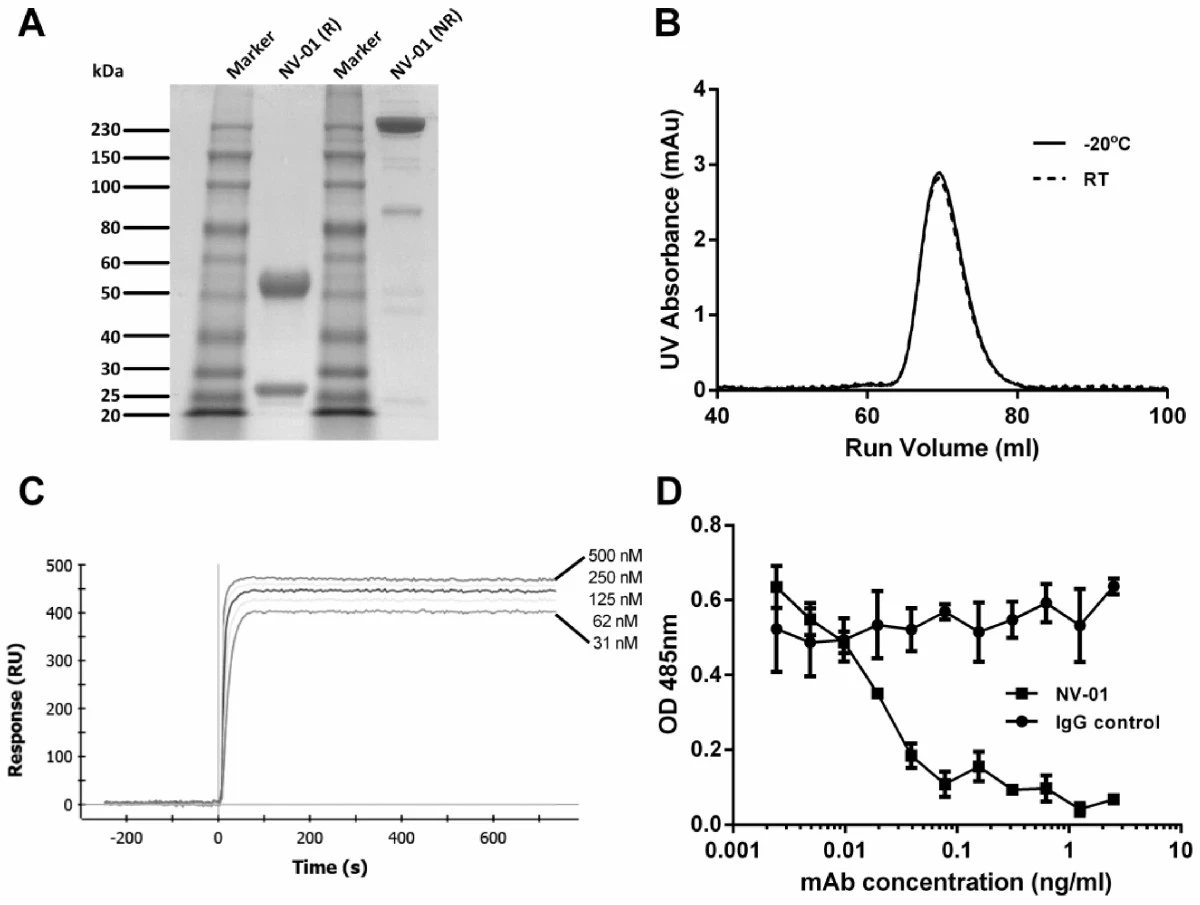
This study reports the generation of NV-01, a fully caninised anti-NGF monoclonal antibody developed from a rat parental antibody for canine pain research. The work follows a practical discovery-to-characterization path, including sequence adaptation, recombinant expression, purification, molecular integrity analysis, antigen binding evaluation, stability testing, Fc-related safety considerations, pharmacokinetic profiling, and assessment in a canine inflammatory pain model.
The figure supports this service-category page because it shows the type of evidence needed before a veterinary antibody candidate can move forward: SDS-PAGE purity and integrity data, accelerated storage stability, concentration-dependent NGF binding, and in vitro inhibition of NGF-driven cell proliferation. Together, these datasets illustrate how antibody discovery, species-specific engineering, analytical characterization, and functional assays can be combined into a decision-ready lead package for pet therapeutic programs.
Creative Biolabs combines veterinary biologics experience, species-aware antibody platforms, and flexible discovery modules to support companion animal therapeutic programs from early target concept to engineered antibody candidates.
Canine and feline discovery paths reflect target species biology.
Target, antigen, discovery, assays, and engineering under one program.
Multiple routes support difficult targets and different lead profiles.
Clear data packages guide candidate selection and next studies.