Antibody Characterization
Characterize engineered antibodies with binding kinetics, specificity, epitope assessment, purity, aggregation, sequence confirmation, and developability-oriented analytics.
View Antibody Characterization →
Antibody candidates developed from mouse, human, or other non-target species often require additional engineering before they can be studied credibly in dogs, cats, or multispecies veterinary settings. Framework selection, constant-region compatibility, Fc function, binding retention, expression behavior, stability, and downstream assay readiness must be considered together rather than as isolated sequence edits.
Creative Biolabs configures veterinary antibody engineering projects around the intended species, therapeutic mechanism, molecular format, target biology, available lead materials, and planned validation package. Programs may begin with a supplied sequence, hybridoma, binding clone, recombinant antibody, or early discovery hit, then move through design, expression, optimization, characterization, and functional assessment with traceable decision points.
Reduce species-mismatch risk while preserving target recognition through careful framework, constant-region, and format decisions.
Canine framework and constant-region adaptation to support dog-focused antibody therapeutic research while retaining key binding residues.
→ 02Feline antibody sequence redesign, format selection, and expression assessment for cat-compatible therapeutic candidate development.
→ 03Variable-region transfer into canine, feline, or other veterinary constant regions to maintain binding while improving species fit.
→ 04Cross-reactive antibody engineering for conserved epitopes when a program must support broader companion animal or veterinary species coverage.
→Optimize antibody performance for binding strength, effector function, pharmacology-oriented research, manufacturability, and specialized formats.
Library-based, structure-guided, or computationally supported optimization to improve binding kinetics, potency, and lead differentiation.
→ 06Canine and feline Fc-region design for effector tuning, receptor interaction studies, half-life-oriented research, and mechanism alignment.
→ 07scFv, Fab, bispecific, and alternative fragment formats for tissue penetration, target access, or modular therapeutic design.
→ 08Canine and feline subclass conversion to align molecular format with desired function, expression behavior, and evaluation strategy.
→ 09Antibody-drug conjugate design, linker-payload strategy, conjugation, and characterization for veterinary oncology or infectious disease research.
→The workflow is organized to keep sequence design, expression feasibility, functional requirements, and data delivery connected from the first project discussion through final reporting.
| Engineering Need | Typical Input | Recommended Module | Decision-Oriented Output |
|---|---|---|---|
| Species compatibility | Mouse, human, or non-target species antibody sequence | Caninization, felinization, or chimerization | Species-adapted sequence, expression data, and binding confirmation |
| Insufficient potency | Lead antibody with useful specificity but weak kinetics | Affinity maturation and screening | Ranked variants with binding kinetics and retained specificity |
| Mechanism tuning | Candidate requiring altered immune engagement | Fc engineering or isotype switching | Engineered Fc or subclass variants with functional assay plan |
| Specialized delivery | Need for small format, bispecificity, or conjugation | Fragment engineering or ADC development | Construct design, conjugation strategy, and characterization package |
Our scientists can map the shortest practical engineering route after reviewing your species, format, mechanism, and available starting material.
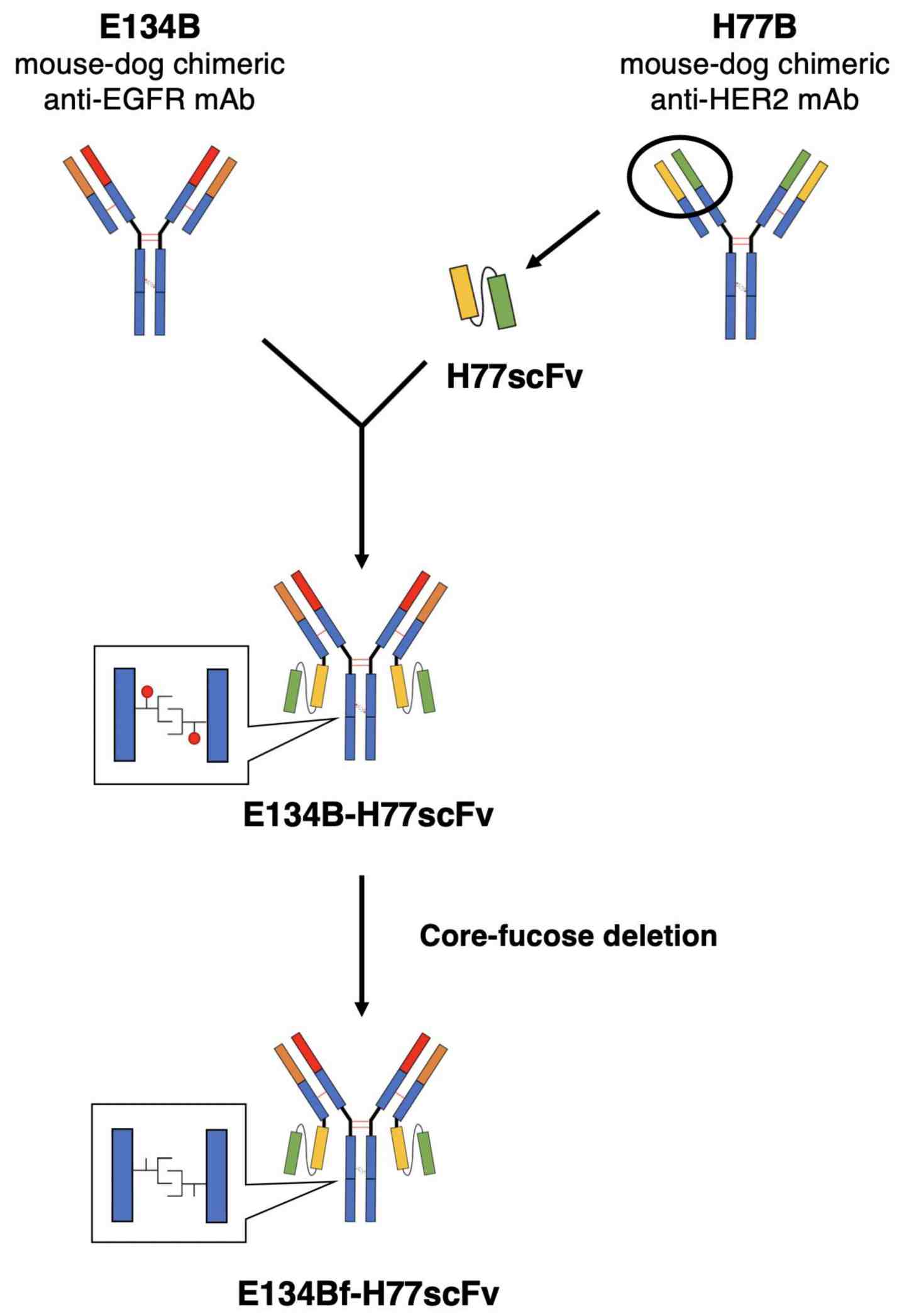
In the study, Tateyama et al. engineered E134Bf-H77scFv, a defucosylated mouse-dog chimeric bispecific antibody designed to recognize dog EGFR and dog HER2. The figure shows the molecular construction strategy, in which an H77B single-chain variable fragment was fused to the light chain of E134B to create a canine tumor-targeting bispecific antibody format.
The study highlights service-relevant elements for veterinary antibody engineering, including mouse-dog chimerization, scFv fusion, Fc glycoengineering, recombinant expression, dog antigen binding by flow cytometry, affinity determination, and ADCC/CDC-oriented functional assessment. Creative Biolabs connects chimerization, antibody fragment engineering, Fc engineering, isotype strategy, characterization, and in vitro evaluation to support decision-ready pet antibody candidates.
Creative Biolabs combines species-aware molecular design, expression support, analytical testing, and downstream evaluation planning in one coordinated service path.
Canine and feline sequence context guides every engineering decision.
Binding, effector function, and developability are optimized together.
Full-length, fragment, multispecific, and ADC formats are supported.
Sequence, expression, characterization, and reporting packages support transfer.