
Integrated Pet Therapeutic Antibody R&D from Target Strategy to Development Material
Creative Biolabs provides modular and integrated research services for veterinary pharmaceutical companies, animal health biotechnology teams, academic translational groups, and biologics developers building antibody-based therapies for companion animals. Our workflow connects target and antigen decisions with discovery, engineering, characterization, functional testing, and development planning, helping teams avoid disconnected studies and late-stage redesign.
Each program is configured around the intended species, disease biology, mechanism of action, antibody format, available starting materials, and required evidence package. Projects may begin with target prioritization or a supplied antigen, sequence, hybridoma, or lead antibody. Clear stage gates and fit-for-purpose assays support transparent candidate selection without overstating clinical translation.
Veterinary Target Discovery and Antigen Preparation Services
Build a defensible discovery starting point with species-relevant target evidence and antigen reagents designed for the selected antibody platform and downstream assay plan.
Pet Therapeutic Antibody Target Discovery
Target identification and prioritization using disease biology, omics evidence, pathway context, species conservation, tractability, and validation planning.
→ 02Veterinary Antigen Services
Recombinant protein, domain, peptide, cell-based, or other antigen strategies supported by construct design, expression, purification, and quality assessment.
→Pet Therapeutic Antibody Discovery and Lead Characterization Services
Select the most appropriate discovery route based on antigen form, desired diversity, target biology, timeline, and available biological material, then characterize hits with orthogonal evidence.
Pet Therapeutic Antibody Discovery
Integrated discovery planning, screening, hit confirmation, sequencing, diversity assessment, and lead nomination for canine and feline therapeutic programs.
→ 04Phage Display Antibody Discovery
Library selection and biopanning workflows for soluble, cell-surface, or difficult targets, with counter-selection and functional screening options.
→ 05Single-B Cell Antibody Discovery
Antigen-specific B-cell enrichment and single-cell recovery to preserve native heavy-light pairing and accelerate sequence-level hit identification.
→ 06Hybridoma Antibody Discovery
Immunization, fusion, clone screening, subcloning, and antibody recovery for projects benefiting from established monoclonal antibody generation workflows.
→ 07Antibody Characterization
Binding kinetics, specificity, epitope analysis, cross-reactivity, sequence confirmation, purity, aggregation, and functional assay support for lead comparison.
→Veterinary Antibody Engineering, Evaluation, and Development Services
Improve species compatibility and therapeutic properties, confirm activity with fit-for-purpose studies, and generate development material for subsequent preclinical research.
Antibody Engineering
Canine or feline framework adaptation, affinity maturation, format conversion, Fc design, sequence liability mitigation, and expression-oriented optimization.
→ 09Pet Therapeutic Antibody Evaluation
Customized in vitro, ex vivo, and, where appropriate, in vivo studies for potency, mechanism, PK/PD, safety-related endpoints, and efficacy-oriented evidence.
→ 10Pet Therapeutic Antibody Development
Developability evaluation, cell line and culture process development, purification, stability, formulation, and non-GMP production for preclinical use.
→Pet Therapeutic Antibody Research and Development Workflow
The workflow is built to generate decision-ready evidence at each stage. Modules may be performed independently or connected into a coordinated program with predefined acceptance criteria, review meetings, and documented transfer packages.
Recommended Starting Information
- Target sequence and source species
- Intended canine or feline indication
- Desired blocking, agonistic, or depletion activity
- Preferred IgG, Fab, scFv, or alternative format
- Available antigen, clone, sequence, or assay
- Required study stage and downstream use
Typical Final Deliverables
- Experimental plan and stage-gate criteria
- Antibody nucleotide and amino acid sequences
- Binding, specificity, and functional datasets
- Expression constructs or purified material
- Engineering and developability recommendations
- Consolidated methods, results, and conclusions
Match the Research Question to the Right Antibody R&D Module
A program does not need to begin at discovery. Existing antigens, hybridomas, sequences, or lead molecules can enter at the appropriate stage after a technical review of quality, traceability, and intended downstream use.
| Program Stage | Primary Research Question | Recommended Service Focus | Decision-Oriented Outputs |
|---|---|---|---|
| Early Concept | Is the target relevant, accessible, and differentiated in the intended pet species? | Target discovery, species conservation analysis, and antigen strategy. | Target rationale, risk map, validation plan, and antigen design. |
| Hit Generation | Which discovery platform can produce diverse, specific, functional binders? | Phage display, single-B cell, hybridoma, or combined discovery. | Confirmed sequences, binding data, diversity clusters, and prioritized hits. |
| Lead Selection | Which candidates combine function, specificity, and acceptable biophysical behavior? | Characterization, functional assays, cross-reactivity, and early developability. | Comparative lead matrix, liability assessment, and nomination rationale. |
| Lead Optimization | How can species compatibility, affinity, format, or Fc activity be improved? | Species adaptation, affinity maturation, format conversion, and sequence engineering. | Optimized sequences, expression data, retained function, and engineering history. |
| Preclinical Supply | Can the candidate be produced and formulated for planned research studies? | Cell line, process, purification, stability, formulation, and non-GMP production. | Qualified material, analytical data, formulation recommendation, and transfer package. |
Start with your species, target, and current project asset
Our scientists can map a focused pilot or an integrated target-to-development workflow after reviewing your intended mechanism, available materials, and required decision points.
Published Data on Species-Compatible Antibody Engineering and Functional Validation
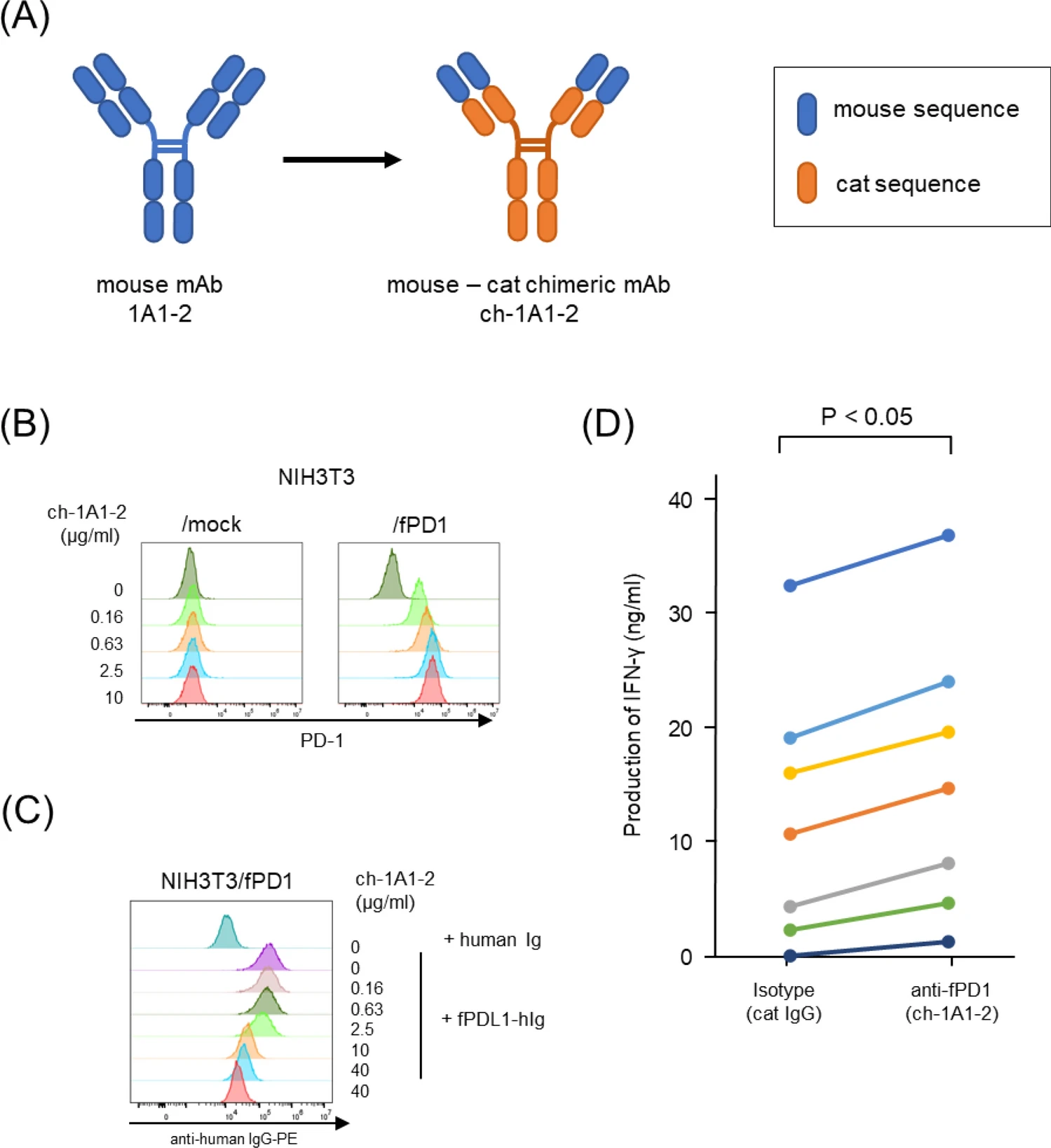
In a 2023 study, Nishibori et al. generated an anti-feline PD-1 antibody and created a mouse-feline chimeric format by combining its variable regions with a feline IgG1 constant region. The study evaluated target binding, blockade of the feline PD-1/PD-L1 interaction, and IFN-γ production in stimulated feline peripheral blood lymphocytes, demonstrating a staged path from antibody generation and species-compatible engineering to functional cellular assessment.
The findings illustrate why veterinary antibody programs benefit from species-relevant sequence design, orthogonal binding assays, pathway-focused testing, and functional validation before candidate advancement. Creative Biolabs integrates target discovery, antibody discovery, species-adapted engineering, characterization, and evaluation services to help clients build a coordinated, decision-oriented research package for canine and feline therapeutic antibody development.
Research Infrastructure for Complex Veterinary Antibody Programs
Our value is not limited to a single discovery technology. We help connect biological rationale, molecular design, experimental evidence, and development practicality so project teams can make better-informed advancement decisions.
Species-Aware Strategy
Program design considers canine or feline sequence context, target biology, constant regions, assay reagents, and intended dosing environment.
Decision-Ready Data
Orthogonal assays and predefined criteria help distinguish binding hits from candidates with functional and development potential.
Modular Integration
Begin with a focused assay or combine target, discovery, engineering, evaluation, and development work under coordinated project management.
Traceable Deliverables
Documented methods, sequence records, raw and analyzed data, material specifications, and conclusions support downstream review and transfer.
Veterinary Therapeutic Antibody R&D FAQs
References
- Nishibori, Shoma, et al. "Development of anti-feline PD-1 antibody and its functional analysis." Scientific Reports 13 (2023): 6420. https://doi.org/10.1038/s41598-023-31543-6
- Distributed under Open Access license CC BY 4.0, without modification.