Phage Display-based Pet Antibody Discovery Services
Creative Biolabs provides integrated phage display antibody discovery for canine and feline programs, combining species-specific or custom library strategies, multi-round biopanning, clone screening, sequence analysis, IgG reformatting, preliminary characterization, and optional lead engineering to generate decision-ready pet therapeutic antibody candidates.
Service Overview
Species-Aware Phage Display Discovery for Pet Therapeutic Antibody Programs
Phage display connects antibody phenotype with its encoding sequence, enabling large repertoires to be screened under controlled in vitro selection conditions. Creative Biolabs configures each project around the target format, intended pet species, required antibody architecture, desired mechanism, assay readiness, and downstream development plan. Programs may begin with a premade canine or feline repertoire, a custom naïve, immune, or synthetic library, or an existing enriched pool that requires screening and sequence recovery.
Our stage-gated workflow combines antigen and selection strategy, enrichment monitoring, monoclonal screening, sequence clustering, antibody reformatting, production, and early characterization. Counter-selection, solution-phase selection, cell-based panning, competitive elution, and functional screening can be incorporated when target biology or specificity requirements demand a more tailored campaign.
Flexible Entry Points
Phage Display Pet Antibody Discovery Service Options
Choose rapid screening from an established species-specific repertoire or build a purpose-designed library when the target, species, immunization history, diversity architecture, or selection challenge requires a customized solution.
Screen established, high-diversity canine or feline phage display libraries against a qualified target to identify species-matched antibody fragments without first constructing a new repertoire.
Best suited for
Rapid canine or feline hit generation
Projects with a screening-ready antigen and assay
Early use of species-relevant antibody frameworks
Parallel selection strategies for difficult targets
Custom Phage Display Library Construction and Screening
Design and construct a naïve, immune, or synthetic phage display library using selected biological sources, veterinary species sequences, antibody formats, and engineered diversity profiles, followed by target-specific screening.
Best suited for
Targets requiring an immune or enriched repertoire
Companion or veterinary species beyond dogs and cats
Tailored CDR diversity or framework constraints
Programs needing full control of library provenance
The workflow is configured around antigen behavior and project decisions rather than a fixed protocol. Estimated timing begins after required materials and assays are ready and may change with library construction, target complexity, screening stringency, and reformatting scope.
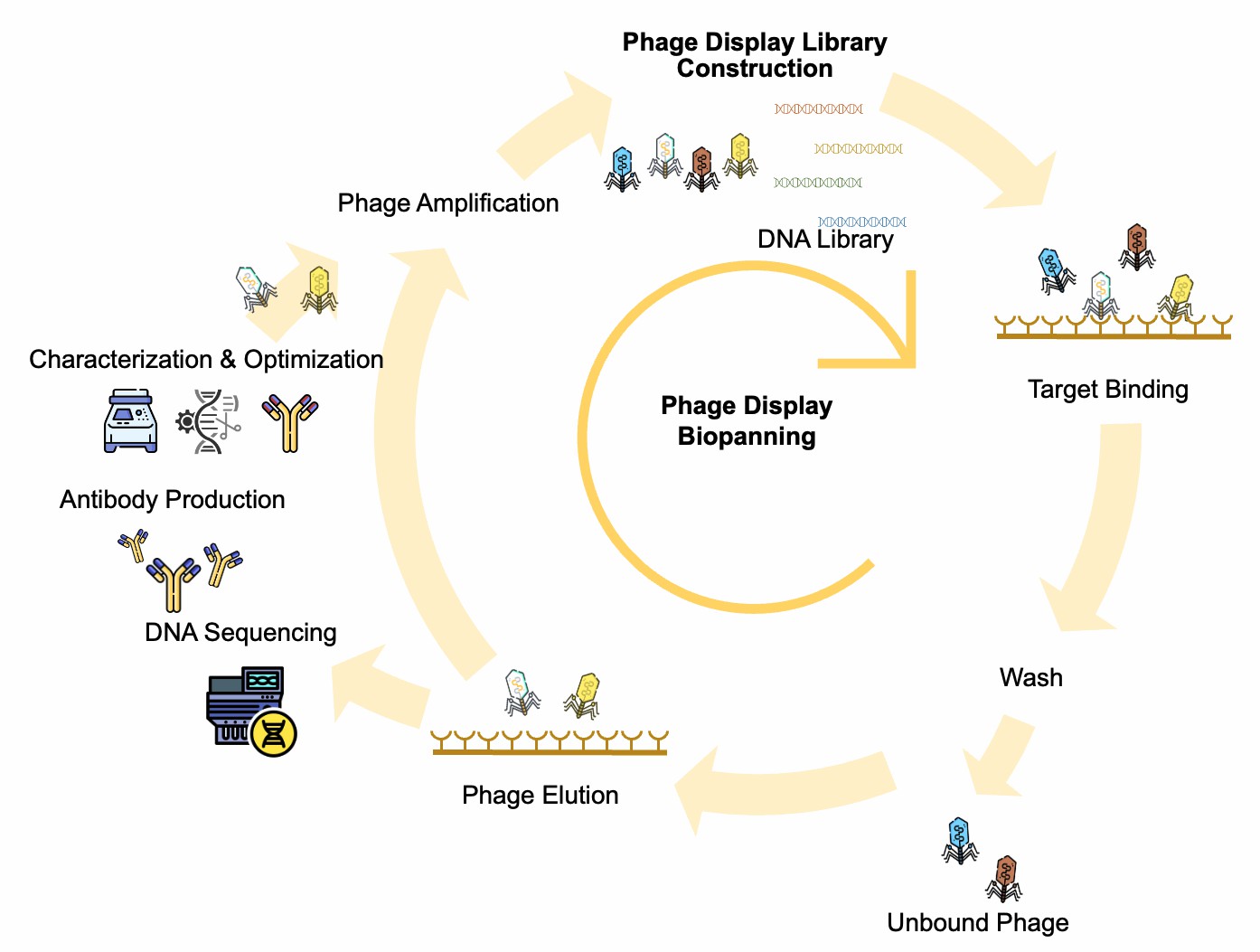
Phage Display-based Pet Antibody Discovery Workflow. Creative Biolabs original.
01
Library and Antigen Readiness
Select a premade repertoire or construct a naïve, immune, or synthetic library. Review antigen quality, presentation format, controls, and screening assay suitability.
Scope dependent
02
Multi-Round Biopanning and Enrichment
Perform iterative binding, washing, elution, bacterial amplification, and re-selection. Apply counter-selection or adjusted stringency to improve target-focused enrichment.
4–6 weeks
03
Monoclonal Hit Screening
Isolate individual clones and screen by phage ELISA, soluble-fragment assays, flow cytometry, competition, or other fit-for-purpose methods.
Project dependent
04
Sequencing and Reformatting
Recover variable-region sequences, cluster unique families, assess sequence liabilities, and reformat prioritized scFv or Fab fragments into canine, feline, or other requested formats.
Scope dependent
05
Production and Preliminary Characterization
Express and purify selected antibodies, then compare binding, specificity, apparent affinity, purity, aggregation, and target-relevant activity as defined in the study plan.
4–6 weeks
06
Optional Lead Optimization
Advance selected molecules through affinity maturation, sequence optimization, format conversion, or Fc engineering with re-screening to confirm retained function.
Project dependent
07
Final Deliverables
Receive a consolidated report, methods, screening and characterization data, unique lead sequences, and agreed quantities of purified lead material.
At completion
Discovery Decision
Available Approaches
Typical Data Generated
How It Supports Selection
Antigen presentation
Immobilized protein or peptide, biotinylated antigen, cells, membrane-associated targets, or competitive formats.
Enrichment trends, target binding, control binding, and assay performance.
Helps preserve relevant epitopes and reduce selection artifacts.
Specificity control
Negative antigens, orthologs, homologous family members, non-target cells, matrix controls, or depletion steps.
Counter-screen profiles and cross-reactivity comparisons.
Removes broadly reactive or context-dependent binders earlier.
Binding rank, specificity, kinetic estimates, competition, and functional evidence.
Separates simple binders from candidates aligned with the intended mechanism.
Molecule format
scFv, Fab, canine IgG, feline IgG, Fc-fusion, or other requested architecture.
Expression, purity, binding retention, and early biophysical observations.
Confirms whether activity is maintained after conversion to a development-relevant format.
Start with your target, species, and current project asset
Our scientists can recommend a premade-library campaign, custom library strategy, or focused screening module after reviewing antigen format, assay readiness, desired antibody format, and selection criteria.
Species-Specific Discovery
Pet Therapeutic Antibody Discovery Platforms
Our canine and feline platforms provide species-relevant repertoires and discovery workflows for pet therapeutic antibody research. Final candidate quality still depends on target biology, selection design, clone properties, and downstream validation.
CynoCure™ supports canine antibody discovery using diverse canine-oriented repertoires and species-aware screening and reformatting strategies. Starting from canine framework content can reduce the amount of later species-adaptation work, while sequence analysis, specificity testing, functional assays, and developability assessment remain important for candidate qualification.
FeliCure™ is configured for feline therapeutic antibody research using feline-relevant repertoire design, selection, sequence review, and full-length reformatting. The platform can support challenging targets through adjusted panning and screening strategies while keeping feline constant-region and downstream assay requirements in view.
Published Data on Antibody Phage Library Construction and Biopanning
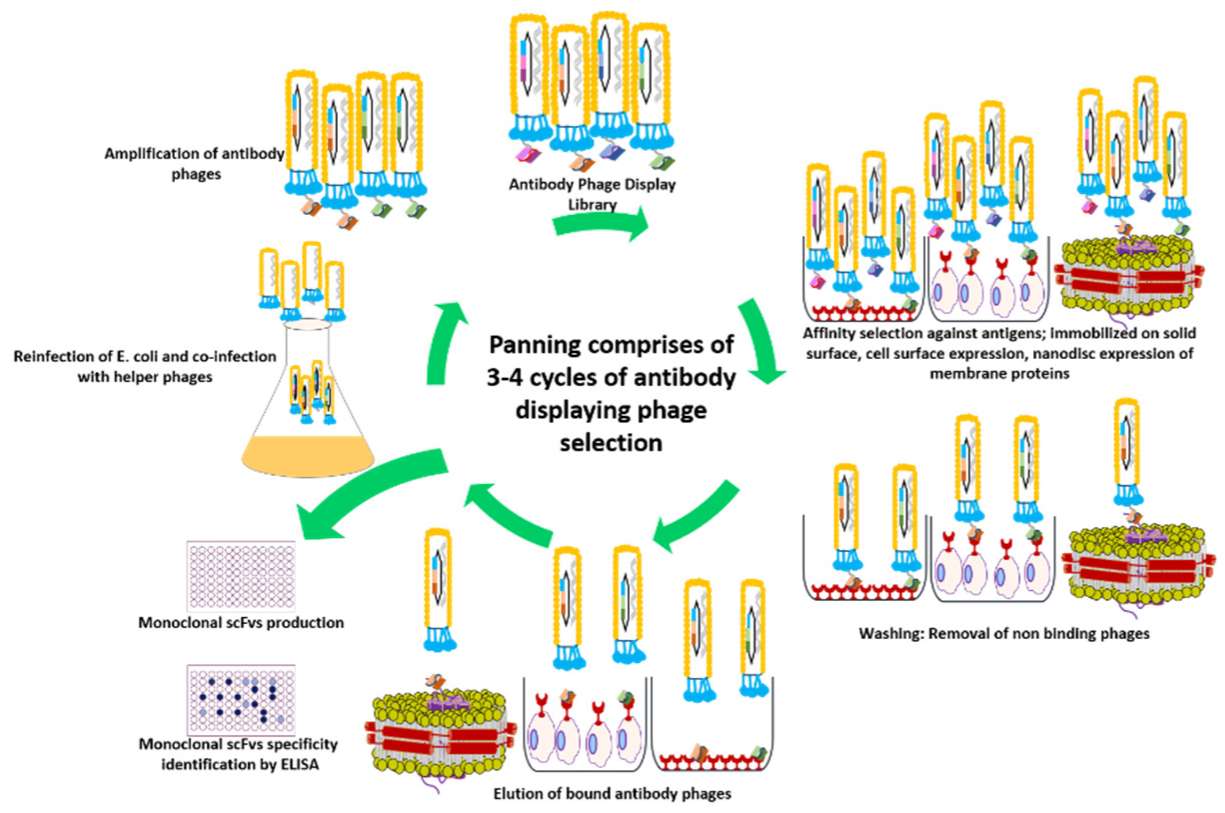
Bashir and Paeshuyse summarized the construction and selection of antibody phage libraries for veterinary immunovirology. The illustrated biopanning cycle shows antigen presentation, incubation with a diverse antibody-displaying phage pool, removal of unbound or weakly bound clones, recovery of retained phage, bacterial amplification, and repeated selection to enrich target-focused binders.1,2
The study highlights technical elements that directly inform pet antibody discovery planning, including scFv and Fab library construction, large repertoire screening, iterative selection pressure, antigen-format choices, enrichment, clone recovery, and downstream characterization. Creative Biolabs applies these principles through premade or custom library services, tailored panning, monoclonal screening, sequence analysis, species-specific reformatting, and preliminary lead evaluation.
Fig.1 Panning of an antibody phage display library for enrichment of high-affinity antibodies.
Service Advantages
Why Choose Creative Biolabs for Pet Antibody Phage Display?
Integrated technical planning helps align library choice, selection pressure, hit screening, species format, and downstream evidence with the decisions your program needs to make.
Diverse Library Routes
Premade, naïve, immune, and synthetic strategies fit different targets and species.
Selection by Evidence
Enrichment, counter-screens, sequence diversity, and function guide candidate decisions.
Species-Aware Reformatting
Canine and feline formats connect discovery fragments with relevant downstream studies.
Traceable Deliverables
Methods, sequences, screening data, purified leads, and conclusions support transfer.
Connected Research Modules
Related Pet Therapeutic Antibody Services
Combine phage display with complementary discovery, characterization, engineering, and evaluation services according to your starting materials and candidate-development plan.
Phage libraries commonly display scFv or Fab fragments. Prioritized sequences can be reformatted into full-length canine or feline IgG, Fc-fusions, or other requested architectures. Format selection is reviewed against the intended mechanism, effector-function needs, expression behavior, assay plan, and downstream research use.
Initial hit discovery is often planned over approximately 11–16 weeks when a qualified antigen and screening assay are available. Custom library construction, difficult membrane targets, additional panning strategies, functional screening, IgG reformatting, production, or engineering can extend the schedule. A project-specific timeline is defined after technical review.
Yes. CynoCure™ and FeliCure™ focus on canine and feline programs, while custom library construction can be considered for other companion, livestock, aquatic, or veterinary species. Feasibility depends on sequence resources, biological source availability, desired format, library design, and downstream assay reagents.
Phage display screens very large recombinant antibody repertoires under controlled in vitro conditions and directly links binding phenotype to sequence. Hybridoma workflows recover antibodies from fused antibody-producing cells after immunization. The better route depends on antigen behavior, desired repertoire, species framework, need for native pairing, screening method, and project timing.
Depending on the target, selections may use purified proteins, domains, peptides, biotinylated antigens, cells, membrane-associated presentations, or competition formats. The antigen should be reviewed for identity, purity, conformation, orientation, accessibility, and compatibility with negative controls before the selection strategy is finalized.
Useful starting information includes the target name and sequence, intended animal species and indication, antigen format and available quantity, desired antibody format and mechanism, known homologs or cross-reactivity risks, available assays, preferred deliverables, and project timing. Existing clones, enriched pools, sequences, or screening data can also be reviewed.
References
Bashir, Shahbaz, and Jan Paeshuyse. "Construction of antibody phage libraries and their application in veterinary immunovirology." Antibodies 9.2 (2020): 21. https://doi.org/10.3390/antib9020021
Distributed under Open Access license CC BY 4.0, without modification.
Online Inquiry
Tell us about your target, intended pet species, antigen format, library preference, and desired antibody deliverables. Our team will review your requirements and follow up with a tailored discovery plan.