
Advancing Canine Health with Therapeutic Antibody Discovery
Dogs are affected by serious cancers, immune-mediated disorders, chronic inflammatory diseases, allergy-related conditions, pain pathways, and infectious challenges that may benefit from antibody-based intervention. Translating monoclonal antibody strategies into canine medicine requires more than target binding alone; discovery programs must consider canine sequence context, immune compatibility, Fc design, functional assays, expression behavior, and manufacturability from the beginning.
Creative Biolabs provides an integrated platform for generating, adapting, and optimizing antibody candidates designed for canine therapeutic research. Whether a program begins with a target concept, a supplied antigen, an existing non-canine antibody, or a lead sequence that requires caninization or chimerization, our team connects discovery, engineering, screening, expression, and characterization into a coordinated workflow for decision-ready preclinical candidates.
Our Integrated Antibody Discovery Services
We provide a full suite of services tailored to your project stage, from de novo canine monoclonal antibody generation to species-adapted engineering for existing candidates that need veterinary development readiness.
Pet Therapeutic Antibody Discovery
Creative Biolabs designs canine therapeutic antibody discovery programs around target biology, antigen format, assay feasibility, and downstream engineering needs. We can apply phage display, hybridoma, single-B cell, or customized integrated strategies to build diverse hit panels, then support binding confirmation, sequencing, epitope or specificity screening, and early functional triage. This module is suitable for programs beginning with a target concept, a validated antigen, or a difficult canine disease pathway requiring multiple discovery routes.
→ 02Caninized Antibody Discovery
Caninized antibody discovery supports projects with promising non-canine antibodies that require adaptation for dog-focused therapeutic research. Our team evaluates the starting sequence, defines CDR and framework boundaries, selects canine framework candidates, and designs grafted variants with attention to affinity retention, structural liabilities, expression behavior, and immunogenicity risk. Follow-up expression and binding confirmation can help select variants for additional optimization or characterization.
→ 03Chimeric Canine Antibody Discovery
Chimeric canine antibody discovery provides a faster conversion route when retaining the original variable regions is desirable. We fuse the VH/VL regions of a non-canine antibody to canine constant regions, generate expression constructs, and evaluate purified candidates for binding, species-compatible Fc context, and functional assay readiness. This route can help compare rapid chimerization with deeper caninization when timeline, evidence needs, and developability risks differ.
→Target-to-Candidate Workflow for Canine Antibody Programs
Our one-stop workflow is designed to move a program from target validation and antigen strategy to a characterized lead candidate. Defined stage gates help clients evaluate binders, engineering options, expression quality, and functional evidence without coordinating multiple vendors.
| Workflow | Description | Representative Outputs | Key Decision Point |
|---|---|---|---|
| Target Validation & Antigen Design | Confirm target relevance and select recombinant, peptide, domain, or cell-based antigen formats. | Target rationale, antigen plan, construct design, and QC criteria. | Is the starting point suitable? |
| Antibody Discovery & Screening | Use phage display, B-cell cloning, hybridoma, or integrated routes to recover specific binders. | Hit panels, sequences, primary binding data, and diversity assessment. | Which binders merit confirmation? |
| Engineering & Optimization | Caninize or chimerize candidates while considering affinity, stability, Fc region, and manufacturability. | Engineered sequences, construct maps, expression feasibility, and retained-binding data. | Which format best balances compatibility and function? |
| Expression & Production | Express prioritized antibodies for analytical assays and preclinical research material needs. | Purified antibodies, concentration data, purity assessment, and material records. | Can production support evaluation? |
| Comprehensive Characterization | Assess binding kinetics, specificity, cross-reactivity, functional activity, biophysical quality, and stability. | Candidate matrix, characterization report, and lead-nomination recommendation. | Which candidate should advance? |
Recommended Starting Information
- Target name, sequence, and canine relevance
- Intended indication or mechanism of action
- Available antigen, clone, hybridoma, or antibody sequence
- Preferred format: canine, caninized, or chimeric
- Known assay, species, or cross-reactivity requirements
- Desired deliverables and downstream study stage
Typical Final Deliverables
- Discovery strategy and experimental design
- Confirmed antibody sequences and construct information
- Binding, specificity, and functional datasets
- Caninized or chimeric candidate documentation
- Purified antibody material for evaluation
- Summary report with lead-selection rationale
Start with your canine target, antibody sequence, or development question
Creative Biolabs can configure a focused discovery module or a fully integrated workflow after reviewing your target biology, existing materials, and desired decision points.
Published Data Supporting Canine Chimeric Antibody Engineering and Functional Validation
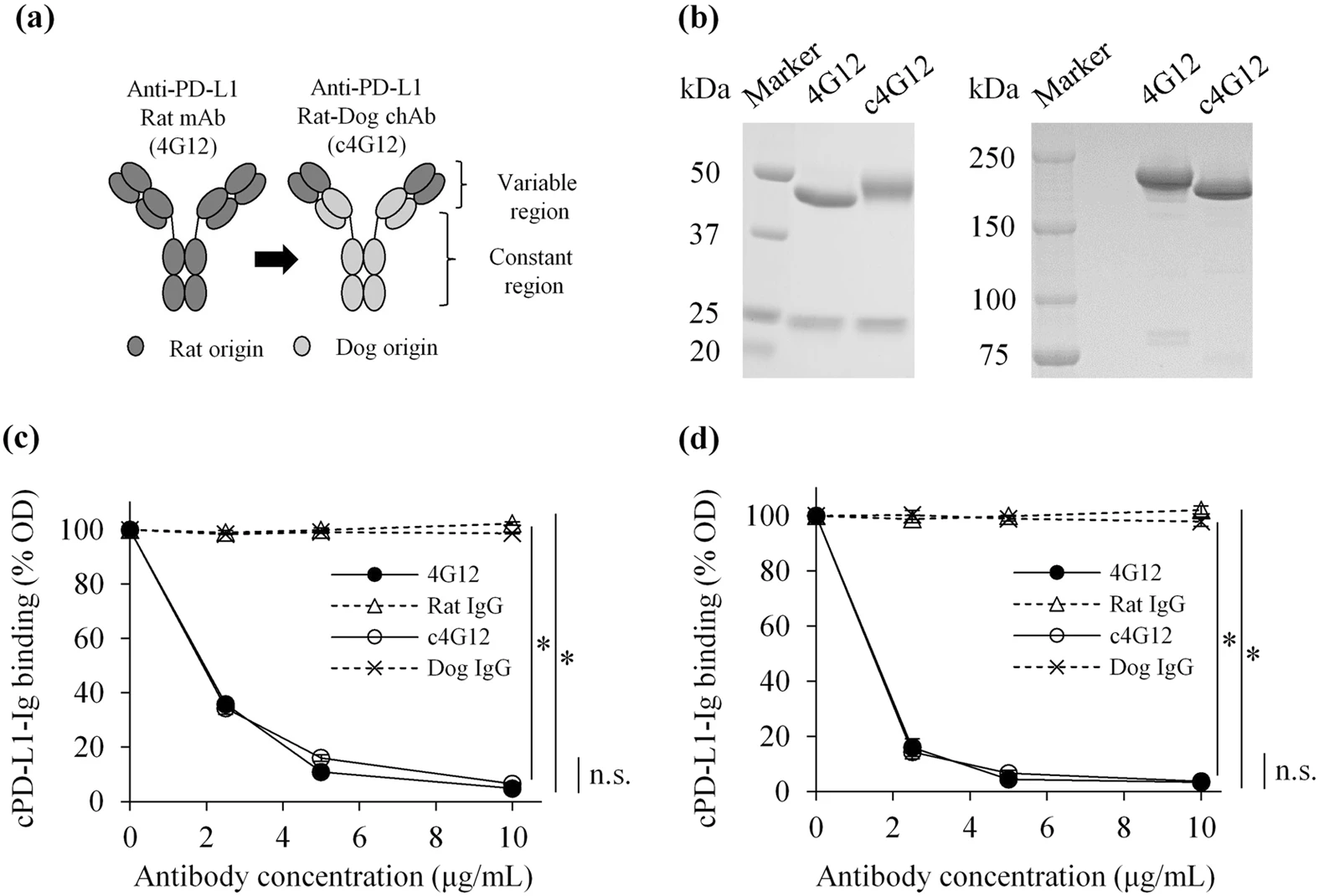
Maekawa et al. reported the preparation and evaluation of c4G12, a canine-chimerised anti-PD-L1 monoclonal antibody. The figure summarizes conversion from the original rat antibody to a canine chimeric format, expression and purification, and recombinant PD-1/PD-L1 or CD80/PD-L1 blocking assays, making it directly relevant to canine antibody engineering and candidate characterization.
The study elements mirror key decision points in canine therapeutic antibody discovery services: antibody selection, species-compatible format design, recombinant expression, purification, binding confirmation, and functional blockade testing. Creative Biolabs integrates canine antibody discovery, caninization, chimerization, expression, and characterization modules to help clients assemble comparable evidence packages before preclinical advancement.
Canine-Centered Capabilities for Therapeutic Antibody Discovery
Creative Biolabs combines veterinary immunology knowledge, antibody discovery platforms, and engineering workflows to support scientifically grounded candidate selection for dog-focused biologics programs.
Canine-Centered Expertise
Discovery and engineering strategies reflect canine immunology, sequence context, and therapeutic format needs.
Comprehensive Discovery Platforms
Integrated discovery, caninization, chimerization, expression, and characterization services under one roof.
Rapid Candidate Identification
Advanced screening workflows accelerate high-affinity, high-specificity candidate nomination.
Canine Therapeutic Antibody Discovery FAQs
References
- Maekawa, Naoya, et al. "A canine chimeric monoclonal antibody targeting PD-L1 and its clinical efficacy in canine oral malignant melanoma or undifferentiated sarcoma." Scientific Reports 7 (2017): 8951. https://doi.org/10.1038/s41598-017-09444-2
- Distributed under Open Access license CC BY 4.0, without modification.