
Pet Antibody In Vivo Evaluation from Candidate Behavior to Decision-Ready Evidence
Evaluating a veterinary antibody in a biologically relevant system is essential when in vitro binding and functional data no longer answer questions about exposure, tissue response, dose selection, tolerability, or disease-modifying activity. Creative Biolabs designs tailored in vivo studies to characterize therapeutic antibody candidates in healthy or disease-relevant animal models, with endpoints matched to the intended species, route, target biology, and program stage. Study modules can examine efficacy, pharmacokinetics, pharmacodynamics, immunogenicity, safety observations, pathology, and biomarker changes, generating actionable evidence for candidate selection and next-step planning.

In Vivo Services for Veterinary Therapeutic Antibody Programs
Our service modules generate the critical data needed to move a therapeutic antibody from a promising candidate toward a more informed development plan. Each protocol is configured around the species, indication, antibody format, dose route, available in vitro evidence, and decision points.
In Vivo Efficacy Evaluation
Study designs assess whether a pet therapeutic antibody produces the intended biological effect in disease-relevant models, with endpoints such as tumor response, inflammatory marker reduction, clinical sign scoring, immune-cell profiling, or target-specific functional outcomes.
In Vivo PK/PD Evaluation
Pharmacokinetic studies characterize exposure, half-life, clearance, bioavailability, and distribution, while pharmacodynamic readouts connect antibody concentration to target engagement, biomarker modulation, or other measurable biological responses.
In Vivo Safety Evaluation
Safety modules may include clinical observations, hematology, serum chemistry, injection-site checks, cytokine or immune monitoring, necropsy, and histopathological review to identify tolerability findings relevant to future study planning.
Match the In Vivo Question to the Right Evaluation Module
A pet antibody program may require a focused PK study, a disease-model efficacy experiment, a repeat-dose safety study, or an integrated package. Creative Biolabs helps align model choice, dosing, sampling, assays, and reporting with the decision that the study must support.
| Evaluation Need | Primary Study Question | Typical Readouts | Decision-Oriented Outputs |
|---|---|---|---|
| Efficacy | Does the antibody produce a measurable biological or disease-relevant effect? | Tumor size, lesion scores, pain or mobility scores, inflammatory markers, immune profiling, target pathway response. | Proof-of-concept evidence, endpoint ranking, responder patterns, and recommendations for candidate advancement. |
| PK/PD | How does exposure relate to target engagement and biological response? | Serum antibody concentration, half-life, Cmax, AUC, clearance, bioavailability, receptor occupancy, biomarkers. | Dose-regimen rationale, therapeutic-window hypotheses, sampling strategy, and exposure-response interpretation. |
| Safety | Are there tolerability, clinical pathology, or tissue findings that require mitigation? | Clinical observations, body weight, food intake, hematology, serum chemistry, urinalysis, cytokines, necropsy, histopathology. | Safety signal summary, dose-level interpretation, pathology findings, and risk-focused follow-up recommendations. |
| Immunogenicity | Does the animal mount an anti-drug antibody response that may affect exposure or response? | ADA screening, confirmatory assays, titer analysis, exposure comparison, efficacy or safety correlation. | Immunogenicity classification, exposure impact assessment, and recommendations for monitoring in future studies. |
Discover how we can help your pet antibody program
Share your target, antibody format, species, available in vitro data, and intended decision point. Our scientists can propose a focused pilot or integrated in vivo evaluation plan.
Pet Antibody In Vivo Evaluation Service Workflow
Our workflow supports therapeutic antibody development for companion animals by generating species-appropriate efficacy, safety, pharmacology, and immunogenicity data. The process is customized to produce actionable evidence for candidate selection and next-step development planning.
Recommended Starting Information
- Target and mechanism of action
- Antibody format, concentration, and purity
- Intended canine, feline, or other species
- Available binding and functional data
- Preferred route and proposed dose range
- Required endpoints and study decision point
Typical Final Deliverables
- Customized protocol and sampling schedule
- Clinical observation and body-weight summaries
- PK/PD, ADA, biomarker, and efficacy datasets
- Clinical pathology and histopathology outputs
- Statistical analysis and graphical summaries
- Integrated interpretation and next-step recommendations
Published Data Supporting In Vivo PK and Immunogenicity Evaluation
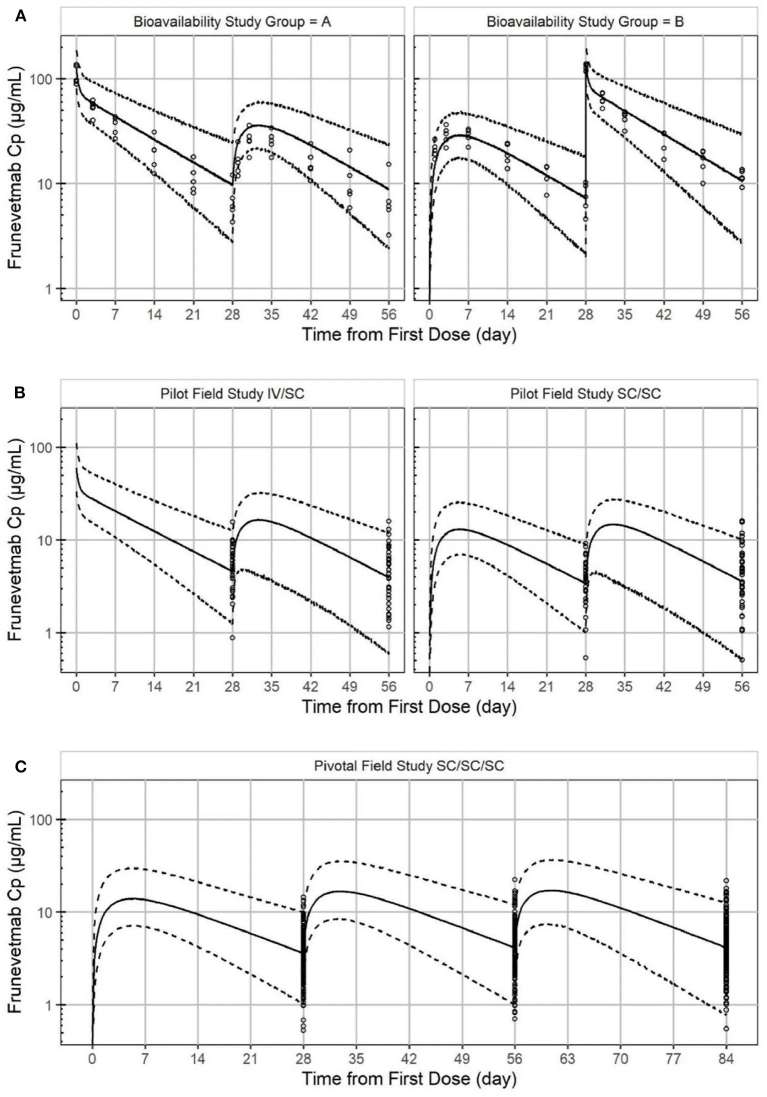
Walters, Boucher, and De Toni reported pharmacokinetic and immunogenicity findings for frunevetmab, a felinized anti-NGF monoclonal antibody, after intravenous and subcutaneous administration in osteoarthritic cats and across field-study dosing settings. The figure shows visual predictive checks for frunevetmab concentration-time profiles, illustrating how measured concentrations can be compared with model-predicted exposure over repeated dosing intervals.
The study elements are directly relevant to veterinary antibody in vivo evaluation because they connect target-species dosing, serial blood sampling, validated bioanalysis, PK modeling, field-study trough concentrations, and anti-drug antibody assessment. Creative Biolabs applies the same decision-oriented logic when designing PK/PD, immunogenicity, efficacy, and safety modules for pet therapeutic antibody candidates.
Service Advantages for Pet Antibody In Vivo Evaluation
Creative Biolabs combines veterinary model knowledge, antibody-specific assay design, bioanalytical execution, and pathology interpretation to help clients understand candidate performance in a species-relevant biological context.
Unmatched Veterinary Focus
Species-aware protocols for canine, feline, and companion-animal antibody studies.
Integrated Pipeline
Discovery, in vitro characterization, and in vivo evaluation connect smoothly.
Advanced Bioanalysis
Ligand-binding assays and LC-MS/MS support sensitive matrix analysis.
Actionable Reports
Clear datasets, summaries, statistics, and expert interpretation support decisions.
Partner with Creative Biolabs for pet antibody in vivo evaluation
Our scientists can help translate your antibody profile, target biology, and development questions into a focused in vivo study design with meaningful endpoints and interpretable deliverables.
Pet Antibody In Vivo Evaluation FAQs
References
- Walters, Rodney R., et al. "Pharmacokinetics and Immunogenicity of Frunevetmab in Osteoarthritic Cats Following Intravenous and Subcutaneous Administration." Frontiers in Veterinary Science 8 (2021): 687448. https://doi.org/10.3389/fvets.2021.687448
- Distributed under Open Access license CC BY 4.0, without modification.