
Recover Native Antibody Pairs from Individual Antigen-Specific B Cells
Single-B cell antibody discovery isolates individual antigen-reactive B cells and recovers their naturally paired heavy- and light-chain variable genes. Preserving this pairing reduces the combinatorial reshuffling associated with display-library construction and provides a direct link between an antigen-selected cell and its recombinant antibody sequence.
Creative Biolabs integrates immunization planning, sample processing, antigen-probe design, flow cytometry or microfluidic sorting, single-cell gene recovery, sequence analysis, recombinant expression, and characterization. Selected antibodies can then be adapted for canine or feline research through species-aware engineering while retaining the binding features that justified lead selection.
Discovery Modules from Immune Response to Engineered Candidate
Each module is configured around antigen quality, host species, B-cell phenotype, desired mechanism, assay readiness, and downstream veterinary antibody format.
Immunization and Antigen-Probe Strategy
We review target biology and design an immunization approach using an appropriate host, schedule, antigen format, adjuvant concept, sampling plan, and response-monitoring assay. For sorting, antigen probes are configured to preserve relevant epitopes and distinguish true B-cell receptor binding from fluorophore, streptavidin, tag, or aggregation-related background. Dual-color probes and decoy controls may be considered when they improve specificity.
Antigen-Specific Single-B Cell Isolation
PBMCs, splenocytes, or another agreed immune-cell source are processed and stained with phenotype markers, viability reagents, and antigen probes. FACS or a suitable single-cell platform identifies and deposits selected cells according to a defined gating strategy. The panel can emphasize class-switched memory B cells, plasmablasts, antibody-secreting cells, or another population consistent with sample type and the desired discovery outcome.
Native-Pair Gene Recovery and Recombinant Validation
RNA from each selected cell is reverse-transcribed, and paired heavy- and light-chain variable genes are amplified with species-relevant primer sets. Product QC, sequencing, annotation, and clonotype analysis support selection of unique candidates for expression. Recombinant antibodies are produced in an appropriate mammalian system and evaluated using binding, affinity, specificity, competition, or functional assays selected for the target.
Caninization, Felinization, and Lead Development
When discovery begins in a non-target host, selected variable regions can be evaluated for canine or feline adaptation. Framework selection, CDR grafting, back-mutation analysis, structural review, recombinant expression, and retained-binding assessment are coordinated according to project needs. Additional engineering, developability review, and functional characterization can support nomination of candidates for further veterinary research.
From Immunization to a Characterized Pet Antibody Candidate
Each stage connects immunization, antigen-specific cell isolation, paired-chain recovery, recombinant validation, and species-focused engineering.
| Stage | Technical Focus | Representative Outputs | Go/No-Go Question |
|---|---|---|---|
| Immunization and Response Review | Select host and antigen presentation; monitor serum response, specificity, and functional signals where applicable. | Immunization records, sampling plan, and response data. | Is the repertoire ready for cell recovery? |
| B-Cell Enrichment and Sorting | Prepare cells, stain phenotype markers and antigen probes, establish controls, gate, and deposit single cells. | Sorting strategy, event statistics, and isolated cell plates. | Are antigen-positive events distinct from background? |
| Antibody Gene Recovery | Perform single-cell RT-PCR, paired-chain amplification, sequencing, annotation, and clonotype grouping. | Native VH–VL sequences and candidate list. | Which unique pairs merit expression? |
| Recombinant Confirmation | Clone, express, purify, and test antibodies using target-relevant binding and functional assays. | Purified research material and candidate comparison data. | Which antibodies meet selection criteria? |
| Caninization or Felinization | Design species-adapted variants, express them, and assess retained affinity, specificity, function, and quality. | Engineered sequences, material, and comparative report. | Which species-compatible candidate should advance? |
Recommended Starting Information
- Target sequence, structure, biology, and desired mechanism
- Antigen, target-expressing cells, and available assay reagents
- Preferred host and existing immunization or serum data
- Desired B-cell subset and antibody isotype
- Affinity, blocking, neutralization, or cross-reactivity criteria
- Target pet species and final antibody format
Typical Final Deliverables
- Sorting panel, gating strategy, and event summary
- Paired antibody DNA and amino acid sequences
- Clonotype and sequence-annotation results
- Purified recombinant research antibodies
- Binding, specificity, and functional characterization data
- Optional caninized or felinized candidate package
Start with your antigen, immunization concept, or existing immune sample
Our team can assess probe design, B-cell population, native-pair recovery, assay needs, and whether downstream species adaptation should be built into the discovery plan.
Published Data on Antigen-Specific Single-B Cell Sorting
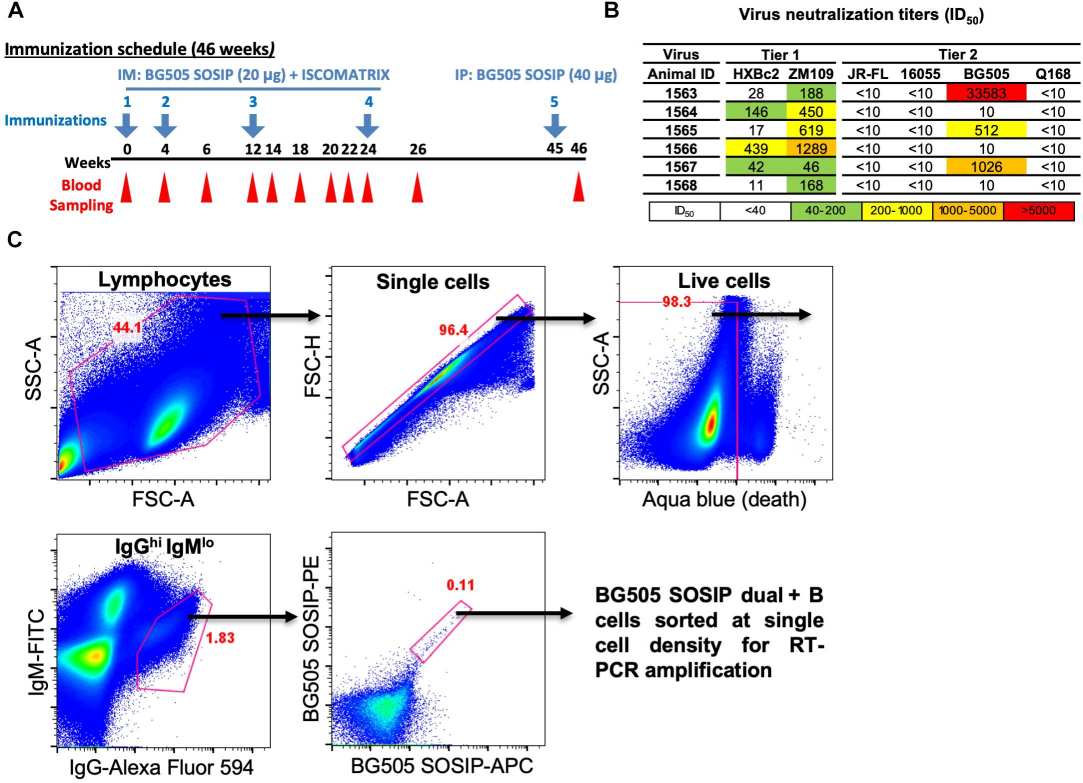
Lei et al. established an antigen-specific single-B cell sorting and monoclonal antibody cloning workflow in guinea pigs. The figure combines the immunization and sampling schedule, serum neutralization results, and a sequential FACS gating strategy that narrows lymphocytes to single live, class-switched, dual-antigen-positive B cells for single-cell deposition and downstream RT-PCR.
The study illustrates several decisions central to Creative Biolabs' service scope: immune-response assessment, antigen-probe design, singlet and viability gating, selection of class-switched B cells, dual-probe specificity control, native heavy–light chain recovery, recombinant expression, and binding or functional confirmation. Comparable modules can be adapted to the host species, target, and veterinary antibody development plan.
Why Choose Our Single-B Cell Antibody Discovery Platform?
Creative Biolabs combines controlled antigen-specific sorting, native-pair sequence recovery, recombinant validation, and veterinary antibody engineering in one coordinated program.
Rare-Cell Resolution
Controlled sorting strategies recover antigen-reactive cells from complex immune populations.
Native Chain Pairing
Heavy and light variable genes remain linked to their original B cell.
Early Recombinant Evidence
Expression and fit-for-purpose assays confirm sequence-level discoveries before engineering.
Pet-Species Adaptation
Caninization and felinization connect discovery to veterinary-format candidate development.
Single-B Cell Sorting Pet Antibody Discovery FAQs
Partner with Creative Biolabs
Connect antigen-specific B-cell isolation with native-pair sequence recovery, recombinant validation, and species-focused engineering in a coherent veterinary antibody discovery program.
References
- Lei, Lin, et al. "Antigen-Specific Single B Cell Sorting and Monoclonal Antibody Cloning in Guinea Pigs." Frontiers in Microbiology 10 (2019): 672. https://doi.org/10.3389/fmicb.2019.00672
- Distributed under Open Access license CC BY 4.0, without modification.