IgG Subclass and Species Selection
Define the desired immune mechanism and select canine, feline, or other relevant IgG constant regions using available receptor biology, literature, assay systems, and downstream development needs.

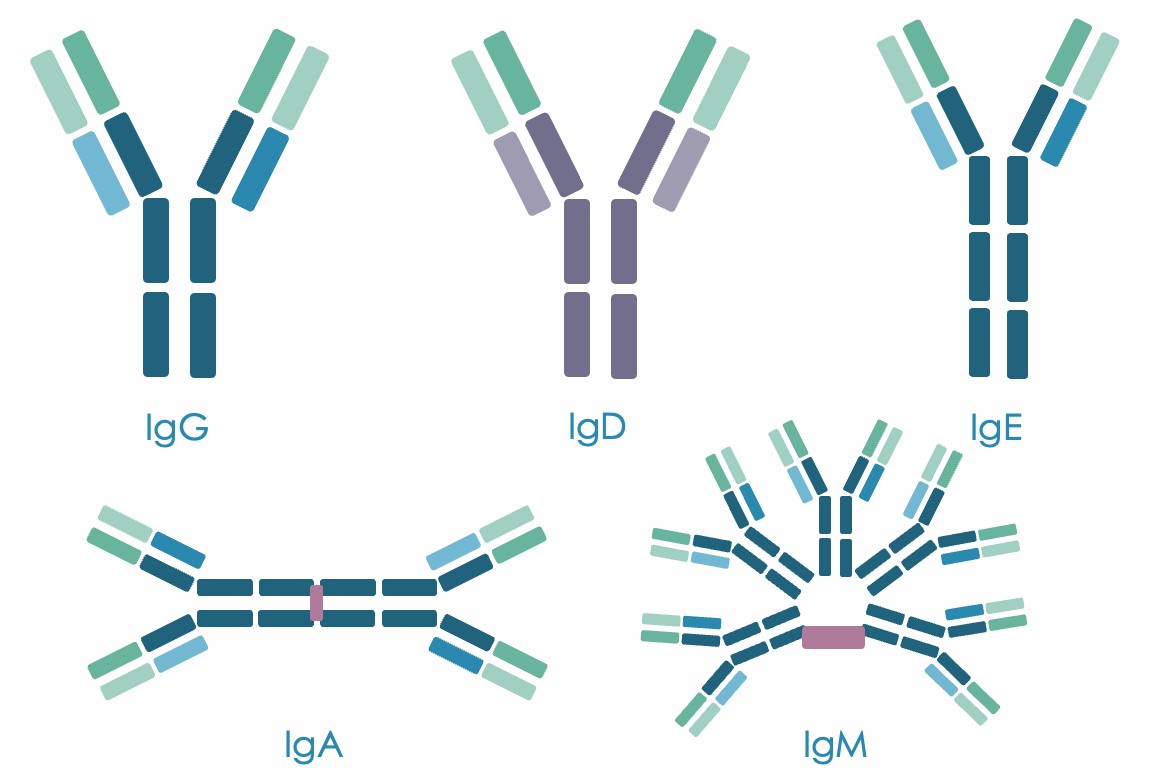
An antibody's variable regions determine target recognition, while its heavy-chain constant region influences Fc receptor binding, complement activation, immune-cell recruitment, molecular assembly, distribution, and persistence. For canine and feline therapeutic programs, switching among species-relevant IgG subclasses can therefore change biological behavior without redesigning the antigen-binding site. The appropriate choice depends on whether the program requires cell depletion, immune silencing, receptor blockade, agonism, altered Fc receptor engagement, or another defined Fc-mediated profile.
Creative Biolabs provides recombinant IgG subclass/isotype switching for veterinary research and therapeutic development. We review the parental sequence and species, recommend one or more species-relevant IgG constant-region backbones, construct matched variants, express and purify them under comparable conditions, and verify retained antigen binding. Optional Fc receptor, complement, effector-cell, stability, and developability assays help distinguish a successful sequence conversion from an IgG subclass that truly supports the program mechanism. Cross-class reformatting into formats such as IgA or IgM is not treated as a routine Fc-backbone replacement and requires separate design and validation planning.
Projects can deliver a single IgG-subclass variant or a matched panel designed to reveal how the heavy-chain constant-region background affects veterinary candidate performance.
Define the desired immune mechanism and select canine, feline, or other relevant IgG constant regions using available receptor biology, literature, assay systems, and downstream development needs.
Inspect variable-region junctions, signal peptides, VH/VL pairing, heavy-chain constant-region sequences, cloning boundaries, and potential liabilities before preparing expression constructs.
Place the parental VH/VL domains into selected heavy-chain constant-region backbones while retaining the parental light-chain configuration unless species adaptation is specifically required.
Express matched variants, purify them using suitable affinity and polishing steps, and assess concentration, identity, purity, integrity, aggregation, and recovery for valid comparisons.
Verify target recognition and compare apparent affinity or kinetics, size distribution, thermal behavior, and expression quality so constant-region effects are not confused with poor material.
Configure Fc receptor, FcRn, C1q, ADCC, CDC, ADCP, or other species-relevant assays to determine whether the switched IgG subclass produces the intended functional direction.
Each gate preserves comparability across switched variants and links construct design, material quality, binding confirmation, and Fc-functional evidence to the intended biological decision.
Set the species, mechanism, IgG subclass candidates, controls, assays, and success criteria.
Review sequences and build verified heavy-chain subclass variants while retaining the parental light-chain configuration unless adaptation is required.
Generate matched material and establish analytical quality for comparison.
Confirm antigen binding and measure relevant Fc-dependent or biophysical effects.
Rank variants and define optional scale-up, engineering, or evaluation support.
| Workflow Gate | Service Activity | Representative Deliverable | Decision Question |
|---|---|---|---|
| Project Consultation & Isotype Selection | Review the parental antibody, veterinary species, target, mechanism, effector requirement, study system, and downstream application; nominate one or more species-relevant IgG subclasses and controls. | Project plan, backbone choices, assay matrix, and success criteria. | Which constant regions can test the mechanism most directly? |
| Antibody Sequence Analysis & Cloning | Inspect VH/VL sequence integrity and junctions, design species-relevant heavy-chain constant-region constructs, retain the parental light-chain configuration unless adaptation is required, and confirm plasmid sequences. | Sequence-verified expression constructs and construct map. | Are variants matched except for the intended isotype change? |
| Expression & Purification | Express isotype variants under comparable conditions, purify them, and evaluate identity, integrity, purity, aggregation, and yield. | Purified antibody panel with analytical QC data. | Does every variant meet the quality threshold for comparison? |
| Functional Validation | Confirm retained antigen recognition and evaluate selected Fc receptor, complement, FcRn, effector-cell, stability, or other mechanism-aligned readouts. | Binding and functional comparison matrix with ranked candidates. | Does the new IgG subclass provide the intended biological profile? |
| Data Reporting & Optional Downstream Support | Integrate sequences, production records, QC, assays, interpretation, and recommendations for engineering, scale-up, characterization, or preclinical evaluation. | Final report, raw and processed data, sequences, and material. | What evidence or optimization is needed for advancement? |
We can begin with a defined IgG subclass or recommend a small matched panel based on species and mechanism.
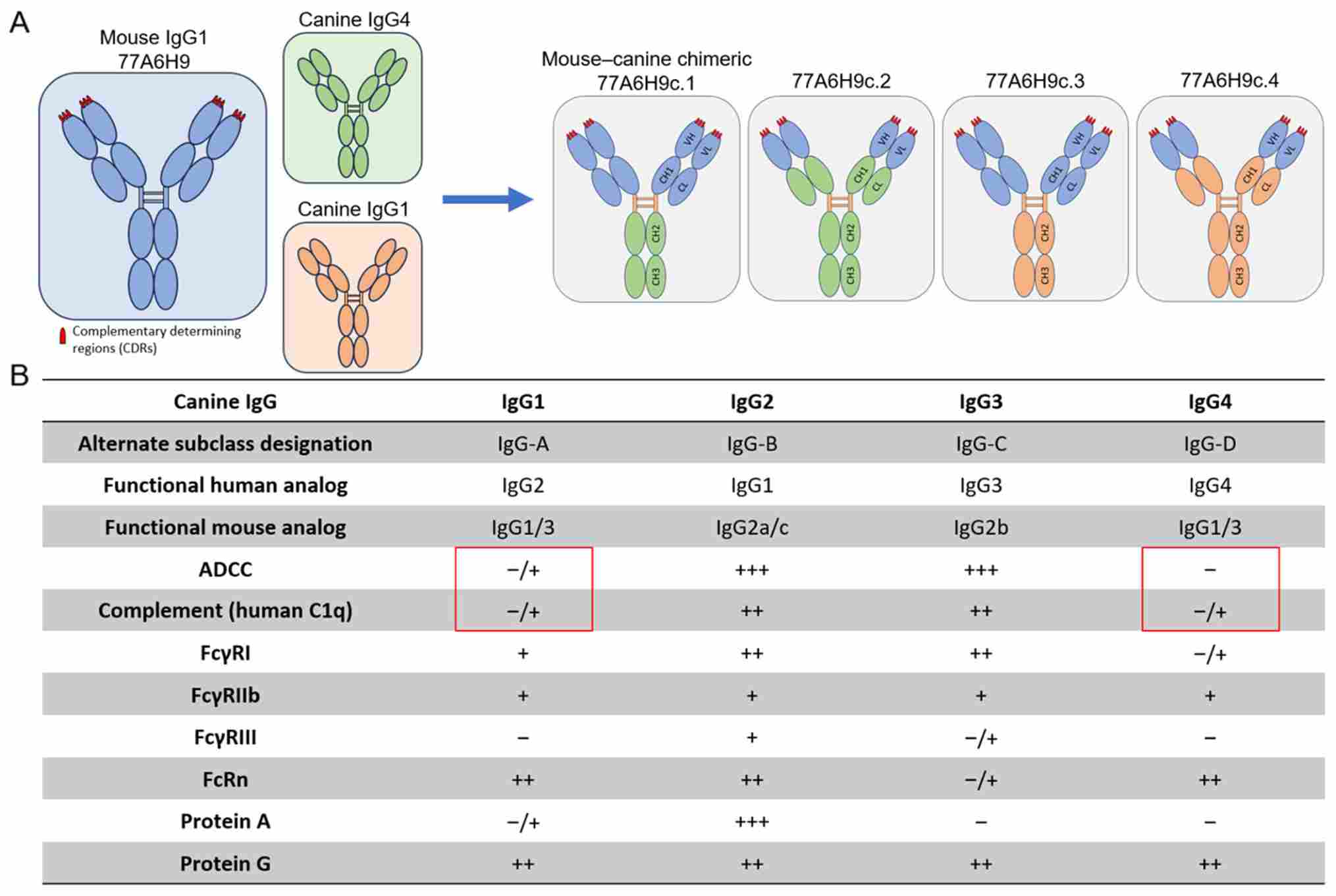
Hartman et al. constructed mouse-canine chimeric anti-PD-1 antibodies incorporating canine IgG1 and IgG4 constant regions and summarized known functional profiles across canine IgG subclasses. The figure illustrates the practical premise of isotype switching: identical antigen-recognition logic can be paired with different constant-region backgrounds, while subclass-dependent Fc receptor and complement activities influence the expected immune behavior.
The study provides a relevant framework for veterinary isotype selection but also reinforces the need for project-specific confirmation. Creative Biolabs can generate matched canine or feline IgG subclass variants, verify sequence and analytical quality, confirm retained target binding, and compare Fc receptor, complement, effector-cell, stability, or exposure-related readouts. This evidence chain supports selection of an IgG subclass based on the intended mechanism rather than nomenclature alone.
We connect constant-region selection, matched recombinant production, and fit-for-purpose testing so each switch answers a biological question and produces reusable development material.