
Canine-Compatible Antibody Engineering for Veterinary Therapeutic Programs
Antibody caninization adapts a non-canine antibody variable region to a canine framework while retaining the complementarity-determining regions responsible for antigen recognition. The goal is to reduce foreign sequence content, support repeated-administration research strategies, and create a better molecular starting point for canine biologics development.
Creative Biolabs configures each project around the antibody origin, target biology, desired format, available sequence or clone, and downstream validation plan. Sequence analysis, framework selection, structural modeling, back-mutation design, mammalian expression, and functional comparison are integrated into a traceable workflow for candidate advancement.
Antibody Caninization Service from Sequence Review to Functional Candidate
This service is designed for teams that already have a promising monoclonal antibody, antibody fragment, hybridoma-derived sequence, or lead binder and need to adapt it for canine therapeutic research without restarting discovery.
Input Assessment
We review VH/VL sequences, species origin, CDR definitions, target class, known binding data, format requirements, and intended canine application before recommending a caninization route.
Framework and CDR Strategy
Canine acceptor frameworks are selected for sequence compatibility, canonical structure support, liability reduction, and manufacturability-aware design, with back-mutations applied only when they are technically justified.
Experimental Confirmation
Caninized constructs can be synthesized, expressed, purified, and compared with parental molecules through binding, specificity, stability, and functional assays matched to the target mechanism.
Antibody Caninization Service Workflow
Our workflow connects computational design with wet-lab validation so each caninized antibody is evaluated against the parental lead and the project's intended decision criteria.
Send your lead antibody sequence for a feasibility review
Our scientists can assess whether a focused caninization package or a broader engineering and characterization plan is the better next step.
Configurable Caninization Deliverables and Decision Points
Caninization projects can be kept computational for early screening or expanded into expression and functional validation packages for candidate nomination.
| Project Module | Typical Activities | Decision-Oriented Outputs | When to Use |
|---|---|---|---|
| Feasibility Review | Sequence intake, CDR annotation, target context review, and risk mapping. | Caninization feasibility, missing information list, and recommended workplan. | Before committing resources to redesign or expression. |
| Framework Selection | Canine germline comparison, structural class review, liability analysis, and acceptor ranking. | Prioritized canine VH/VL frameworks and design rationale. | When parental affinity and canine compatibility must be balanced. |
| CDR Grafting | CDR transfer, residue-by-residue review, back-mutation selection, and variant design. | Caninized sequences, variant map, and engineering history. | For mouse, rat, rabbit, hamster, or other non-canine leads. |
| Expression and Purification | Gene synthesis, cloning, transient expression, purification, and material QC. | Purified caninized antibody material with basic analytical data. | When experimental comparison with the parental antibody is required. |
| Functional Characterization | Binding kinetics, antigen specificity, cell-based activity, stability, and developability assays. | Comparative dataset for lead selection or further optimization. | Before advancing to broader pet therapeutic antibody evaluation. |
Published Data Supporting Canine-Specific Antibody Validation
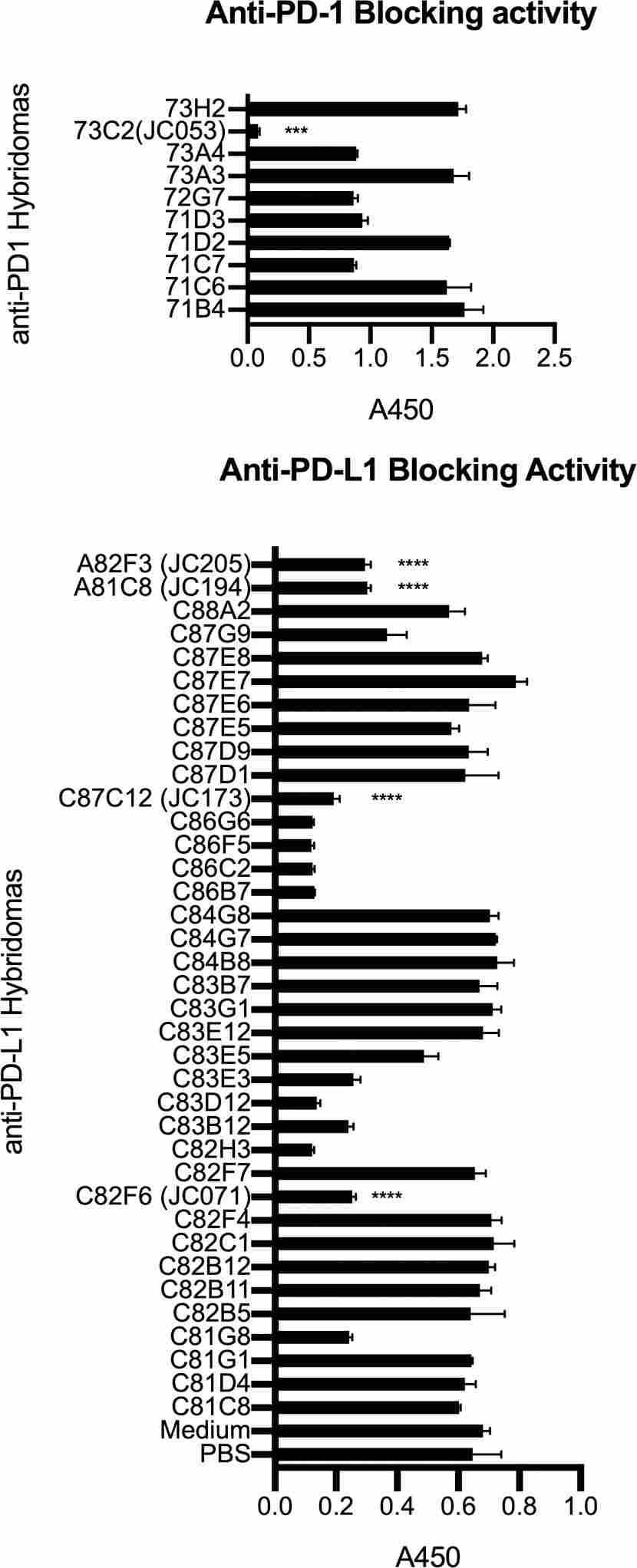
The figure from Choi et al. shows that canine-specific anti-PD-1 and anti-PD-L1 monoclonal antibodies can block the interaction between canine checkpoint proteins and restore IFN-γ production in canine T-cell assays. This is directly relevant to caninization because engineered antibody sequences must ultimately be evaluated in species-matched binding and functional systems.
The study connects target biology, antibody generation, blockade assays, and canine immune-cell readouts - the same evidence chain that informs Creative Biolabs' antibody caninization service. After CDR grafting and back-mutation design, our teams can support mammalian expression, comparative characterization, and mechanism-focused in vitro assays to confirm that canine framework adaptation preserves the lead antibody's intended activity.
Service Advantages for Canine Antibody Therapeutic Engineering
Creative Biolabs combines veterinary biologics experience with structure-guided antibody engineering to support practical canine therapeutic antibody development decisions.
Canine Framework Expertise
Framework choices prioritize canine compatibility, CDR support, and sequence liability reduction.
Affinity-Aware Design
Back-mutation strategy helps preserve binding while minimizing non-canine residues.
Integrated Wet-Lab Support
Designs can move directly into expression, purification, and validation.
Traceable Reports
Reports document sequences, design rationale, data, and next-step recommendations.
Antibody Caninization Service FAQs
References
- Choi, Jin Wook, et al. "Development of canine PD-1/PD-L1 specific monoclonal antibodies and amplification of canine T cell function." PLOS ONE 15.7 (2020): e0235518. https://doi.org/10.1371/journal.pone.0235518
- Distributed under Open Access license CC BY 4.0, without modification.