
Feline-Compatible Antibody Engineering for Safer Candidate Advancement
Antibody felinization modifies a non-feline monoclonal antibody so its variable-region framework more closely resembles feline antibody sequences while key complementarity-determining regions remain positioned for target recognition. This engineering strategy is used to reduce avoidable anti-drug antibody risk, preserve binding activity, and create a better starting molecule for recombinant production, characterization, and preclinical evaluation in feline therapeutic research.
Creative Biolabs configures each felinization project around the parental antibody sequence, target biology, mechanism of action, preferred constant region, assay availability, and downstream material needs. The result is a traceable package of engineered sequences, rationale, expression material, comparative data, and practical recommendations for next-stage development.
Felinized Antibody Design, Production, and Characterization Modules
Projects may be delivered as a focused design package or as an integrated service that includes molecular construction, recombinant expression, purification, and comparability testing against the parental antibody.
CDR Grafting and Framework Engineering
We identify feline framework candidates, preserve antigen-contacting residues, evaluate Vernier-zone effects, and design back-mutations when structural support is needed.
Feline Constant-Region Strategy
Constant-region selection is aligned with blocking, neutralization, depletion, Fc-mediated function, half-life, and manufacturability goals.
Comparative Functional Validation
Binding, specificity, activity, expression, purity, aggregation, and stability assays help identify felinized variants suitable for further research.
| Module | Scientific Purpose | Methods and Considerations | Decision-Oriented Output |
|---|---|---|---|
| Sequence Assessment | Define the engineering baseline and map residues that may influence binding or immunogenicity. | VH/VL annotation, CDR boundary review, framework comparison, liability screening, and germline similarity analysis. | Engineering risk map and candidate framework strategy. |
| Design and Modeling | Preserve the parental paratope while reducing non-feline framework content. | CDR grafting, structure prediction, Vernier residue evaluation, targeted back-mutation, and variant ranking. | Prioritized felinized antibody sequences with design rationale. |
| Expression and Purification | Generate material for analytical and functional comparability testing. | Gene synthesis, vector construction, transient mammalian expression, purification, SDS-PAGE, SEC, and concentration checks. | Purified felinized variants and analytical quality data. |
| Comparability Testing | Determine whether felinized variants retain target recognition and intended function. | ELISA, SPR/BLI, cell binding, competition, blocking, neutralization, or other fit-for-purpose assays. | Variant selection matrix comparing affinity, activity, and developability. |
Start with your lead sequence and intended feline indication
Our scientists can recommend a focused design-only package or an integrated felinization-to-validation workflow after reviewing your parental antibody and assay plan.
Antibody Felinization Service Workflow
Our workflow connects rational sequence design with experimental confirmation, helping clients move from a promising parental antibody to a felinized candidate supported by practical, decision-ready data.
Recommended Starting Materials
- Parental heavy- and light-chain sequences
- Antibody origin and isotype information
- Target antigen and species sequence
- Binding, potency, or screening data
- Desired feline constant region or MOA
- Planned downstream assays and material quantity
Typical Final Deliverables
- Felinized VH and VL sequence designs
- Framework and back-mutation rationale
- Structural and immunogenicity-risk summaries
- Expression constructs or purified material
- Comparative binding and functional datasets
- Technical report and next-step recommendations
Published Data Supporting Feline-Compatible Antibody Engineering
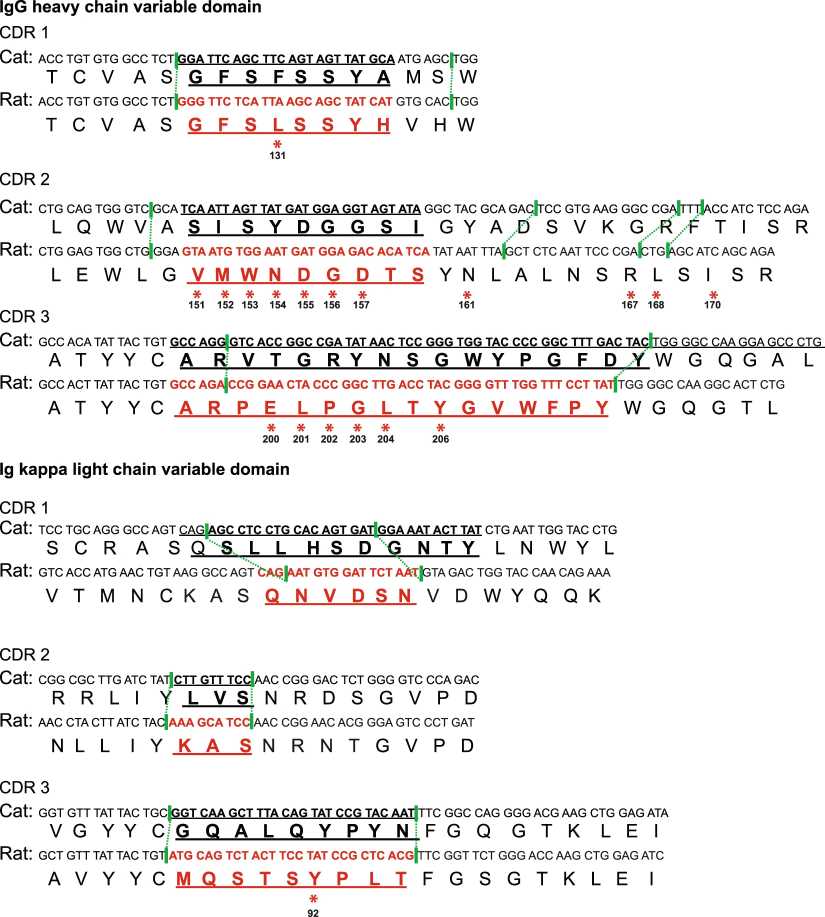
Lu et al. reported feline immunoglobulin transcript sequences and used them to guide the development of a felinized monoclonal antibody against feline panleukopenia virus. The figure compares parental and felinized variable-region sequences, highlighting how CDRs were transferred into feline antibody frameworks to generate felinized mAb E.
This example shows why felinization is more than a simple sequence substitution: CDR definition, framework compatibility, structural support residues, recombinant expression, and binding comparison all influence whether an engineered antibody remains useful after species adaptation. Creative Biolabs builds on the same principles through feline framework screening, CDR grafting, in silico modeling, rational back-mutation, expression, purification, and validation services.
Why Choose Creative Biolabs for Antibody Felinization
Our platform is designed to balance feline sequence compatibility, retained antigen recognition, practical expression, and clear downstream development decisions.
Feline Framework Strategy
Framework selection supports reduced foreign sequence exposure.
Affinity-Preserving Design
Modeling and back-mutations help maintain CDR geometry.
Integrated Validation
Expression, purification, and assays compare engineered variants.
Traceable Reports
Sequence rationale and results support downstream review.
Antibody Felinization Service FAQs
References
- Lu, Hsin-Chieh, et al. "Sequence analysis of feline immunoglobulin mRNAs and the development of a felinized monoclonal antibody specific to feline panleukopenia virus." Scientific Reports 7 (2017): 14425. https://doi.org/10.1038/s41598-017-12725-5
- Distributed under Open Access license CC BY 4.0, without modification.