
Species-Compatible Chimeric Antibody Engineering for Animal Health R&D
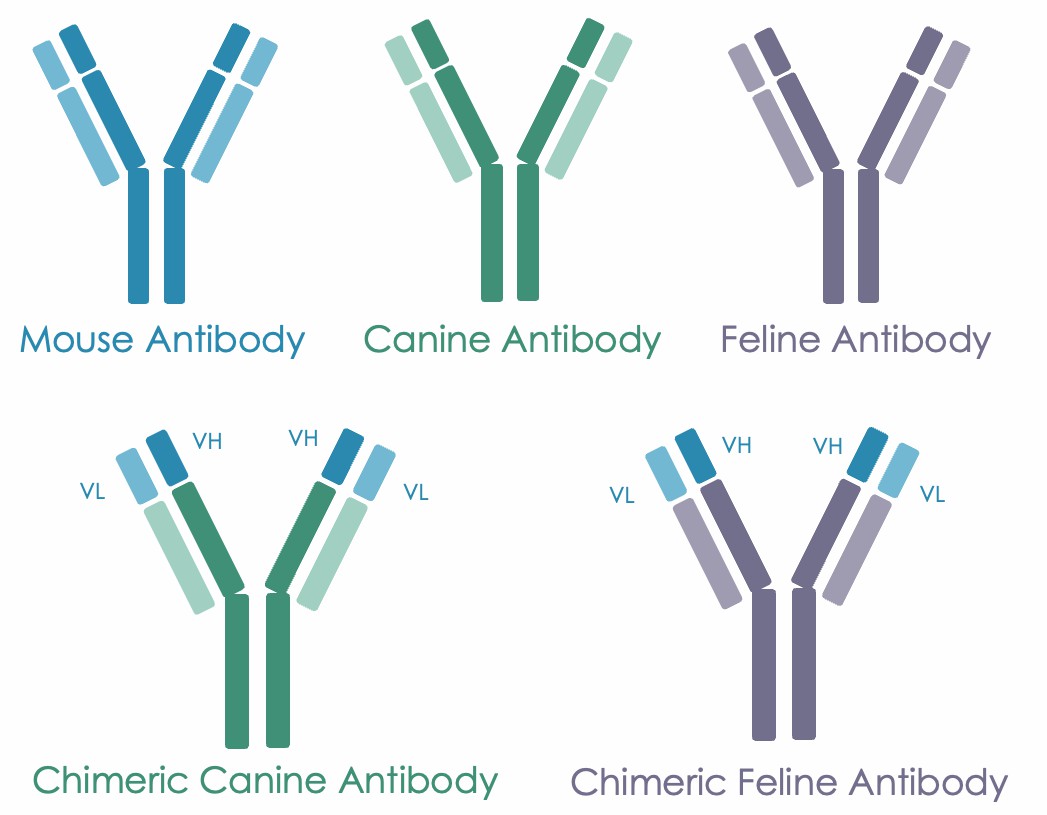
Antibody chimerization uses recombinant DNA methods to retain antigen-binding variable regions while replacing non-host constant domains with species-matched Fc and light-chain constant regions. The approach can preserve the original binding profile, reduce host recognition of foreign antibody components, and provide a practical bridge from discovery clones to veterinary research candidates. Creative Biolabs configures each project around the source antibody, intended animal species, target biology, assay requirements, expression format, and downstream evaluation plan, delivering purified chimeric antibodies and traceable datasets for functional and preclinical decision-making.
Custom Antibody Chimerization
We offer flexible chimerization tailored to your specific needs, whether you have a mouse hybridoma, a purified antibody, or only sequence data. Choose from canine, feline, or other veterinary species constant regions.
Canine Chimerization
Replace mouse constant domains with canine IgG1, IgG2, or IgG4 to create dog-compatible antibodies suitable for in vivo studies.
Feline Chimerization
Generate feline chimeric antibodies using feline IgG1 or IgG2 constant regions, preserving affinity and reducing immunogenicity in cats.
Multi-Species Chimerization
For projects requiring cross-species testing, we can produce chimeric antibodies with constant regions from multiple target species simultaneously.
De Novo Sequencing & Chimerization
If you only have purified antibody, we provide sequencing services to obtain variable region sequences and then perform chimerization in one integrated project.
Antibody Chimerization Service Workflow
Our streamlined process ensures high-quality chimeric antibodies with full traceability and functional validation. Each step is tailored to your starting material and project goals.
What You Need to Start
- Hybridoma cell line
- Purified antibody; sequencing can be included
- Variable region sequences, including VH and VL
- Target species, such as canine, feline, or other veterinary species
- Desired isotype, including IgG1, IgG2, or project-specific alternatives
- Functional assay requirements
What You Receive
- Purified chimeric antibody, typically ≥2 mg
- Full sequence and construct maps
- Binding affinity and specificity data
- Purity and aggregation analysis
- Optional additional characterization
- Project summary report
Match the Antibody Asset to the Right Chimerization Route
A technical review at project initiation helps determine whether direct chimerization, sequence recovery, additional engineering, or a broader optimization workflow is the most efficient route.
| Available Input | Recommended Starting Module | Key Technical Questions | Decision-Oriented Outputs |
|---|---|---|---|
| Validated VH/VL sequences | Direct chimeric construct design and expression. | Are framework boundaries, signal peptides, pairing, and constant regions appropriate? | Designed constructs, sequence map, purified antibody, and QC data. |
| Hybridoma cell line | Variable-region sequencing followed by chimerization. | Is the clone stable, productive, and matched to the reported binding activity? | Recovered sequences, expression constructs, antibody material, and binding confirmation. |
| Purified antibody only | De novo sequencing before engineering. | Can variable-region sequences be confidently recovered and verified against antigen binding? | Sequence report, engineered constructs, and optional activity comparison. |
| Existing mouse antibody | Canine, feline, or other host constant-region replacement. | Which Fc class and light-chain constant region best fit the intended studies? | Species-adapted antibody, analytical QC, and recommended next tests. |
| Lead requiring chronic-use planning | Chimerization plus caninization or felinization review. | Is constant-region replacement sufficient, or should framework-level engineering be considered? | Risk assessment, staged engineering plan, and downstream development recommendations. |
Send us the clone, sequence, or purified antibody details
Creative Biolabs can recommend a direct chimerization route or a staged plan that includes sequence recovery, functional assays, and follow-up species adaptation.
Published Data on Canine Chimeric Heavy-Chain Antibody Engineering and Validation
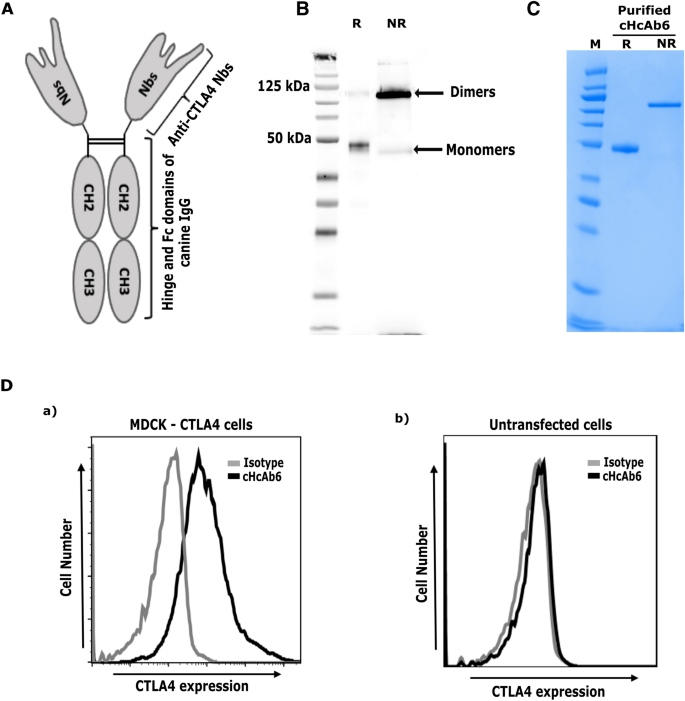
In an open-access Scientific Reports study, Marable et al. engineered canine CTLA4-targeting chimeric heavy-chain antibodies by genetically fusing anti-CTLA4 nanobody sequences with the Fc domain of canine IgG subclass B. The figure shows the predicted cHcAb6 structure, dimer formation, purified protein quality, and flow-cytometry confirmation of binding to canine CTLA4-expressing cells.
This study is closely aligned with antibody chimerization service needs because it links sequence-level fusion design, mammalian expression, Protein A purification, SDS-PAGE or western blot QC, and cell-based binding validation in a canine system. Creative Biolabs uses comparable engineering and validation logic when building canine, feline, or multi-species chimeric antibodies for veterinary biologics research.
Why Choose Creative Biolabs for Antibody Chimerization
Our service is designed for veterinary antibody programs that need more than a sequence swap: the final material must remain specific, express well, and support downstream research decisions.
Species-Focused Engineering
Canine, feline, and veterinary Fc choices guide construct design.
High-Yield Expression
Optimized mammalian systems support correctly folded chimeric antibody production.
Integrated Validation
Binding, specificity, and functional assays can be coordinated.
Traceable Deliverables
Sequence, construct, QC, and assay data support transfer.
Antibody Chimerization Service FAQs
References
- Marable, Jonathan, et al. "Nanobody-based CTLA4 inhibitors for immune checkpoint blockade therapy of canine cancer patients." Scientific Reports 11 (2021): 20763. https://doi.org/10.1038/s41598-021-00325-3
- Distributed under Open Access license CC BY 4.0, without modification.