Cross-Species Reactive Veterinary Antibody Development Service

Advance cross-reactive veterinary antibody candidates through conserved-epitope analysis, multispecies discovery, ortholog binding validation, species-compatible engineering, and functional characterization coordinated by Creative Biolabs for companion-animal therapeutic research.

Service Introduction

One Antibody Strategy Across Multiple Companion-Animal Species

Cross-species antibody development begins with a biological question: can a therapeutically meaningful epitope be recognized across relevant animal orthologs without compromising specificity or function? Sequence conservation alone is not sufficient. Epitope accessibility, structural context, post-translational modification, assay format, and the intended Fc biology must also guide candidate selection.

Creative Biolabs integrates comparative target analysis, antibody discovery, cross-reactivity screening, species-compatible reformatting, and functional validation. Programs can pursue one broadly reactive binding region, parallel species-adapted formats, or a staged strategy that first establishes cross-species target recognition and then optimizes canine, feline, or other veterinary constant regions for downstream evaluation.

Technical Service Scope

Designing and Testing Cross-Species Reactive Antibody Candidates

The service can be configured as an integrated discovery program or as focused modules for an existing antibody sequence, clone, antigen set, or lead panel.

Comparative Target and Epitope Analysis

We align target sequences across the requested species, map conserved and divergent residues, examine predicted or known structural context, and prioritize epitopes compatible with the desired mechanism. The resulting strategy considers antigen constructs, ortholog panels, counter-targets, and assays needed to distinguish broad recognition from nonspecific binding.

Discovery and Cross-Species Screening

Phage-display screening, single-B-cell antibody recovery, or a tailored combination can identify antibody leads against conserved or cross-species target regions. Primary hits are evaluated against orthologous antigens under comparable conditions, allowing sequence families to be ranked by breadth, specificity, binding profile, and suitability for subsequent engineering.

Species-Compatible Engineering and Validation

Selected variable regions can first be paired with canine, feline, or other relevant constant regions for species-compatible reformatting. Where broader species adaptation is needed, caninization or felinization may include variable-framework engineering in addition to constant-region selection. Affinity maturation, stability improvement, and Fc modification can then be incorporated before expression, biophysical characterization, and mechanism-relevant in vitro functional testing.

Program Element Representative Methods Decision Supported Typical Outputs
Ortholog Assessment Sequence alignment, conservation mapping, structural review, epitope accessibility analysis. Is a shared target region scientifically plausible? Comparative analysis and antigen recommendation.
Antibody Generation Phage display, library screening, antigen-specific single-B-cell antibody recovery, or integrated discovery. Which discovery route fits the target and species breadth? Binder panel and recovered variable-region sequences.
Cross-Species Profiling ELISA, flow cytometry, BLI/SPR, competition, ortholog binding, and counter-screening. Which hits retain selective recognition across species? Cross-species binding matrix, apparent binding profiles, and kinetic affinity data where applicable.
Format Optimization Caninization, felinization, IgG reformatting, Fc selection, affinity or stability engineering. Which molecular format best supports the intended program? Engineered constructs and purified candidates.
Functional Validation Cell-based binding, pathway modulation, neutralization, blocking, or other fit-for-purpose assays. Does cross-species binding translate into relevant activity? Functional dataset and lead recommendation.
Development Workflow

A Six-Stage Cross-Species Antibody Development Workflow

A staged workflow connects target feasibility, antibody discovery, cross-species validation, species adaptation, functional testing, and evidence-based lead selection.

01

Target Analysis & Custom Strategy Design

Compare target orthologs, identify conserved candidate epitopes, define antigen formats, and select a discovery platform based on the intended species and mechanism.

02

Antibody Discovery & High-Throughput Screening

Apply phage display, antigen-specific single-B-cell antibody recovery, or another agreed route to identify target-dependent antibody leads with useful sequence diversity.

03

Hit Characterization & Cross-Species Validation

Express priority hits and compare binding, specificity, affinity, and cross-reactivity against the requested ortholog panel using harmonized assay conditions.

04

Antibody Engineering & Format Optimization

Reformat selected variable regions with species-appropriate constant domains where appropriate, then apply framework adaptation/caninization or felinization, affinity maturation, stability optimization, or Fc engineering according to program needs.

05

Functional Validation & Characterization

Evaluate engineered candidates in target-relevant cell-based assays and characterize molecular quality, binding retention, functional breadth, and early developability.

06

Data Analysis & Report Delivery

Integrate sequence, affinity, specificity, ortholog, and in vitro functional results into a decision-ready report with candidate-ranking rationale and recommended next steps.

Workflow Stage Key Activities Representative Output Primary Stage Gate
Target Analysis & Custom Strategy Design Bioinformatic comparison, conserved-epitope review, antigen and platform planning. Cross-species target strategy and assay plan. Is the selected epitope sufficiently conserved and accessible?
Antibody Discovery & High-Throughput Screening Library selection or B-cell workflow, iterative screening, primary hit confirmation. Diverse target-binding antibody lead panel. Do recovered hits meet initial binding and specificity criteria?
Hit Characterization & Cross-Species Validation Ortholog binding comparison, affinity measurement, counter-screening, sequence-family analysis. Ranked cross-reactivity and affinity profiles. Which hits provide the required species breadth?
Antibody Engineering & Format Optimization Species-compatible constant-region reformatting, framework adaptation/caninization or felinization, affinity, stability, or Fc optimization. Engineered canine, feline, or cross-species candidate formats. Which format balances retained binding, species compatibility, and manufacturability?
Functional Validation & Characterization Cell-based activity, mechanism assays, purity, aggregation, stability, and binding confirmation. Functional and biophysical characterization package. Does the engineered candidate retain cross-species functional relevance?
Data Analysis & Report Delivery Integrated review of sequences, binding matrices, functional data, and development risks. Final report, data files, sequences, and lead-ranking recommendation. Which candidate and format should advance?

Begin with target sequences, orthologs, or an existing antibody lead

We can define the minimum antigen and assay panel needed to assess whether a cross-species strategy is appropriate.

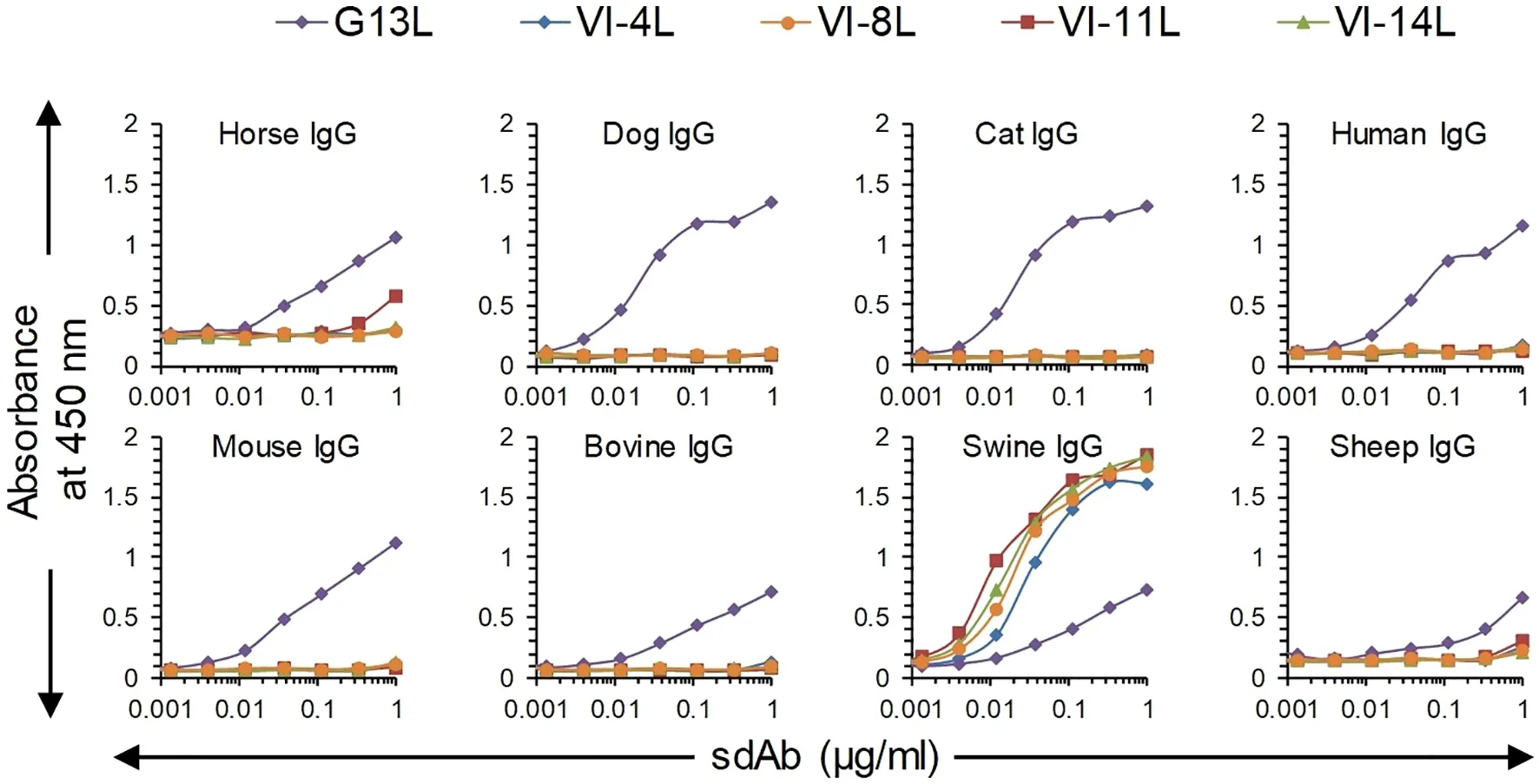
ELISA curves comparing a broadly reactive single-domain antibody against IgG from eight animal species. (OA Literature)
Fig.1 Cross-species binding of broadly reactive sdAb G13L to IgG from eight species.1,2
Peer-Reviewed Evidence

Published Example of Cross-Species Antibody Binding

Harmsen et al. compared the ELISA binding of single-domain antibodies to IgG from horse, dog, cat, human, mouse, bovine, swine, and sheep. G13L showed measurable binding across the tested species panel. The study provides a useful experimental example of side-by-side cross-species binding assessment, but it is not a direct model of multispecies therapeutic-target antibody development.

For veterinary antibody programs, the relevant lesson is methodological: cross-species recognition should be demonstrated experimentally with matched antigens and comparable assay conditions, then followed by species-appropriate functional testing. Depending on the target and mechanism, these data can help determine whether one cross-reactive variable region or parallel species-adapted candidates should advance.

Why Choose Us?

Service Advantages for Cross-Species Veterinary Antibody Programs

A multispecies program requires coordinated decisions across target biology, antibody format, comparative assays, and species compatibility.

Creative Biolabs multispecies veterinary antibody development expertise

Comparative Target Strategy

Conservation, accessibility, ortholog variation, and assay design are evaluated together.

Flexible Discovery Platforms

Phage display and single-B-cell routes can match target and repertoire needs.

Species-Compatible Engineering

Canine, feline, and tailored formats support relevant downstream evaluation.

Integrated Candidate Evidence

Binding, function, sequence, and developability data inform lead selection.

Frequently Asked Questions

Cross-Species Reactive Veterinary Antibody Development FAQs

A shared-antibody strategy is most plausible when the relevant target epitope is sufficiently conserved, structurally accessible, and functionally comparable across the intended species. It can also be useful when one variable region will be paired with different species-compatible constant regions. Comparative sequence and antigen analysis helps determine whether one cross-reactive lead or parallel species-specific candidates are more appropriate.
No. Binding establishes recognition but does not by itself demonstrate pathway modulation, neutralization, receptor blockade, or Fc-dependent activity. Functional assays should be configured for each species or a justified comparative model. Differences in target density, receptor biology, Fc receptors, cell systems, and assay reagents can affect observed activity even when ortholog binding is retained.
Format selection considers the starting sequence, intended mechanism, desired effector function, half-life strategy, expression behavior, and downstream assay system. A cross-reactive variable region may be expressed in separate canine and feline IgG formats, or another architecture may be chosen for discovery and early characterization before species-specific reformatting.
Useful inputs include target sequences for all relevant species, structural or epitope information, available antigens, an existing antibody sequence or clone, the intended mechanism, preferred species and formats, known cross-reactivity concerns, assay requirements, and desired final deliverables. Missing antigens or assays can be incorporated into the proposed scope after feasibility review.
Deliverables may include comparative target analysis, antigen and assay plans, antibody sequences, construct maps, purified fragments or full-length antibodies, cross-species binding matrices, affinity and specificity results, functional datasets, biophysical characterization, and a final report with lead-ranking rationale. The package is tailored to the starting point and next development decision.

Partner with Creative Biolabs

Connect comparative target analysis, cross-species screening, engineering, and functional evidence in one coordinated veterinary antibody development plan.

References

  1. Harmsen, Michiel M., et al. "Serum immunoglobulin or albumin binding single-domain antibodies that enable tailored half-life extension of biologics in multiple animal species." Frontiers in Immunology 15 (2024): 1346328. https://doi.org/10.3389/fimmu.2024.1346328
  2. Distributed under Open Access license CC BY 4.0, without modification.

This site is protected by reCAPTCHA and the Google Privacy Policy and Terms of Service apply.