
Veterinary (Pet) Antibody-Drug Conjugate (ADC) Development Service

Creative Biolabs supports canine and feline antibody-drug conjugate development from antibody readiness and linker-payload strategy through conjugation, purification, analytical characterization, internalization, and cell-based activity testing, helping veterinary research teams build decision-ready ADC candidates for subsequent preclinical evaluation.

Service Overview

Veterinary ADC Development Built Around Antibody, Linker-Payload, and Cellular Behavior

Antibody-drug conjugates combine target recognition with controlled delivery of a linked payload, but successful veterinary ADC research depends on more than simply attaching a drug to an antibody. Antigen density and internalization, antibody species compatibility, conjugation chemistry, linker stability, payload properties, drug-to-antibody ratio (DAR), aggregation, retained binding, and target-dependent cell activity must be considered together.

Creative Biolabs organizes canine and feline ADC development as a connected research program. Projects can begin with a supplied antibody, sequence, hybridoma-derived lead, or partially characterized candidate and can include conjugation-oriented engineering, linker-payload selection, ADC preparation, purification, physicochemical characterization, and fit-for-purpose in vitro testing.

Does the antibody still bind?Compare parental antibody and conjugate with orthogonal binding measurements.
Does it internalize?Measure uptake kinetics in target-positive veterinary-relevant cell systems.
Is the conjugate well defined?Assess DAR, purity, aggregation, free drug, and product heterogeneity.
Is activity target dependent?Use target-positive and control cells to interpret cytotoxic or functional effects.
Technical Scope

Integrated ADC Development Modules for Canine and Feline Therapeutic Research

Each module can be performed independently or linked into one program. The exact scope depends on the starting antibody, target biology, desired conjugation strategy, payload class, analytical needs, and intended downstream study.

Antibody Readiness and Conjugation-Oriented Engineering

Confirm that the antibody is an appropriate delivery scaffold before linker-payload chemistry is finalized.

  • Sequence, isotype, expression, purity, and aggregation review.
  • Binding and specificity confirmation against the intended canine or feline target.
  • Internalization-oriented candidate comparison when intracellular payload delivery is required.
  • Site or sequence engineering when a controlled conjugation handle is needed.
Linker-Payload and Conjugation Strategy

Match the chemical design to target biology, antibody properties, payload behavior, and analytical objectives.

  • Cleavable versus non-cleavable linker evaluation.
  • Payload class, potency, hydrophobicity, and attachment chemistry review.
  • Lysine-, cysteine-, or site-specific conjugation options where appropriate.
  • Target DAR range and product-homogeneity strategy defined before synthesis.

ADC Conjugation, Purification, and Analytical Characterization

Generate purified ADC material and characterize attributes that influence interpretation of subsequent functional assays.

  • Conjugation reaction optimization and purification of the product fraction.
  • DAR and DAR-distribution analysis using fit-for-purpose methods.
  • SEC, HIC, mass spectrometry, UV/Vis, or other suitable analytical measurements.
  • Purity, aggregation, free drug, recovery, and stability-oriented quality checks.

Binding, Internalization, and Cell-Based ADC Evaluation

Connect analytical quality with target engagement and payload-dependent biological activity.

  • Binding retention versus the unconjugated parental antibody.
  • Internalization measurement by flow cytometry, imaging, or related approaches.
  • Target-positive and target-negative cell comparison for selectivity context.
  • Dose-response cytotoxicity or mechanism-relevant functional assays.

Start with your antibody, target, and intended veterinary indication

Our scientists can define a focused conjugation study or a broader antibody-to-ADC development plan after reviewing your existing sequence, material, target biology, and assay package.

Decision Framework

Match the Development Variable to the Right ADC Evidence

ADC quality is multidimensional. A single metric such as average DAR is useful, but candidate decisions are stronger when chemical, biophysical, binding, internalization, and functional data are interpreted together.

Development Variable Key Question Representative Approaches Decision-Oriented Output
Antibody & Target Does the antibody recognize an accessible, internalizing target in the intended species context? Binding, cell-surface binding, specificity, internalization, target-expression review. Go/no-go rationale for ADC conversion and candidate prioritization.
Conjugation Chemistry Which attachment route can provide the required control without compromising antibody behavior? Lysine, cysteine, or site-specific approaches; reaction-condition optimization. Conjugation protocol, reaction performance, and purified ADC material.
DAR & Heterogeneity Is payload loading within the intended range and distribution? HIC, LC-MS, UV/Vis, or other fit-for-purpose DAR measurements. Average DAR, distribution profile, and batch-comparison evidence.
Biophysical Quality Did conjugation increase aggregation or create a less stable product profile? SEC, purity analysis, free-drug assessment, concentration and stability checks. Quality profile supporting functional-study interpretation.
Binding & Internalization Does the ADC retain target recognition and reach the intracellular compartment needed for payload delivery? SPR/BLI where appropriate, cell binding, flow cytometry, imaging, uptake kinetics. Parental-versus-ADC comparison and internalization profile.
Cellular Activity Is the observed effect concentration dependent and linked to target expression? Viability, apoptosis, proliferation, or mechanism-specific cell assays with controls. Potency curves, selectivity context, and candidate ranking.
Stage-Gated Execution

Veterinary Antibody-Drug Conjugate Development Workflow

The workflow uses six connected stages so that each stage produces information needed to design, qualify, or advance the next experiment.

01

Project Definition

Define target species, indication, target, mechanism, starting antibody, payload concept, downstream use, and success criteria.

02

Antibody Readiness

Review sequence, quality, binding, species compatibility, internalization requirements, and conjugation-site options.

03

Linker-Payload Design

Select linker class, payload, attachment chemistry, target DAR range, and analytical strategy based on project biology.

04

Conjugation & Purification

Optimize the reaction, remove unconjugated components, recover the ADC fraction, and document material balance.

05

Analytical Qualification

Characterize DAR, distribution, purity, aggregation, free drug, and other fit-for-purpose quality attributes.

06

Functional Evaluation & Handoff

Compare binding, internalization, and cellular activity, then integrate results into a development recommendation.

Recommended Starting Information

  • Heavy- and light-chain sequences or purified antibody.
  • Target antigen and intended canine or feline indication.
  • Available affinity, specificity, internalization, or functional data.
  • Preferred payload or payload class, if already selected.
  • Desired conjugation strategy or existing chemistry constraints.
  • Planned downstream assay, model, and material quantity.

Typical Final Deliverables

  • ADC design and conjugation strategy summary.
  • Purified ADC material according to the agreed scope.
  • DAR, purity, aggregation, and relevant analytical datasets.
  • Binding-retention and internalization results when included.
  • Target-dependent cell-activity data when included.
  • Technical report with methods, results, interpretation, and next-step recommendations.
Peer-Reviewed Canine ADC Evidence

Published Data Supporting Veterinary ADC Design and Functional Evaluation

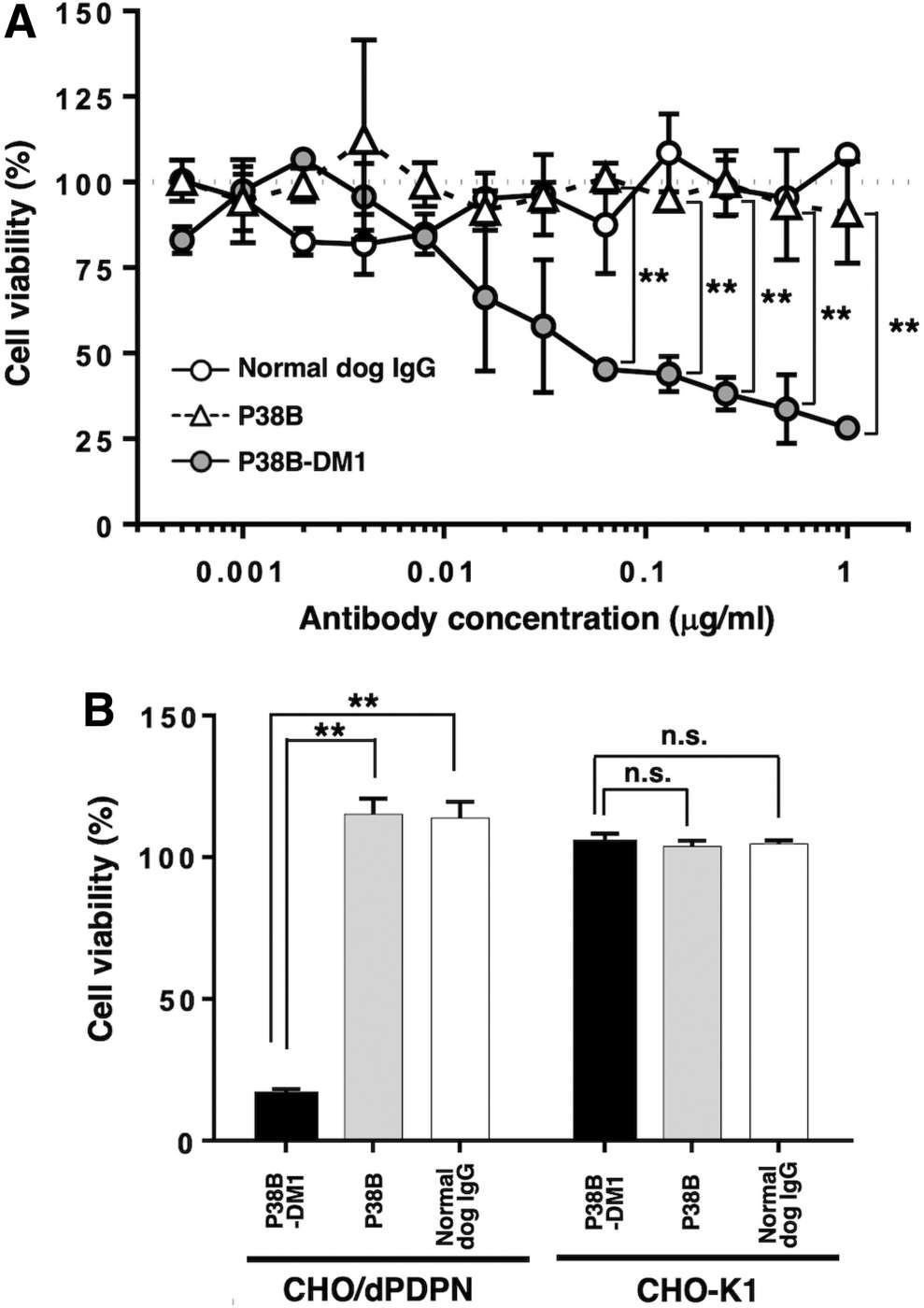
Kato et al. developed P38B-DM1 from a mouse-canine chimeric antibody directed against dog podoplanin and reported target-dependent in vitro cytotoxicity. In the published cell-viability experiment, P38B-DM1 reduced viability of dPDPN-expressing CHO cells in a concentration-dependent manner, while the target-negative CHO-K1 control did not show the same cytotoxic response.1,2

The study links several elements that are directly relevant to an ADC development service: species-adapted antibody format, conjugation chemistry, payload attachment, analytical confirmation, retained target binding, controlled cell comparison, and functional readout. These elements support an integrated development strategy in which conjugation quality is interpreted together with binding, internalization, and target-dependent cellular activity rather than as an isolated chemistry endpoint.1,2

Dose-response cell viability comparison of P38B-DM1, unconjugated P38B, and canine IgG in dPDPN-positive and control cells (OA Literature)
Fig.1 Target-dependent cytotoxicity of the canine-directed P38B-DM1 antibody-drug conjugate in cell viability assays.1,2
Service Advantages

Why Choose Creative Biolabs for Veterinary ADC Development

The platform connects species-aware antibody engineering with conjugation, analytical characterization, and functional evidence for practical ADC development decisions.

A

Veterinary Antibody Context

Canine and feline antibody considerations guide design choices.

C

Conjugation Flexibility

Chemistry is matched to antibody, payload, and homogeneity goals.

Q

Integrated Characterization

DAR, quality, binding, and activity are interpreted together.

R

Decision-Ready Reporting

Reports connect methods, data, risks, and next-step recommendations.

Frequently Asked Questions

Veterinary ADC Development FAQs

Practical answers on project inputs, linker-payload strategy, conjugation, DAR, functional testing, and downstream study planning.

Useful inputs include the antibody sequence or purified antibody, target antigen information, intended canine or feline indication, available binding or functional data, desired payload class, and planned downstream assays. If the antibody is not yet conjugation-ready, engineering and characterization can be incorporated before ADC construction.
Selection is based on target biology, internalization behavior, conjugation site, desired release mechanism, payload potency, hydrophobicity, stability requirements, and the intended assay plan. Cleavable and non-cleavable linkers can be considered, but the final design should be tested experimentally rather than selected from linker class alone.
Projects may use lysine- or cysteine-based conjugation, or a site-specific strategy when tighter control of conjugation location or drug-to-antibody ratio distribution is required. The approach is chosen with regard to antibody structure, available functional groups, desired homogeneity, material requirements, and downstream analytical capability.
DAR is one important ADC attribute, but it should not be interpreted in isolation. Average DAR and DAR distribution can affect potency, hydrophobicity, aggregation, clearance, and product heterogeneity. We therefore evaluate DAR together with purity, aggregation, binding retention, functional activity, and stability-related measurements.
Yes. Fit-for-purpose comparison of the parental antibody and ADC can include binding assays, cell-surface binding, internalization measurements, and target-positive versus target-negative cell testing. These data help determine whether conjugation preserved target recognition and whether the ADC has the cellular behavior required for payload delivery.
Yes. After analytical and cell-based qualification, projects can transition into additional pharmacokinetic, pharmacodynamic, safety-related, or efficacy-oriented studies through Creative Biolabs' veterinary antibody evaluation capabilities. The downstream plan is defined separately according to species, model availability, test article quantity, and study objective.

References

  1. Kato, Yukinari, et al. "Antibody-Drug Conjugates Using Mouse-Canine Chimeric Anti-Dog Podoplanin Antibody Exerts Antitumor Activity in a Mouse Xenograft Model." Monoclonal Antibodies in Immunodiagnosis and Immunotherapy 39.2 (2020): 37–44. https://doi.org/10.1089/mab.2020.0001
  2. Distributed under Open Access license CC BY 4.0, without modification.

This site is protected by reCAPTCHA and the Google Privacy Policy and Terms of Service apply.